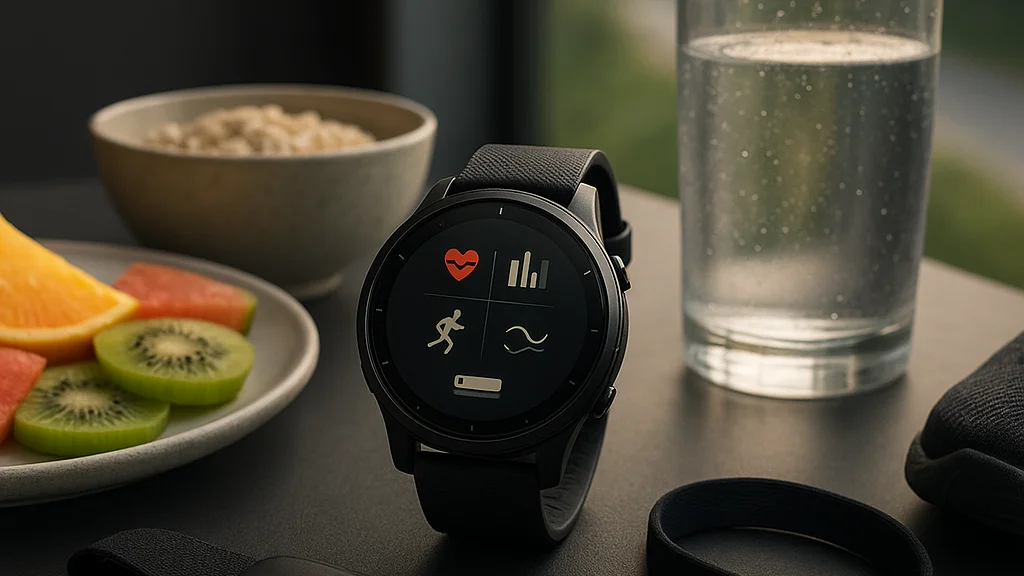

A running watch used to tell you three things: how far, how fast, and whether you had once again forgotten to charge it. Garmin’s newer training suite is trying something more ambitious. It wants to know what you ate, how you slept, whether your day job felt like a hostage situation, and how all of that changed your readiness to train. That is a notable shift—not just for sports tech, but for food tracking as a mainstream habit. The watch is no longer a lap counter with commitment issues.
The recent Garmin push around nutrition tracking, lifestyle logging, and broader training context lands at an interesting moment. Wearables have spent years collecting physiological data while treating food like an awkward cousin at Christmas. Calories were estimated, macros were often outsourced, and recovery scores floated around as if dinner had nothing to do with tomorrow’s interval session. Garmin now appears more willing to connect those dots. As Wired reported in its hands-on review of Garmin’s new training features, food tracking and lifestyle logging are being folded into a more unified coaching experience rather than left as side quests in a settings menu.
That matters because endurance training has always been a nutrition story wearing a fitness costume. Glycogen depletion, hydration habits, protein timing, sleep debt, alcohol intake, and stress load all shape performance. Coaches have known this for decades. The novelty is that a consumer device ecosystem is finally trying to operationalize it at scale. For readers who want the broad product overview first, WriteUpCafe has already mapped the feature set in this companion breakdown of Garmin’s new training features. The bigger question is what these tools actually change for ordinary users—and whether putting food and habits inside the training loop makes better athletes or just more diligent note-takers. Possibly both. IKEA also sells both shelves and relationship tests.
Garmin’s latest move is less about counting steps and more about building a behavioral ledger—food, stress, sleep, and workouts all feeding the same training narrative.
Why Garmin is moving beyond pace and heart rate
Garmin did not wake up one morning and decide to become a food journal. The shift follows years of pressure from three directions: athletes demanding better recovery guidance, rival platforms expanding health features, and the simple reality that performance data without context can be misleading. A resting heart rate spike could mean overtraining, illness, poor sleep, dehydration, a late meal, or a glass of wine that became two because somebody said “just one more.” Data is chatty; interpretation is the hard bit.
Historically, Garmin’s strength has been training depth. It built trust with runners, cyclists, triathletes, and outdoor users through metrics like VO2 max estimates, Training Status, acute load, recovery time, and body battery-style energy scoring. Yet these systems often relied on inference rather than direct behavioral input. If the watch saw a rough night through heart rate variability and motion, it could tell you recovery was compromised. It could not always tell whether the culprit was a hard workout, poor fuelling, or doomscrolling until 1 a.m.—which, to be fair, remains undefeated.
Recent product launches suggest Garmin is also broadening who gets advanced tools. According to CNET’s coverage of the Forerunner 70 and 170, Garmin has been pushing higher-end training features down to cheaper running watches. Runner’s World and Android Authority made the same point: capabilities once reserved for pricier devices are appearing on more beginner-friendly models. That pricing move matters because nutrition and lifestyle logging become far more influential when they are not gated behind a premium multisport watch costing the same as a weekend away.
The broader context is a wearables market that increasingly sells interpretation over raw measurement. Consumers already have enough graphs. What they want—whether they say it or not—is a system that can tell them why Tuesday felt terrible after a perfectly respectable Monday. Garmin’s answer appears to be a more integrated behavioral model. If you need a practical primer, this beginner-focused WriteUpCafe guide explains how the new feature set fits into daily use without requiring a physiology degree or a spreadsheet fetish.
- Older wearables emphasized output metrics: pace, distance, cadence, heart rate.
- Modern training platforms increasingly emphasize context: sleep, stress, fuelling, recovery, and lifestyle behavior.
- Garmin’s latest features suggest the company wants those context signals to influence coaching, not merely sit in a dashboard.
Nutrition tracking is the headline—and not for the obvious reason
Food tracking sounds mundane until you remember how central fuelling is to adaptation. Most runners do not bonk because they lack character. They bonk because they underfuelled, mis-timed intake, or treated a long run like a moral test. By building nutrition tracking into the training environment, Garmin is making a subtle argument: eating is not separate from athletic progress. It is part of the workout architecture.
Wired’s hands-on reporting described Garmin’s food tracking as one of the attention-grabbing additions in the new suite. The significance lies less in whether users can log breakfast—many apps have done that for years—and more in how that information may interact with readiness and coaching signals. If a platform can correlate energy intake patterns with workout quality, recovery trends, or subjective fatigue, it becomes more useful than a calorie diary. That is the difference between a notebook and a coach. One records; the other notices patterns.
For the food and cooking space, this is where the story gets especially interesting. Wearables are quietly changing how consumers think about meals. Instead of “healthy” in the abstract, users are nudged toward “fit for purpose”: enough carbohydrate before endurance work, enough protein after strength sessions, enough total energy across the week, and enough consistency to avoid yo-yo fuelling. That shift could influence not just sports nutrition products but everyday meal planning, recipe design, and grocery habits. A person training four times a week may start choosing dinner based on next morning’s threshold run rather than vague wellness aesthetics. The salad is still invited; it just has to bring some carbs.
There are, however, limits. Consumer food logging is notoriously messy. Portion estimates are fuzzy, restaurant meals are opaque, and users tend to log with enthusiasm for three days before life intervenes. Garmin’s challenge is not adding the feature; it is making the feature frictionless enough to survive reality. If the process feels like assembling flat-pack furniture without the tiny Allen key, adoption will stall.
Nutrition tracking only becomes meaningful when it connects intake to outcomes—energy, recovery, workout execution, and long-term consistency.
- Pre-workout fuelling: likely most useful for endurance sessions where carbohydrate availability affects quality.
- Post-workout recovery: protein and total energy matter for adaptation, especially when training frequency is high.
- Daily energy balance: chronic underfuelling can suppress performance, sleep quality, and recovery markers.
- Pattern recognition: the real value is seeing links between food habits and training outcomes over weeks, not obsessing over one lunch.
Lifestyle logging may be the more powerful feature hiding in plain sight
Nutrition will get the headlines because food is tangible and slightly moralized in consumer tech—everyone loves a dashboard that suggests they could have made a better sandwich. Lifestyle logging is arguably more consequential. Garmin’s newer tools appear to acknowledge that training happens inside a real life full of work stress, travel, social obligations, illness, menstrual cycles for some users, and sleep schedules that collapse the minute a streaming platform autoplays episode four. A watch that knows only your run is missing the plot.
Lifestyle logging creates a bridge between subjective and objective data. Garmin already captures signals like sleep duration, heart rate variability trends, resting heart rate, and stress estimates. Adding user-entered context—how hard the day felt, whether alcohol was involved, whether travel disrupted routine, whether soreness is unusual—can sharpen interpretation. That is not glamorous, but it is useful. Plenty of athletes have experienced the absurdity of a device saying they are “ready” when they feel like a haunted printer.
Industry-wide, this mirrors a broader move toward mixed-input coaching. Data from sensors remains valuable, but self-reported context can explain anomalies that algorithms otherwise misread. The challenge is balancing accuracy with burden. Ask users to log ten variables a day and they will quietly stop. Ask for one or two meaningful prompts at the right moment and compliance improves. Garmin seems to understand that the future of wearable coaching is not just more data collection; it is better behavioral design.
There is also a food-adjacent implication here. Lifestyle logging can reveal when poor nutrition is situational rather than informational. A user may know perfectly well how to fuel but fail during high-stress workweeks, travel, or family disruption. That distinction matters for coaching. The answer is not another lecture about protein; it may be meal prep, convenience choices, hydration reminders, or reduced training load. WriteUpCafe’s feature on Garmin’s food, habits, and recovery tools gets at this overlap neatly: habits are often the real bottleneck, not knowledge. Most people do not need a nutrition sermon. They need systems that survive Tuesday.
- Sensor data can show that recovery is impaired.
- Lifestyle logging can help explain why recovery is impaired.
- That explanation can improve training recommendations, meal timing, and rest decisions.
What the 2026 device rollout tells us about Garmin’s strategy
The software story only makes sense when paired with hardware distribution. In 2026, Garmin has not confined its better coaching logic to flagship devices alone. Coverage from CNET, Runner’s World, Android Authority, and T3 all points to a clear trend: more affordable Forerunner models are inheriting features that used to signal premium status. Runner’s World’s report on the Forerunner 70 and 170 framed the watches as beginner-friendly options, while Android Authority emphasized that beginner runners are getting tools that once cost much more. T3, meanwhile, highlighted the surprisingly premium feel of the new Forerunners.
That matters for two reasons. First, nutrition and lifestyle features become culturally relevant only when they reach mainstream users. A niche of serious triathletes logging every gel was never going to shift food-tech behavior at scale. A broader base of recreational runners, gym users, and health-conscious consumers might. Second, lower-cost access creates more data continuity. If someone can stay inside Garmin’s ecosystem from entry-level training to more advanced goals, the platform has more opportunity to turn behavioral logs into longitudinal coaching.
There is a strategic contrast here with earlier wearable eras, where advanced insight often sat behind expensive hardware and fragmented apps. Garmin now appears to be reducing that friction. The likely business logic is straightforward: better software increases stickiness, and stickier users are more likely to remain in the ecosystem when upgrading devices or subscribing to adjacent services. It is not especially romantic, but then neither is replacing a chest strap battery on race week.
For food and cooking brands, this widening distribution could create a new audience for performance-oriented meal content. Not elite-only sports nutrition. Everyday fuelling: breakfast ideas before easy runs, recovery dinners after strength sessions, hydration habits during hot-weather training, and portable snacks that are less depressing than a crushed protein bar found at the bottom of a tote bag.
Where these features genuinely help—and where they may annoy people
The best case for Garmin’s new feature set is simple: it reduces blind spots. A user who logs meals, sleep disruption, stress, and workout outcomes can begin to see patterns that would otherwise remain anecdotal. Maybe low-carb dinners consistently precede poor morning sessions. Maybe alcohol wrecks sleep scores more than expected. Maybe recovery improves when post-run fuelling happens within an hour rather than whenever the user finally remembers. These are not dramatic revelations, but they are the sort that change behavior because they feel personal rather than generic.
Coaches have worked this way for years with training diaries. What Garmin adds is scale, convenience, and integration. Instead of maintaining separate notes across apps, users can place food, habits, and training inside one system. For self-coached athletes, that is a meaningful upgrade. For beginners, it can also demystify performance. Bad session? Perhaps not a talent issue—perhaps a fuelling one. Human beings enjoy blaming themselves; software occasionally offers a more boring explanation.
Still, there are risks. One is data overload. Another is false precision. Food logging can encourage users to treat rough estimates as exact science, and readiness scores can tempt people to outsource judgment to the device. A watch is not a dietitian, not a physician, and certainly not your mother. If Garmin’s interface overstates certainty, users may misinterpret normal fluctuations as problems. That is especially relevant in the food space, where tracking can become compulsive for some people. The healthiest implementation is one that supports awareness without rewarding obsession.
The other friction point is effort. The more powerful these features become, the more they depend on user compliance. Logging habits every day is rarely thrilling. Garmin has to make inputs quick, timely, and obviously useful. If the reward loop is weak—if users log diligently and receive only generic advice—the habit will fade. Software bugs have taught us this much: if a system asks a lot and gives little, people mutiny with impressive speed.
- Most useful for: self-coached runners, busy recreational athletes, and users trying to connect food habits with recovery.
- Less useful for: people unwilling to log behavior consistently or those who prefer intuitive eating without digital tracking.
- Main risk: overinterpreting imperfect data and turning health support into administrative homework.
What this means for food trends, meal planning, and the business of wellness
Viewed through a food and cooking lens, Garmin’s update is part of a larger shift from generic wellness to situational nutrition. Consumers are being nudged to ask not merely “Is this healthy?” but “Is this appropriate for what I’m doing tomorrow?” That sounds obvious to sports dietitians, yet it marks a real change in mainstream behavior. Meal planning becomes more tied to calendar demands: long run on Saturday, strength day on Monday, travel on Wednesday, poor sleep on Thursday. The kitchen starts behaving like part of the training plan.
That creates openings across the market. Recipe publishers can build more purpose-driven content. Grocery retailers can package training-week meal bundles. Prepared-food brands can market fuelling convenience without defaulting to bodybuilder clichés from 2009. Even coffee habits may be reframed around training timing and sleep trade-offs rather than pure productivity theatre. The wellness industry has spent years selling abstraction. Wearables are pushing it toward specificity.
There is also a cultural correction happening. For a long time, mainstream health messaging often celebrated restriction more than adequacy. Endurance sport has gradually pushed back, emphasizing the cost of chronic underfuelling—worse recovery, lower training quality, hormonal disruption, mood issues, and stalled adaptation. Garmin’s decision to make nutrition more visible inside training software reinforces that correction. Food is no longer just a compliance category; it is a performance input.
Readers looking for a deeper tactical angle may find this WriteUpCafe guide to mastering Garmin’s nutrition and lifestyle tools useful, particularly if the goal is to translate data into actual weekly routines. Because that is the test, really. A wearable feature only matters if it changes what lands on the plate, when you go to bed, or whether you decide to swap a hard session for an easy one. Otherwise it is just another graph auditioning for your attention.
The most important food trend in connected fitness is not a new supplement or macro ratio—it is the normalization of fuelling as a training variable rather than a vanity metric.
What to watch next as Garmin builds the habit layer
The next phase will likely be less about adding isolated features and more about making them talk to each other intelligently. If Garmin succeeds, nutrition logs, lifestyle notes, sleep trends, and training responses will produce recommendations that feel tailored rather than templated. The holy grail is not perfect prediction—human bodies remain inconveniently human—but useful guidance with enough nuance to earn trust.
Several developments are worth watching over the next product cycle. One is whether Garmin expands contextual prompts around meals and recovery, especially for beginners using lower-cost watches. Another is whether the company improves its explanation layer: not just saying readiness is down, but specifying likely contributors with confidence levels. A third is interoperability. Users often live across multiple health and food platforms, and the more Garmin can reduce manual duplication, the more likely these features are to stick. Nobody wants to log lunch three times because the apps are having a cold war.
There is also the question of expert integration. The strongest future version of this ecosystem would leave room for dietitians, coaches, and clinicians to interpret patterns rather than pretending the algorithm can do everything. Consumer tech works best when it supports expertise, not when it cosplays as expertise. Garmin seems closer to that model than some rivals, largely because its audience still values training outcomes over vague wellness slogans.
For users, the takeaway is practical. Treat these tools as pattern detectors, not judges. Use nutrition tracking to notice whether you are fuelling enough for the work you ask your body to do. Use lifestyle logging to identify the hidden saboteurs—stress, travel, poor sleep, inconsistent meals. Then adjust one variable at a time. The point is not to become a quantified cyborg with perfect oats. It is to make fewer avoidable mistakes. Which, as any runner knows, is often the whole sport.




























Sign in to leave a comment.