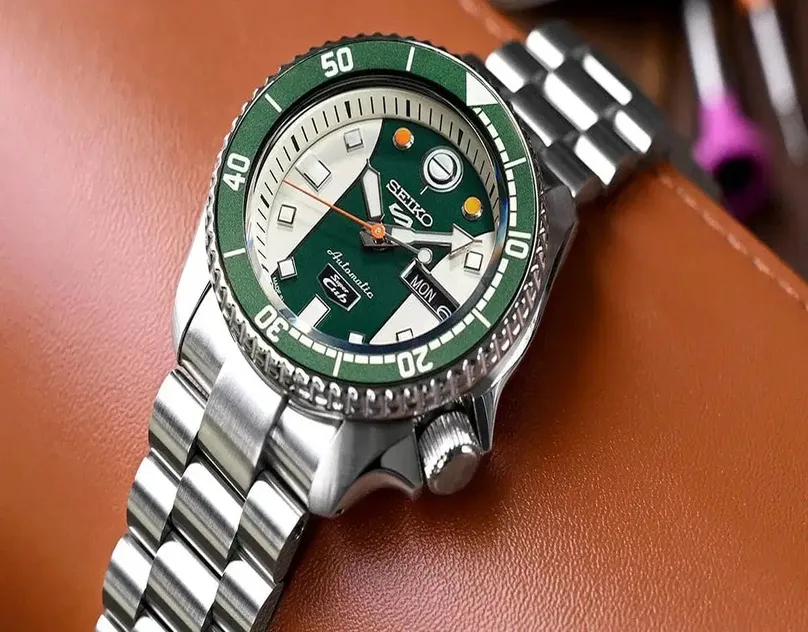

Quick Answer: The Seiko 5 SNK references are compact automatic watches with day-date displays, exhibition case backs and a 37mm-class case, built as the accessible entry point into mechanical watches. They include field-style dial variants such as the SNK809 family and dress-leaning versions, all running on Seiko's self-winding movement without battery dependence.
Seiko 5 SNK references sit at the point where mechanical watchmaking stops being expensive. They wind themselves from wrist movement, show day and date, and let you look through the case back at the movement doing it. Understanding what the SNK line actually offers, and where it compromises, makes the choice between references far simpler.
What the SNK Designation Covers
SNK is a reference prefix inside the wider Seiko 5 family rather than a separate collection with its own identity. References sharing it tend to use the same compact case architecture and the same self-winding movement platform, with dial, hand and strap changes distinguishing one from the next. Treat SNK as a case-and-movement family, not a style, since the same platform carries both field-style and dress-style dials.
The Five Attributes Behind the Name
The Seiko 5 name refers to a defined set of attributes the line commits to: automatic winding, a day and date display, water resistance, a recessed crown position, and a durable case and bracelet. Every reference carrying the badge meets that specification. This is why the range feels consistent across decades of production, and why buyers can shop the Seiko 5 SNK range with a clear idea of what arrives regardless of which dial they pick.
Case Size and Who It Suits
SNK cases are small by modern standards, typically sitting in the 37mm region with short lugs. That compactness reads as vintage-correct on slimmer wrists and can read as undersized on larger ones. Measure your wrist and compare against a watch you already own before ordering, since case diameter alone understates how a short lug-to-lug span changes the way a watch sits.
The Exhibition Case Back
Most SNK references show the movement through a mineral window in the case back. This is unusual at the price and it is a large part of why the line converts people into mechanical watch owners. Watching the rotor swing and the balance oscillate makes the difference between quartz and automatic tangible in a way specification sheets never do.
Field Dials Versus Dress Dials
The SNK line splits broadly into two visual directions. Field-style references use high-contrast dials, Arabic numerals, an inner twenty-four hour track and fabric or nylon straps. Dress-leaning references use applied indices, cleaner dials and steel bracelets. Both use the same underlying watch, so the decision is purely about where you intend to wear it rather than about capability.
Accuracy Expectations
Entry automatics are not chronometers, and expecting chronometer accuracy from one leads to disappointment. Daily drift of several seconds either way is normal for this class of movement, and it varies with how the watch is worn, how well it is wound and which position it rests in overnight. If accuracy to the second matters more than mechanical character, a quartz reference is the honest answer.
Hacking and Hand-Winding
Older SNK references generally lack hacking, meaning the seconds hand does not stop when the crown is pulled, and many lack manual hand-winding. Later Seiko 5 platforms added both. Confirm which behaviour a specific reference has if setting to the exact second matters to you, because this is one of the clearest functional differences across the Seiko 5 SNK line.
Water Resistance in Practice
Seiko 5 references in this family carry daily-wear water resistance rather than dive capability. That covers rain, handwashing and incidental splashing. It does not cover swimming, diving or hot showers, where pressure and temperature changes stress the seals. Buyers wanting genuine water capability should look at a purpose-built diver instead of stretching an SNK beyond its rating.
Strap and Bracelet Swaps
The short lug width on SNK cases makes strap changes a low-cost way to reposition the watch entirely. The same reference reads as a military-styled tool watch on a nylon strap and as a modest dress watch on leather. Confirm the lug width for your specific reference before buying straps, since guessing wrong is the most common ordering mistake in this category.
Servicing and Long-Term Ownership
Mechanical movements need eventual servicing, and this is the ownership cost quartz buyers do not carry. In practice, entry-level Seiko automatics are often run until they stop rather than serviced on schedule, because service cost can approach replacement cost. Understanding that trade-off before purchase prevents surprise later, and it is a reasonable trade at this end of the Seiko 5 SNK range.
Power Reserve and Wearing Patterns
An automatic winds from wrist motion and stops once the reserve depletes. If you rotate between several watches, expect to reset the SNK each time you return to it. Owners who wear one watch daily rarely notice the reserve at all. Deciding how the watch fits your rotation matters more than the reserve figure itself.
Legibility and Lume
Field-style SNK dials prioritise legibility, with clear numerals and coated hands and markers. Lume performance at this level is functional rather than long-lasting, giving readable time for a period after light exposure rather than through a full night. Buyers expecting dive-watch luminosity should adjust expectations, since that capability belongs to a different tier of watch.
Common Mistakes to Avoid
The first mistake is assuming every SNK reference hacks and hand-winds, when many do not. The second is buying without checking case diameter and lug-to-lug against your wrist, since these watches wear notably small. The third is treating daily-wear water resistance as swim capability. The fourth is expecting quartz-level accuracy from an entry automatic. Checking movement behaviour, dimensions, water rating and realistic accuracy before ordering resolves all four.
How to Choose
Choose an SNK reference by deciding whether you want the field-style or dress-style direction, then confirming case dimensions against your wrist and checking whether the specific reference hacks and hand-winds. Compare shortlisted Seiko 5 SNK references if you are unsure whether a compact automatic is the right starting point.
Verdict
Seiko 5 SNK references remain the clearest route into mechanical watch ownership, offering self-winding movement, day-date function and an exhibition case back in a compact package. Confirm dimensions, movement behaviour and water rating, then pick the dial direction that matches where you will wear it. Browse the current Seiko 5 SNK range.
Frequently Asked Questions
What does SNK mean on a Seiko watch?
It is a reference prefix within the Seiko 5 family, identifying a group of compact automatic watches that share case architecture and movement platform, with dial and strap variations distinguishing individual references.
Do Seiko 5 SNK watches need a battery?
No. They are self-winding mechanical watches powered by wrist motion, so there is no battery to replace, though they stop running once the power reserve depletes and need resetting.
How big is an SNK case?
Most sit in the 37mm region with short lugs, which is compact by current standards and suits slimmer wrists. Verify the exact diameter and lug-to-lug for your chosen reference.
Can I swim with a Seiko 5 SNK?
No. These carry daily-wear water resistance covering rain and handwashing, not swimming or diving. Choose a purpose-built diver if water capability matters.
Do SNK watches hack?
Many older references do not, meaning the seconds hand keeps running when the crown is pulled. Later Seiko 5 platforms added hacking and hand-winding, so confirm per reference.
How accurate is an SNK automatic?
Expect several seconds of daily drift either way, varying with wear, winding and resting position. This is normal for entry mechanical movements and is not a fault.
Is the exhibition case back on every reference?
Most SNK references include one, showing the movement through a window in the case back. Confirm on the specific reference, since case back treatment varies across the wider Seiko 5 family.




























Sign in to leave a comment.