
There is a distinct, sinking feeling every backend developer or DevOps engineer knows all too well: a staging environment suddenly goes down because a microservice update silently broke an downstream endpoint.
The pull request passed unit tests. The build succeeded. Yet, the moment the service tried talking to the user service in staging, HTTP 500 errors started cascading across the network. The culprit? Someone renamed user_id to userId in a shared JSON response, assuming “nobody was using that field anymore.”
This failure pattern points to a fundamental flaw in traditional QA: relying on heavy, end-of-pipeline integration tests in staging to catch contract breaks. When you defer API verification until after code is deployed to a shared environment, debugging becomes complex, release cycles slow down, and feedback loops stretch from minutes to hours.
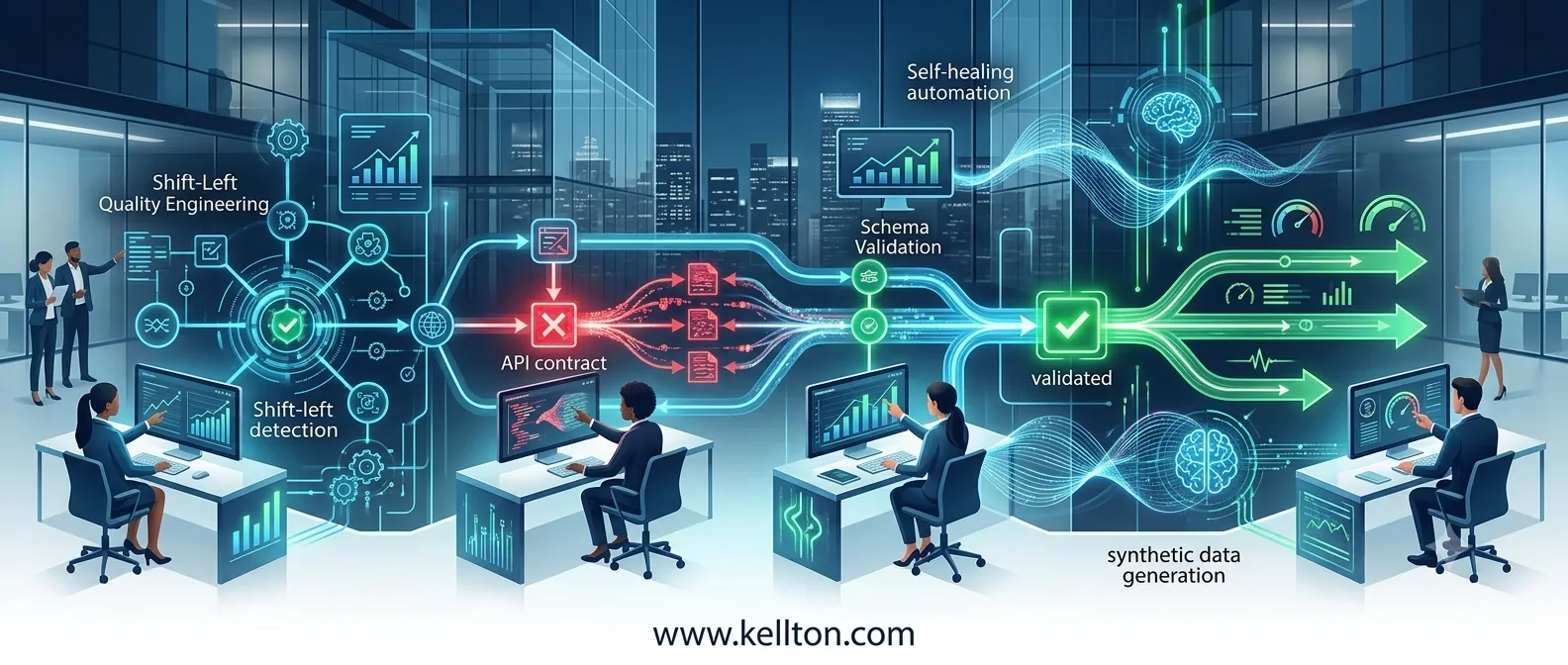
Shifting quality left means catching these breaking changes at the pull request level—long before the code ever touches staging. Here is how to build an automated, contract-driven API guardrail into your modern development workflow.
The Problem with Traditional API Integration Testing
In a monolithic architecture, the compiler often protects you from breaking method signatures. In a distributed microservices ecosystem, service boundaries are defined by network calls—typically HTTP/REST, gRPC, or GraphQL.
Teams usually attempt to validate these service boundaries using one of two approaches:
- End-to-End (E2E) Integration Suites in Staging: Spin up all 20 microservices in a staging cluster and run automated suite runs.
- Mocking External Services in Local Tests: Developers hardcode static JSON mocks in unit tests to simulate external dependencies.
Both approaches have severe drawbacks. Staging environments are notoriously fragile, slow to deploy, and subject to test data drift. Conversely, static mocks easily become stale—your local unit test passes because your mock expects the old API structure, completely ignoring the fact that the provider team altered the production schema yesterday.
Traditional Flow (High Friction): [PR Opened] ──> [Merge to Main] ──> [Deploy to Staging] ──> [Run E2E Suite] ──> 💥 [Breakage Detected] Shift-Left Contract Flow (Fast Feedback): [PR Opened] ──> [Automated Contract Validation] ──> 🟢/🔴 [Instant Feedback in PR]
To eliminate this friction, engineering teams are adopting Consumer-Driven Contract Testing (CDCT).
What Is Consumer-Driven Contract Testing?
Instead of testing the full implementation of both services simultaneously, contract testing isolates the interface contract between a Consumer (the service making the API request) and a Provider (the service fulfilling the request).
In a consumer-driven pattern:
- The Consumer defines an explicit expectation file (a "contract") specifying the request headers, body payload, and expected status codes it requires from the provider.
- This contract is published to a shared artifact broker (such as Pact Broker or an OpenAPI Schema Registry).
- The Provider runs lightweight verification tests against this contract during its build phase—without needing to spin up the consumer service at all.
If a backend developer removes or mutates a field required by an active consumer contract, the build fails instantly in the provider's local PR check.
Implementing Contract Verification in GitHub Actions
Let's look at a concrete implementation. Suppose we have a Node.js API provider and we want to enforce schema validation on every pull request using a GitHub Actions pipeline and Spectral (an OpenAPI linter) combined with contract execution.
First, we set up a workflow rule that triggers strictly on changes to API controllers, schemas, or route handlers:
name: API Contract & Schema Guardrail
on:
pull_request:
branches: [ main, develop ]
paths:
- 'src/controllers/**'
- 'src/routes/**'
- 'openapi.yaml'jobs:
verify-contract:
runs-on: ubuntu-latest
steps:
- name: Checkout Code
uses: actions/checkout@v4- name: Setup Node.js
uses: actions/setup-node@v4
with:
node-version: '20'
cache: 'npm'- name: Install Dependencies
run: npm ci- name: Lint OpenAPI Spec for Breaking Changes
run: |
npx @stoplight/spectral-cli lint openapi.yaml --fail-severity=error- name: Run Consumer Contract Verification
env:
PACT_BROKER_BASE_URL: ${{ secrets.PACT_BROKER_URL }}
PACT_BROKER_TOKEN: ${{ secrets.PACT_BROKER_TOKEN }}
run: |
npm run test:pact-provider
In this pipeline, before any code gets merged, two critical checks occur:
- Schema Linting: Ensures the OpenAPI specification strictly adheres to organizational standards (no missing type definitions, missing error responses, or untyped parameters).
- Contract Execution: The provider suite fetches consumer contracts from the broker and replays them against the local service instance running in headless mode.
Scaling API Guardrails Across Enterprise Architectures
Implementing contract testing for two microservices is straightforward. However, scaling this model across dozens of distributed teams, multi-cloud environments, and legacy backend services requires structural governance.
When scaling contract testing across enterprise pipelines, consider these four operational principles:
- Decouple Provider and Consumer Builds: Never require both microservices to build in the same pipeline. Use a centralized contract broker to store and version JSON contracts asynchronously.
- Automate Can-I-Deploy Checks: Utilize CLI tools like can-i-deploy prior to deployment steps. This tool queries your contract broker to verify whether the specific git hash of Service A is compatible with the version of Service B currently deployed in production.
- Combine Contracts with Synthetic Data Generation: Pair schema assertions with dynamic test data generators to simulate edge cases, such as special characters, null values, or unexpected array lengths.
- Govern the Quality Lifecycle: Establishing resilient software assurance requires treating test suites as first-class software products. Organizations aiming to modernize legacy QA processes often standardize their strategy around robust quality engineering and testing practices, integrating automated verification directly into continuous delivery pipelines.
Key Takeaways
Shifting quality engineering to the left transforms testing from a late-stage gatekeeper into an active developer enabler.
By replacing brittle staging-environment integration runs with event-driven contract verification:
- Feedback times drop from hours to under two minutes per PR.
- Staging environments stabilize, eliminating downtime caused by silent schema mismatches.
- Developer confidence increases, allowing teams to deploy independent microservice updates multiple times per day.
If your team is still spending release nights triaging broken API endpoints in staging, it's time to stop testing at the end and start enforcing contracts at the commit.
How is your team handling cross-service API breaking changes? Are you using OpenAPI diff checks, Pact, or custom schema registries? Let's discuss in the comments below!




















Sign in to leave a comment.