

In today’s fast-paced digital environment, businesses and service providers need networking solutions that are cost-effective, scalable, and efficient. One such solution gaining popularity is the Single Fiber SFP (Small Form-factor Pluggable) transceiver. This innovative technology allows data transmission over a single optical fiber strand, cutting costs while maintaining high-speed connectivity.
In this blog, we will explore what Single Fiber SFP is, how it works, its benefits, applications, and why it’s becoming an essential part of modern networks.
What is a Single Fiber SFP?
A Single Fiber SFP is a compact optical transceiver module designed to send and receive data over just one strand of optical fiber, using different wavelengths for upstream and downstream communication. Unlike traditional dual-fiber SFPs, which require two separate fibers (one for transmitting and one for receiving), Single Fiber SFPs use a bidirectional (BiDi) technology that allows both signals to travel on the same fiber.
This is achieved through Wavelength Division Multiplexing (WDM), where two different wavelengths (for example, 1310nm for transmitting and 1550nm for receiving) are combined on one fiber. This approach saves fiber resources and simplifies network deployment.
How Does Single Fiber SFP Work?
The operation of Single Fiber SFP is based on the principle of using two wavelengths to differentiate between incoming and outgoing data streams. Each module has:
- Tx (Transmit) Port: Sends data using one wavelength.
- Rx (Receive) Port: Receives data on a different wavelength.
For proper operation, Single Fiber SFP modules are used in complementary pairs. For example:
- Module A transmits at 1310nm and receives at 1550nm.
- Module B transmits at 1550nm and receives at 1310nm.
This configuration allows full-duplex communication over a single strand of optical fiber.
Key Features of Single Fiber SFP
Single Fiber SFP modules come with several features that make them a preferred choice for network operators:
- Bidirectional Data Transmission using only one optical fiber.
- Cost-Efficiency by reducing fiber usage by half.
- Hot-Swappable Design for easy installation and replacement without network downtime.
- Long Transmission Distances, typically ranging from 10 km to 80 km, depending on the model.
- Compatibility with Standard Networking Equipment including switches, routers, and OLTs.
- Compact Form Factor enabling high port density in networking devices.
Advantages of Using Single Fiber SFP
Switching to Single Fiber SFP offers numerous benefits for businesses, ISPs, and data centers:
1. Reduced Fiber Infrastructure Costs
Since it uses only one fiber instead of two, the overall fiber consumption is cut in half. This is particularly valuable in environments where laying new fiber is expensive or impractical.
2. Simplified Network Deployment
With fewer fibers to manage, installation becomes easier and faster. This also leads to reduced maintenance costs over time.
3. Efficient Use of Limited Fiber Resources
In locations where fiber availability is limited, Single Fiber SFP allows network expansion without requiring additional fiber installations.
4. High-Performance Connectivity
Despite using only one fiber, Single Fiber SFP modules support Gigabit and even 10-Gigabit speeds, ensuring no compromise on network performance.
5. Flexible and Scalable
These modules are widely compatible with existing network equipment, making them ideal for scaling up networks without large infrastructure changes.
Applications of Single Fiber SFP
Single Fiber SFP modules are widely used across multiple industries and network setups. Common applications include:
- FTTH (Fiber-to-the-Home) Deployments: ISPs use Single Fiber SFP to deliver broadband services while conserving fiber resources.
- Enterprise Networks: Companies use them to connect different buildings or floors with minimal fiber usage.
- Data Centers: Helps in connecting servers, switches, and storage devices efficiently.
- Campus Networks: Ideal for educational institutions that need reliable and cost-effective connectivity.
- Telecom and Service Providers: Used in backbone and access networks to increase efficiency and reduce costs.
Single Fiber SFP vs. Dual Fiber SFP
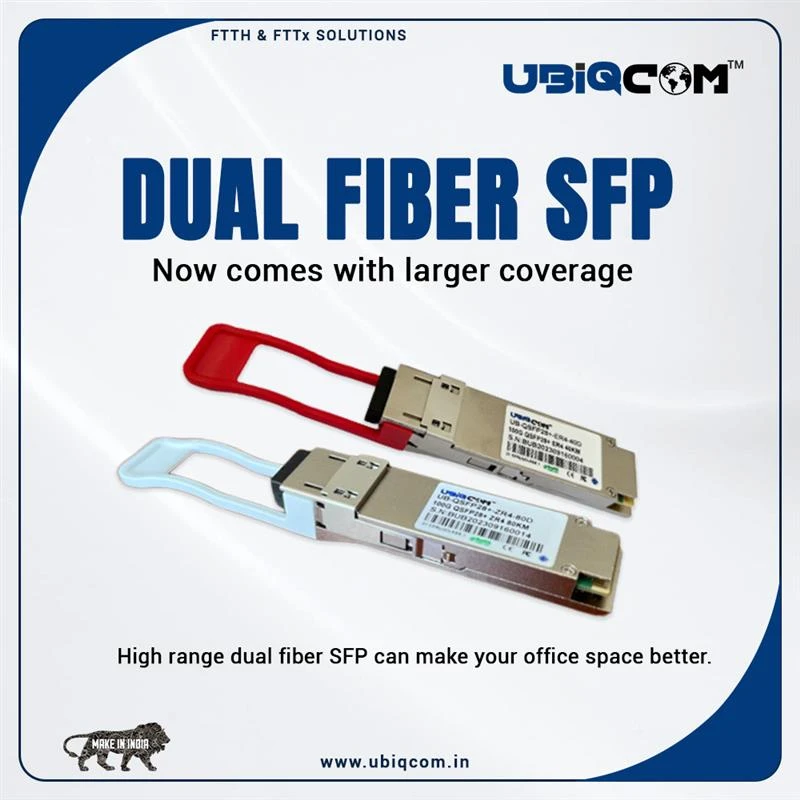
FeatureSingle Fiber SFPDual Fiber SFPFiber UsageOne strand of fiberTwo strands of fiberCostLower fiber cost, slightly higher module costHigher fiber cost, lower module costWavelengthsUses two wavelengths (Tx/Rx)Same wavelength for both modulesDeployment ComplexityEasier with limited fiber resourcesRequires two fibers for each linkTypical ApplicationsFTTH, enterprise, data centers, metro networksStandard fiber links, older networks
This comparison clearly shows why Single Fiber SFP is a better choice for modern networks where cost, efficiency, and scalability matter.
Choosing the Right Single Fiber SFP
When selecting a Single Fiber SFP, consider the following factors:
- Transmission Distance – Choose a module that supports the required link distance (e.g., 10 km, 40 km, 80 km).
- Data Rate – Ensure compatibility with your network’s speed requirements (1G, 10G, etc.).
- Wavelength Pairing – Use complementary modules with matching Tx/Rx wavelengths.
- Compatibility – Verify that the SFP is compatible with your network switches, OLTs, or routers.
- Quality & Brand Reliability – Opt for trusted brands to ensure long-term stability and performance.
Why Service Providers Prefer Single Fiber SFP
Internet service providers (ISPs) and telecom operators favor Single Fiber SFP due to:
- Lower operational expenditure (OPEX) by saving fiber resources.
- Simplified maintenance with fewer physical connections.
- Faster network expansion without needing new fiber infrastructure.
- Seamless integration with existing GPON, EPON, and other fiber-based systems.
Future of Single Fiber SFP Technology
With the growing demand for high-speed internet and the expansion of FTTH and 5G backhaul networks, Single Fiber SFP will continue to gain importance. The technology is evolving to support higher data rates and longer distances, making it a future-proof solution for modern connectivity needs.
Conclusion
The Single Fiber SFP is an innovative, cost-effective, and efficient solution for modern networking requirements. By enabling bidirectional communication over a single strand of fiber, it helps businesses, ISPs, and data centers optimize their infrastructure, reduce costs, and scale effortlessly. Whether you are upgrading an existing network or deploying a new one, Single Fiber SFP modules provide the flexibility and performance needed to meet today’s connectivity demands.























Sign in to leave a comment.