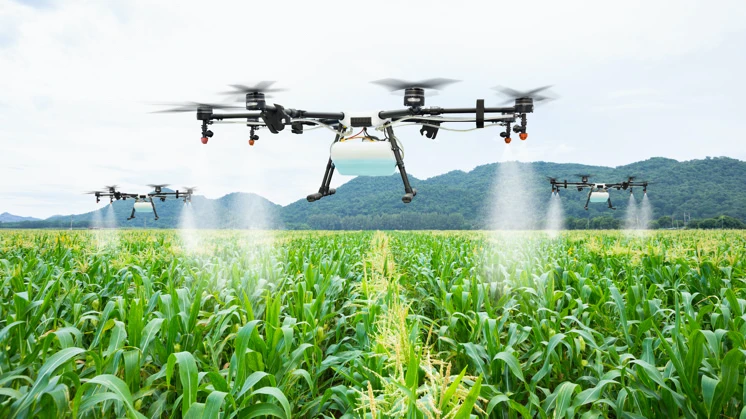

Smart farming, also known as precision farming, is becoming widespread in the agricultural industry. By utilizing data analysis and cutting-edge technology, smart farming aims to enhance crop production, reduce resource consumption, and promote eco-friendly farming practices, ultimately revolutionizing agricultural operations.
As the global population projected to reach over 9 billion by 2050 (according to the World Bank), there is a pressing need to increase food production by approximately 70%. Smart farming presents a solution to this challenge, allowing us to sustainably meet the growing food demands of a rapidly expanding population.The problem has been made more difficult by declining production and earnings as well as the environmental effects of traditional agricultural practices.
Precision Agriculture and Smart Farming Technologies
The following are some of the most significant technologies that are redefining agriculture today and will shape it in the future:
Drone
Due to their ability to cover hundreds of acres in a single flight and their ability to gather a wide range of information about the state of the land, crop growth, irrigation requirements, pathogen presence, and, in the case of cattle, the number of animals, their weight, and any anomalies like lameness or unusual movements, drones make farm supervision tasks easier.
IoT
With the help of smart sensors that can measure anything from solar radiation to leaf moisture and stem diameter, or, in the case of livestock, the ambient temperature of individual animals, farms can be monitored more effectively thanks to the Internet of Things. This also facilitates the decision-making process for various management tasks.
Blockchain
Blockchain enables supply chain traceability, for example, by monitoring cattle and crops from birth until they turned over to vendors. Instead of banning the import of vegetables from their entire nation of origin, this technique allows for the easy tracking down of the outbreak's source and the withdrawal of only the impacted items in the event that an imported vegetable poisons customers.
Big Data
Farmers can handle all the information gathered from drones, the Internet of Things, and other measuring devices and integrate it with meteorological data and previous agricultural information thanks to big data's ability to analyze vast amounts of data.
Artificial Intelligence
Artificial intelligence and robotics mostly employed in agriculture to analyze field photos, administer pesticides and fertilizers precisely, and manage weeds. For example, on a farm, it means that piglets that squealing and being squashed by their mother may identified by microphones, and a vibration can transmitted to her through a sensor to urge her to get up.
Importance of Smart Farming
The use of the aforementioned technology benefits cattle farming and agriculture. Let's examine a few of these enhancements:
Enhanced productivity: Production rates are raised through the optimization of all agricultural and livestock-rearing activities. You can also consider Mahindra Tractor to improve your farm productivity.
Water conservation: weather forecasts and sensors that gauge soil moisture allow for the proper amount and timing of irrigation.
Animal health and pest detection: By identifying agricultural pests or illnesses early on, production losses can be minimized and animal welfare can be enhanced.
Improved sustainability: maximizing the use of the land and conserving resources, such as irrigation water, lessen environmental effect.
Improved quality: By comparing the quality of the produce obtained with the tactics used, changes can made to improve the quality of succeeding output.
Lower costs: In the case of agriculture, automation of planting, treating, and harvesting minimizes resource usage. Swaraj tractor are also an economical option for farming.
Future of Agriculture Focused on Smart Agriculture
The combined use of information and communication technologies, known as the "third green revolution," is laying the groundwork for smart agriculture and IoT-powered agriculture. This covers gadgets like robots, unmanned aerial vehicles (UAVs), geo-positioning systems, precision equipment and IoT sensors and actuators.
IoT technology enables predictability of production outcomes, helps farmers better plan and allocate crops, and helps optimize farming processes to reduce production risk. For example, farmers can reduce labour and waste by using data about the precise batches of crops and the amount of crops to harvested.
In order to prepare for the 5G rollout, service providers and mobile operators are also updating their network infrastructure in a numeral of industries, including farming. They are doing this by moving network resources to the edge and integrating far-reaching technologies like massive MIMO and small cells.
Precision Farming: Towards Sustainability
Farmers that use precision agriculture can accomplish the following:
Determine which hybrid seeds and crops best suited for a given region.Only work on the precisely designated replanting areas.Additionally, implement targeted measures to supply the necessary and ideal quantity of inputs (chemicals and fertilizers).Reduce the negative effects of soil and water pollution on the environment while saving time and money.To reduce waste, make maps for irrigation schedules and use the right amount of water.Before pests and diseases ruin crops, prepare for them and take preventative action.Use pesticides and weed killers without destroying non-target plants or endangering biodiversity.Harvest produces early enough to allow for longer storage times and when it is mature enough to satisfy consumer preferences.These are all about Boosting Efficiency and Yield through Precision Agriculture and Smart farming. I hope this blog is beneficial to you. For more information like this, stay connected with us.



























Sign in to leave a comment.