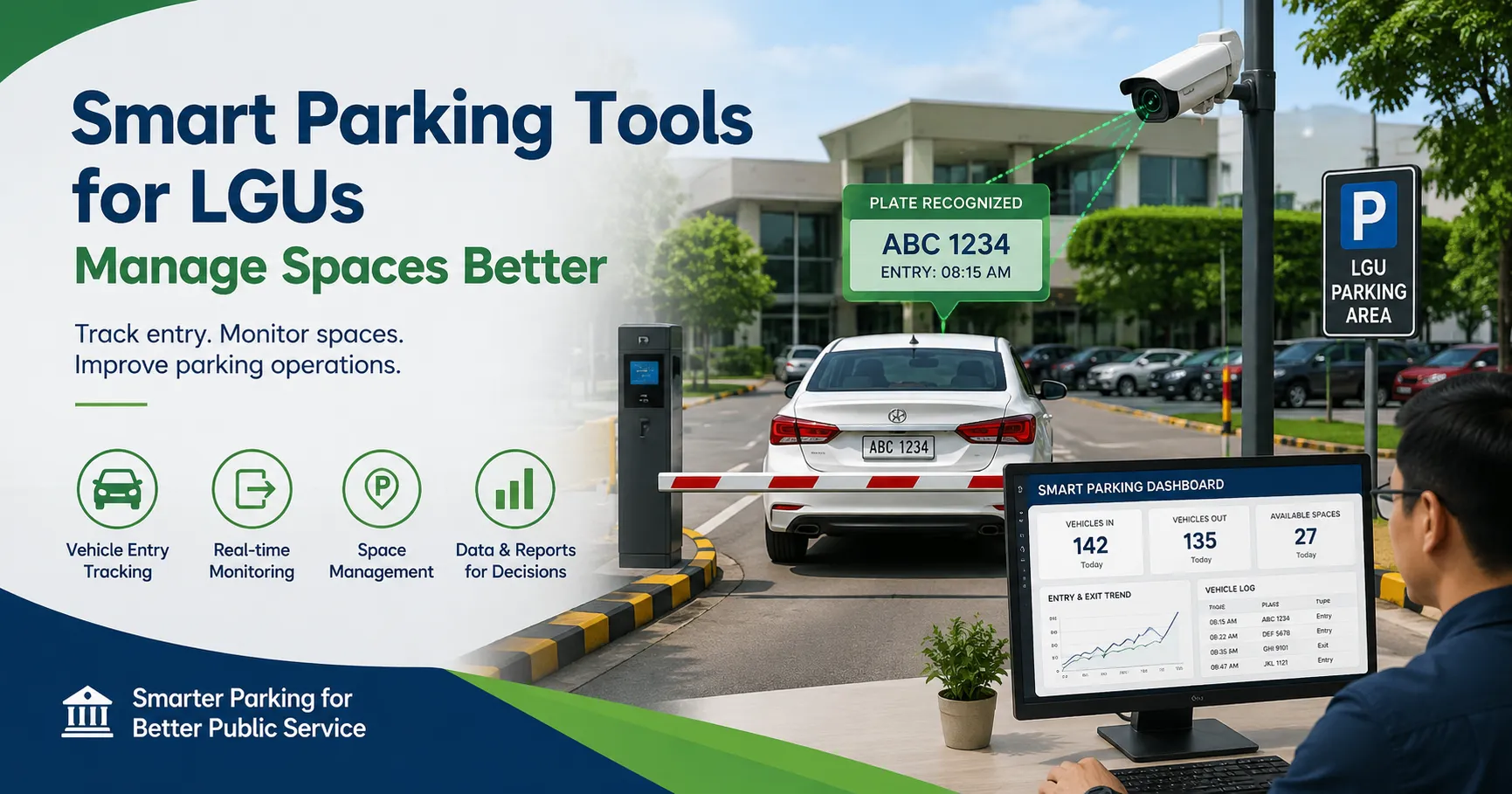

Smart parking tools for LGUs help local government teams manage parking spaces with clearer information about vehicle entry, exit, and parking activity. Instead of relying only on manual logs, visual checking, or separate reports, a smart parking setup gives authorized personnel a better way to monitor vehicles moving in and out of a parking area.
For LGUs, parking management is part of daily local service work. A municipal hall, public market, transport terminal, government facility, or public parking area may need clear tracking of vehicle movement. This guide explains how smart parking tools help LGUs manage spaces, what information staff should review, and how GoLGU Smart Parking Solutions fits into a practical digital parking plan.
Why Smart Parking Tools for LGUs Matter
Parking activity can become difficult to manage when staff rely only on manual notes or visual checking. A parking area may fill up during busy hours. Vehicles may enter and leave without a clear record. Staff may need to check who entered, when a vehicle exited, or how long a parking space was used.
Smart parking tools help LGUs improve visibility. They support parking teams by making vehicle movement easier to review. This is useful when an office needs to understand parking use, manage entry and exit activity, or maintain information connected to parking operations.
The goal is not to replace staff judgment. The goal is to give teams better information so they can review parking activity more clearly and respond to daily parking concerns with less guesswork.
What Smart Parking Tools Help LGUs Track
Smart parking tools support parking management by helping teams capture and review information connected to vehicle movement.
Common information may include:
- Vehicle entry time.
- Vehicle exit time.
- Vehicle plate details, when license plate recognition is part of the setup.
- Parking area activity.
- Vehicle movement history.
- Relevant parking information stored for authorized review.
This type of information helps staff understand how parking areas are being used. It also gives department heads a clearer view of activity when reviewing staffing, traffic flow, or facility operations.
How Smart Parking Tools Support Daily Parking Operations
A smart parking workflow should match the way an LGU manages its facilities. It should help staff handle real parking work, not add another difficult process.
Clearer Entry and Exit Monitoring
Entry and exit tracking helps the parking team understand vehicle movement. When a vehicle enters, the system should capture the relevant information based on the approved setup. When the vehicle exits, staff should be able to review the related activity.
This is helpful when parking teams need to check whether the vehicle already left, when the space became available, or how long the vehicle stayed in the area.
Better Parking Space Awareness
Parking teams need a practical view of space use. When staff know which areas often fill up, which entry points become busy, and which times create pressure, they can plan daily operations better.
A smart parking system can support that review by keeping parking information more organized. This does not mean every parking issue disappears. It means staff have a clearer basis for decisions.
Faster Review of Vehicle Movement
Manual checking takes time when staff need to confirm vehicle movement. A written log may be incomplete. A file may be difficult to retrieve. A staff member may need to ask another person for confirmation.
Smart parking tools help reduce that repeated checking by organizing entry and exit information in one process. This helps authorized personnel review parking activity when questions arise.
Support for Facility and Operations Planning
LGUs may manage parking areas near public buildings, markets, terminals, offices, or other local facilities. Parking information can help teams plan where additional signage, staff assignment, or process improvement may be needed.
The system should help leaders ask practical questions:
- Which parking areas are busiest?
- Which entry points need closer monitoring?
- Which times create the most activity?
- Which parking information should staff review regularly?
- Which issues need operational adjustment?
What LGUs Should Review Before Smart Parking Setup
A smart parking project should begin with the parking area and the operating process, not only the technology. Before choosing tools, the LGU should review how parking is handled today.
Identify the Parking Areas to Monitor
Start with one parking area or facility. List the entry points, exit points, available spaces, traffic flow, and current staff responsibilities.
This keeps the review practical. A focused starting point gives the LGU a better way to test whether the process fits the location.
Define the Vehicle Information Needed
The LGU should decide which information is necessary for parking management. If license plate recognition is part of the setup, the team should discuss how plate details are captured, reviewed, protected, and used by authorized personnel.
Only collect information that supports the parking process. Staff should know why each data point is needed.
Review Staff Roles and Access
A parking workflow needs clear user roles. Identify who monitors the system, who reviews entry and exit activity, who handles exceptions, and who may access reports.
Access should match job responsibility. Not every user needs the same level of system access.
Check How Reports Will Be Used
Reports should support real decisions. Before setup, list the reports or summaries the LGU expects to review. These may involve entry and exit activity, space use, high-traffic times, or unusual parking situations.
A report is useful only when it helps staff improve operations.
Common Parking Problems Smart Tools Can Help Reduce
Smart parking tools can help reduce several daily issues when the workflow is planned well.
Unclear Vehicle Movement
When entry and exit activity is not organized, staff may struggle to confirm whether a vehicle is still inside the parking area. A smart parking workflow helps create a clearer review path.
Manual Log Errors
Manual logs may be incomplete, hard to read, or difficult to match with actual vehicle activity. Digital entry and exit tracking helps reduce repeated manual checking.
Limited Visibility During Busy Hours
During peak hours, staff may need better information about space use and vehicle movement. Smart parking tools can help teams see activity more clearly.
Hard-to-Retrieve Parking Information
When parking information is scattered across paper logs or messages, later review takes more time. A connected system helps authorized users retrieve relevant information more easily.
Smart Parking as Part of Better Local Service Access
Parking management affects how citizens, employees, visitors, and service users experience a public facility. A parking area that is difficult to monitor can create confusion, delays, and extra work for staff.
Smart parking should fit the LGU’s broader digital service direction. It can support facility access, vehicle flow, and service planning when paired with clear staff roles and useful information.
For a related guide on citizen-facing access, read our article on mobile access for LGU citizen services.
How GoLGU Supports Smart Parking Review
GoLGU supports LGUs through a web-based ERP platform that connects department modules in one centralized system. Its Smart Parking Solutions service helps organizations track vehicles entering and leaving premises using license plate recognition, with relevant parking information stored for review.
The official service page also describes the Intelligent Parking Management System, or IPMS, as a solution for monitoring vehicles that enter and leave parking areas. It notes that API-capable systems, such as a vehicle registration system, may be integrated when applicable to the setup.
To review the official service details, visit the GoLGU Smart Parking Solutions page.
For a broader view of GoLGU and its connected LGU modules, visit About GoLGU.
Questions LGUs Should Ask During a Smart Parking Demo
A demonstration becomes more useful when the LGU brings one actual parking location into the discussion. This lets the team review how the system handles the parking area, entry points, exit points, user roles, and reporting needs.
Ask these questions:
- How does the system capture vehicle entry and exit activity?
- How does license plate recognition work in the proposed setup?
- What parking information is stored for authorized review?
- Which users can access the dashboard or reports?
- How does the system handle peak parking hours?
- What happens when a vehicle plate is unclear or unreadable?
- Can the parking setup connect with another API-capable system?
- What support is included after deployment?
These questions keep the review focused on the LGU’s parking operations instead of a general feature list.
Frequently Asked Questions About Smart Parking Tools for LGUs
What are smart parking tools for LGUs?
Smart parking tools help local government teams monitor parking spaces, vehicle entry, exit activity, and related parking information. The exact setup depends on the parking area, staff roles, and system features selected.
Do smart parking tools replace parking staff?
No. Smart parking tools support staff by giving them clearer information for monitoring and review. Personnel still manage operations, handle exceptions, and follow local procedures.
Why is entry and exit tracking important?
Entry and exit tracking helps staff understand vehicle movement in a parking area. It can support review of space use, peak activity, and parking concerns.
Does GoLGU use license plate recognition for Smart Parking Solutions?
The official GoLGU Smart Parking Solutions page describes the use of vehicle license plate number recognition to monitor and manage vehicles entering and leaving a parking lot gate. LGUs should review the exact setup during a demo.
What should an LGU prepare before reviewing smart parking tools?
Prepare a list of parking areas, entry and exit points, current monitoring steps, user roles, common issues, and expected reports. This helps the demo focus on real operating needs.
Smart Parking Tools for LGUs: Next Step
Smart parking tools for LGUs help local teams manage spaces by improving visibility over vehicle entry, exit, parking activity, and related information. The best starting point is one real parking area with clear entry points, exit points, staff roles, and reporting needs.
Before choosing a setup, map how parking is handled today and identify where staff need clearer information. When your city or municipality is ready to review smart parking options, request a GoLGU demo.























Sign in to leave a comment.