

Every road widening, intersection redesign, or new signal installation across the UAE depends on one thing above all: accurate data. Smart Traffic Surveys now sit at the center of how engineers plan modern roads and junctions, replacing guesswork with measurable evidence drawn directly from how vehicles and people actually move through a specific location.
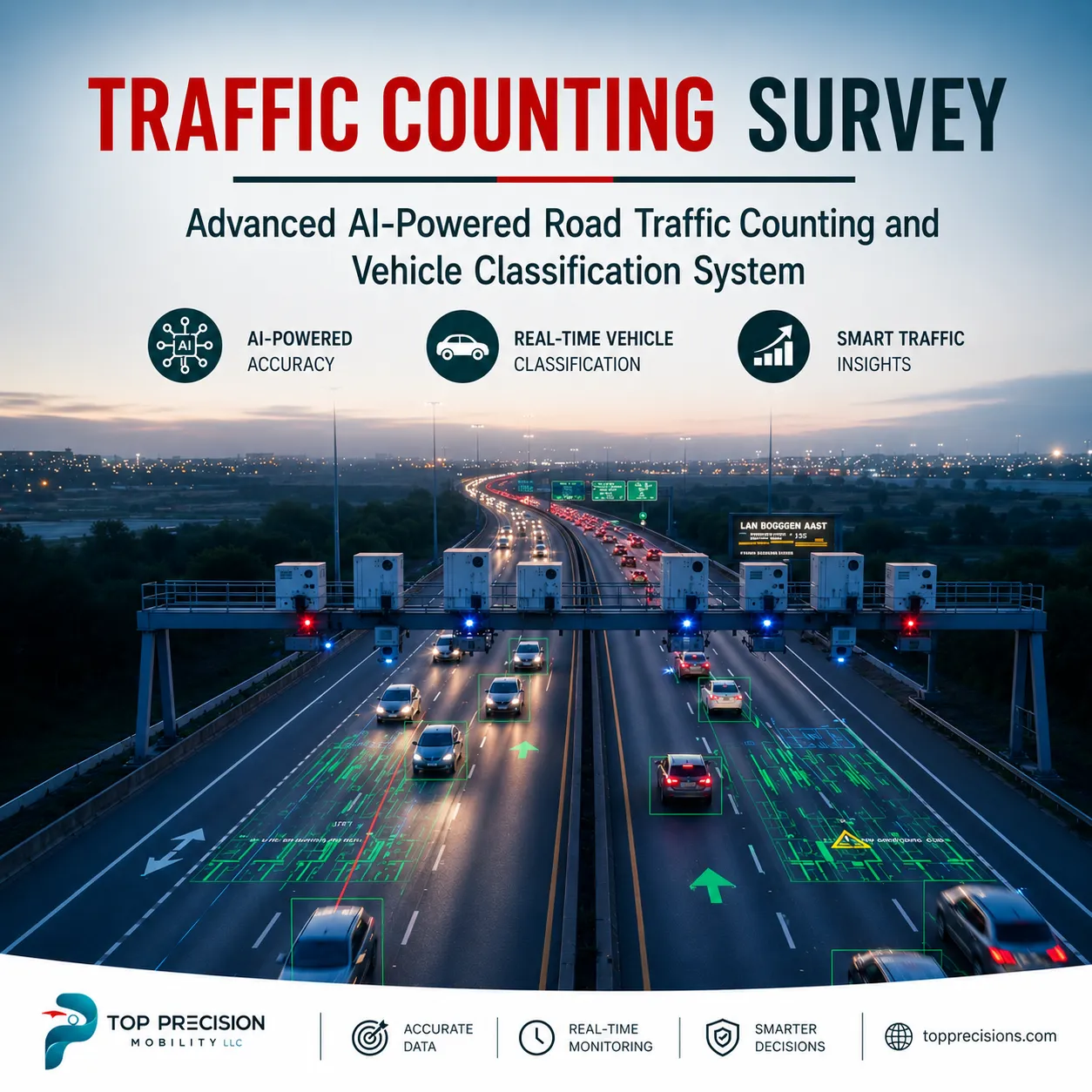
Road engineering has grown far more demanding in a country expanding as quickly as the UAE. A single intersection redesign might need to account for freight traffic, tourist volumes, school-zone pedestrian activity, and a growing number of e-scooters, all within the same signal cycle. Meeting that complexity requires survey methodology built around modern sensors, cameras, and analytics rather than a clipboard and a stopwatch.
Designing Roads and Intersections for Tomorrow's UAE
Road networks built even a decade ago are increasingly being asked to carry loads well beyond their original design assumptions. New residential communities, expanding business districts, and record tourism numbers are placing pressure on intersections and corridors that were never engineered for today's volumes or vehicle mix.
Forward-looking road authorities and consultancies are responding by building future-proofing directly into their design process, using survey data not just to fix today's congestion, but to anticipate growth over the next decade of planned development in a given corridor or district.
The Role of Traffic Surveys in Modern Road Engineering
Traffic Surveys provide the empirical foundation for nearly every decision an engineering team makes about a road or intersection, from lane configuration and signal phasing to pedestrian crossing placement and speed management measures. Without this evidence, design choices default to assumption or precedent rather than the specific behaviour of road users at that exact location.
A properly scoped survey captures far more than a single count. It documents how traffic composition shifts across the day, how directional flow changes during peak periods, and how different road user groups, from freight trucks to schoolchildren on bicycles, interact at the same junction.
Automated Traffic Counts (ATC): Continuous Intelligence for Every Road Segment
Automated Traffic Counts (ATC) deploy road tubes, radar, or video sensors that log vehicle volumes continuously across a road segment, without requiring a field technician to remain on site. This unlocks data collection windows spanning days, weeks, or months, revealing volume patterns that a single-day manual count would never capture, including weekend spikes, event-driven surges, and seasonal tourism variation.
Engineers rely on this continuous intelligence to validate design assumptions against real-world conditions rather than short, potentially unrepresentative snapshots, giving infrastructure investments a stronger evidentiary foundation before construction begins.
Classified Vehicle Counts: Engineering Roads for the Right Vehicle Mix
A road built without understanding its true vehicle mix risks being under-engineered from day one. Classified vehicle counts break total traffic volume down by category, cars, buses, trucks, motorcycles, and heavy goods vehicles, giving design teams the composition data needed to set appropriate lane widths, pavement specifications, and turning radii.
This is particularly critical near industrial areas, ports, and logistics corridors, where a higher-than-expected proportion of heavy vehicles can quietly undermine a road's structural lifespan if the original design did not account for that loading pattern.
Turning Movement Counts (TMC): The Data Behind Every Intersection Redesign
Turning Movement Counts (TMC) record the precise direction every vehicle takes at a junction, left turns, right turns, and through movements, logged by time interval. Intersection engineers depend on this directional breakdown to model signal timing scenarios, evaluate capacity, and identify exactly which approach or movement is creating a bottleneck.
A dedicated turn lane, an adjusted signal phase, or a full geometric overhaul is rarely justified on volume data alone. It is the directional detail from TMC studies that typically settles the design decision.
ATC & TMC Camera: Smart Sensors for Smarter Junctions
Many modern intersection studies now rely on a combined ATC & TMC camera deployment, a single video-based sensor positioned to capture both continuous volumes counts and detailed turning movement data from one vantage point. This dual-purpose setup reduces field deployments while still delivering the granular, movement-by-movement detail engineers need for signal design.
These camera systems use AI-driven detection to classify vehicles and track their paths through a junction automatically, producing consistent, repeatable data across extended survey windows without the accuracy drift that can affect manual observation over long shifts.
Pedestrian & Cyclist Counts: Engineering Safer Crossings and Corridors
Pedestrian & cyclist counts document how people on foot or bicycle use crossings, sidewalks, and dedicated cycling infrastructure at a given location. As UAE road authorities invest in safer, more walkable corridors, this data increasingly shapes decisions once made almost exclusively around vehicle throughput.
Accurate pedestrian and cyclist counts justify signalized crossing placement, walk-phase timing allocations, and the case for physically separated cycling infrastructure, helping engineers design junctions that serve every road user rather than optimizing for cars alone.
Micro-mobility Counts: Planning Infrastructure for the Next Wave of Urban Transport
Micro-mobility counts measure the growing volume of e-scooters, e-bikes, and other light electric vehicles now sharing UAE streets and pathways. As this category continues to expand, engineers need reliable data on how these devices move, at what speeds, and where they intersect with pedestrian and vehicle traffic.
This data is increasingly shaping decisions on dedicated micro-mobility lanes, shared-path capacity planning, and design interventions at conflict points where light electric vehicles interact with faster-moving traffic.
Traffic Surveys UAE: Standardizing Smart Data Collection Nationwide
Traffic Surveys UAE-wide projects benefit from methodology calibrated specifically to national conditions: extreme summer heat that suppresses pedestrian and cyclist activity, sharp seasonal tourism swings, and a road network spanning everything from dense downtown cores to fast-developing suburban districts. Generic international survey templates frequently fail to account for these local realities.
Engineering consultancies and government authorities increasingly favor survey providers with proven, on-the-ground experience across the Emirates, ensuring data collection timing, equipment placement, and final report formatting align with the standards local planning departments expect.
Traffic Surveys Dubai: Precision Engineering for a Rapidly Evolving Skyline
Dubai's road network changes at a pace few global cities can match, and Traffic Surveys Dubai projects reflect that reality directly. New master-planned communities, major corridor upgrades, and transit-oriented developments all depend on current, precise traffic data to support planning submissions and environmental assessments across the emirate.
Because Dubai's land use and road geometry can shift meaningfully within just a few years, engineers increasingly treat survey data as a perishable asset, one that needs regular refreshing rather than a one-time baseline used indefinitely.
From Data to Design: How Engineers Use Survey Findings
Survey data only becomes valuable once it is translated into a design decision. Turning movement findings might justify a protected left-turn phase; pedestrian counts might support a new signalized school crossing; micro-mobility data might justify a physically separated lane along a busy retail corridor. The most effective projects begin with a clearly defined engineering question, then scope the survey specifically to answer it.
Feeding validated survey results directly into traffic modeling software also allows engineers to test proposed interventions virtually before committing construction budgets, significantly reducing the risk of costly redesigns after a project has already been built.
What to Look for in a Smart Traffic Survey Partner
Engineering teams should evaluate potential survey partners on the breadth of sensor and camera technology offered, the rigor of their data validation process, typical reporting turnaround time, and demonstrated experience delivering studies specifically within UAE road networks. A provider unfamiliar with local seasonal patterns or planning authority formatting requirements can quietly introduce delays and rework into an already tight project schedule.
Breadth of Sensor and Camera Technology
A strong partner offers a full toolkit, automated tube and radar counters, AI-driven camera systems, and manual verification methods, so the survey approach can be matched precisely to the site conditions and the specific engineering question being answered.
Data Accuracy and Quality Control
Raw sensor and video data should always be validated against manual spot checks before a final report is issued, catching any calibration drift or detection errors before the dataset is used to inform an actual design decision.
Reporting Turnaround and Project Coordination
Large-scale corridor or multi-intersection studies require careful field scheduling to keep equipment calibrated consistently across every site and avoid conflicting deployments. Partners with dedicated project management resources tend to keep multi-site studies on schedule and deliver findings in a format ready for immediate engineering use.
Timing a Survey for Reliable, Representative Results
The engineering value of any survey depends heavily on when and how long it runs. A single weekday snapshot may be adequate for a minor local review, but larger intersection redesigns and corridor studies typically benefit from week-long or multi-week collection windows that capture weekday, weekend, and seasonal variation more reliably.
Data collected during atypical periods, school holidays, major events, or unusual weather, can distort results if not clearly flagged and accounted for during analysis. Providers with strong regional experience know how to plan collection windows around these variables, or explicitly note their impact in the final report so downstream design decisions are not built on an unrepresentative dataset.
Why Top Precisions: Experience, Expertise, and Trusted Engineering Data
Top Precisions has delivered traffic and mobility data collection for government road authorities, engineering consultancies, and private developers across the UAE, giving the team direct, practical familiarity with local road conditions, seasonal behaviour patterns, and the reporting standards different planning departments require. That hands-on experience shapes every survey design, from sensor placement to count duration.
The team pairs automated sensor and camera-based technology with rigorous quality control, ensuring every dataset delivered is accurate, defensible, and ready for direct submission to planning authorities or integration into transport modeling software. Engineering teams planning an upcoming intersection or corridor study can review Top Precisions' full range of traffic survey solutions, or reach out to the Top Precisions engineering data team to scope a project-specific study.
Conclusion
Modern UAE roads and intersections are built on evidence, and reliable Traffic Surveys are the starting point for every sound design decision. Continuous Automated Traffic Counts (ATC) and detailed Classified vehicle counts establish how a corridor truly behaves, while precise Turning Movement Counts (TMC) captured through a combined ATC & TMC camera setup guide smarter junction design. Add reliable Pedestrian & cyclist counts and forward-looking Micro-mobility counts, and engineers gain the complete picture needed to build safer roads. Whether the project calls for Traffic Surveys UAE-wide or focused Traffic Surveys Dubai studies, smart, technology-driven data remains the foundation of every well-engineered intersection.
FAQs
1. Why are Automated Traffic Counts (ATC) preferred over manual counting for engineering studies?
Automated Traffic Counts (ATC) run continuously across extended periods, capturing volume patterns and variation that short manual counts would miss, while eliminating the fatigue-related errors common in long observation shifts.
2. How do Classified vehicle counts affect pavement and lane design?
Classified vehicle counts reveal the proportion of heavy vehicles using a road, directly informing pavement thickness, lane width, and turning radius specifications needed to handle that traffic mix safely.
3. What makes an ATC & TMC camera setup useful for intersection redesigns?
An ATC & TMC camera captures both continuous volume data and detailed turning movement information from a single sensor, giving engineers full-detail results with fewer field deployments needed.
4. How do engineers use Pedestrian & cyclist counts in road design?
Pedestrian & cyclist counts justify signalized crossing placement, walk-phase timing, and dedicated cycling infrastructure, ensuring intersection designs serve non-motorized road users safely alongside vehicle traffic.
5. Is survey methodology different for Traffic Surveys Dubai compared to other UAE projects?
The core methodology stays consistent, but Traffic Surveys Dubai projects often require faster turnaround and more frequent data refreshes given the emirate's rapid development pace, compared to broader Traffic Surveys UAE studies with longer planning cycles.

































Sign in to leave a comment.