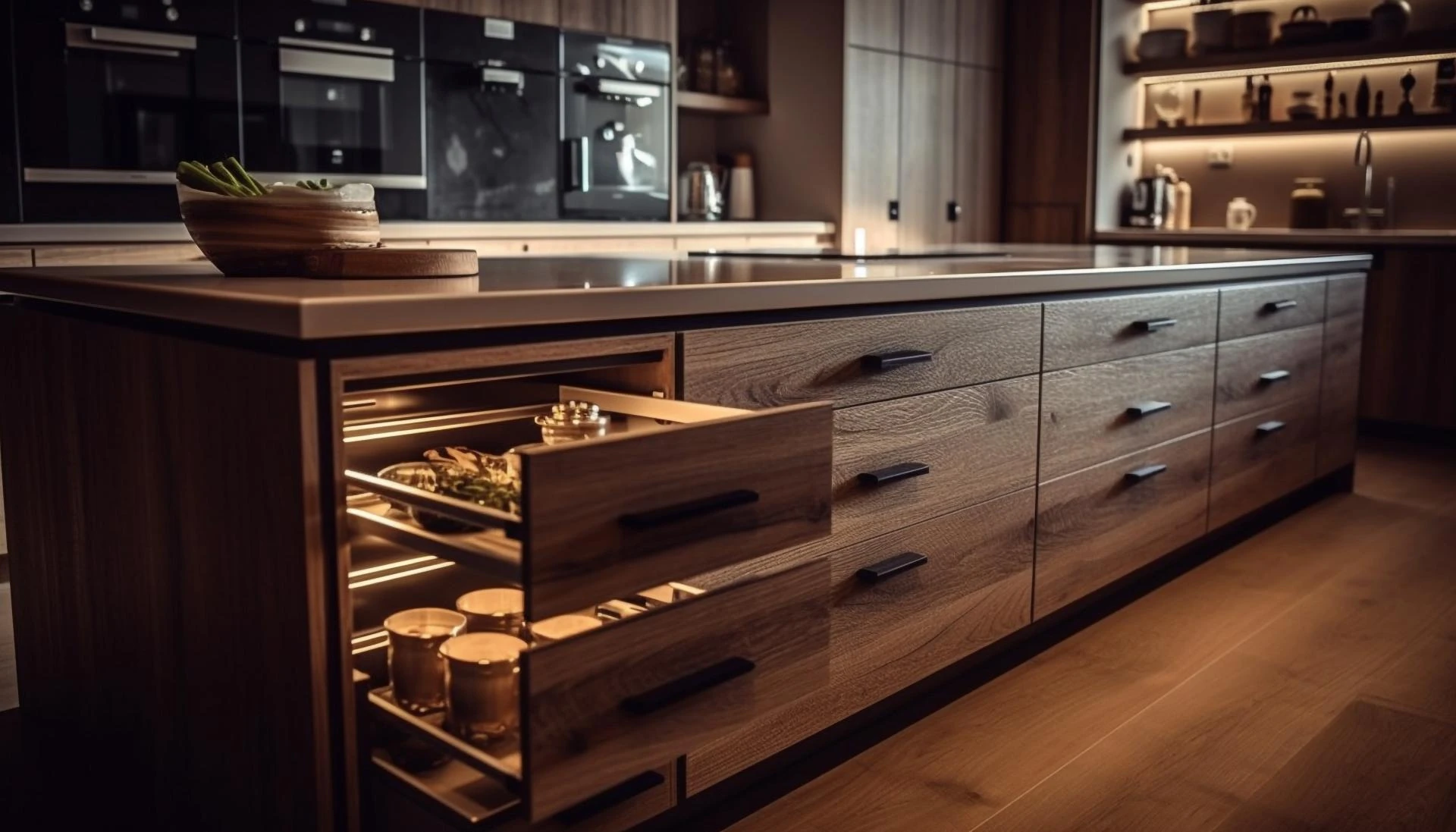

When homeowners decide to reface their kitchen cabinets, the first conversation is almost always about style — door profiles, finish colors, hardware options. But the decision that will have the greatest impact on how the finished kitchen looks, feels, and holds up over time is one that happens a step earlier: the choice between solid wood and laminate materials.
This is not a simple good-versus-better comparison. Both solid wood and laminate have genuine strengths, and the right choice depends on how you use your kitchen, what you value in a finished surface, how long you plan to stay in your home, and what your budget allows. Understanding the real differences — not the oversimplified version — is what allows you to make a decision you will still feel good about ten years from now.
This guide walks through the honest trade-offs between solid wood and laminate for cabinet refacing, the situations where each material excels, and how to evaluate which choice delivers the most value for your specific kitchen and circumstances.
What Solid Wood Refacing Actually Means
When a refacing company refers to solid wood, they may mean one of two things, and the distinction matters. True solid wood doors and drawer fronts are fabricated entirely from natural wood — typically species like maple, oak, cherry, hickory, or walnut — with no composite core. The face frames are covered with a real wood veneer, meaning a thin slice of genuine wood is bonded to the existing cabinet box surface, giving every visible element of the cabinet the look, texture, and character of natural wood throughout.
The alternative sometimes marketed as wood is a wood veneer over a medium-density fiberboard (MDF) or particleboard core. This construction is common, durable, and used by many reputable manufacturers — but it is not the same as solid wood, and understanding that distinction helps you ask the right questions when evaluating providers and quotes.
For the purposes of this comparison, solid wood refers to doors and drawer fronts with a natural wood construction and real wood veneer face frames — the premium end of the refacing material spectrum.
What Laminate Refacing Actually Means
Laminate in the context of cabinet refacing covers a family of synthetic surface materials applied over an MDF or particleboard substrate. The most common types are high-pressure laminate (HPL), low-pressure laminate (LPL or melamine), and thermofoil — a vinyl film applied under heat and pressure to create a seamless, smooth surface.
Modern laminate products are genuinely impressive. Advances in printing and surface technology mean that today's laminates can convincingly replicate the appearance of wood grain, stone, painted surfaces, and a range of textures that were difficult to achieve synthetically even fifteen years ago. High-quality thermofoil products in particular have shed their earlier reputation for peeling and delamination, provided they are installed correctly with appropriate materials and techniques.
Laminate is not a compromise material chosen only when wood is unaffordable. It is a legitimate option with specific performance advantages that make it the right choice in certain kitchens and for certain homeowners. The key is understanding where those advantages apply.
Durability: How Each Material Holds Up Over Time
Durability is the performance dimension most homeowners prioritize, and the comparison between wood and laminate here is more nuanced than the conventional wisdom suggests.
Solid wood is exceptionally strong, and a quality wood door can last for decades with normal care. However, wood is a natural material, and natural materials respond to their environment. Wood expands and contracts with changes in temperature and humidity — a characteristic that is manageable in most kitchens but can cause problems in environments with extreme or rapid humidity swings. Over time, solid wood doors may show minor warping, cracking at joints, or finish wear that requires refinishing or touch-up. These are not failures — they are the natural aging of a living material — but they do represent maintenance considerations that laminate does not carry.
Laminate surfaces, by contrast, are dimensionally stable. They do not expand, contract, or warp in response to humidity changes, which makes them particularly well-suited to kitchens that experience temperature and moisture variation. High-quality thermofoil and HPL surfaces are also highly resistant to scratching, staining, and the everyday wear of a working kitchen. The trade-off is that when laminate surfaces do sustain damage — a significant chip, a deep scratch, or edge delamination — repair is more difficult and less seamless than touching up a wood finish.
For most kitchens in most climates, both materials perform well over the long term. The durability edge depends less on which material is inherently superior and more on which material is better matched to the specific conditions of your kitchen.
Aesthetics: The Look and Feel Difference
This is where many homeowners have already formed a strong opinion, and for good reason. The visual and tactile experience of solid wood cabinetry is distinct from laminate, and for homeowners who care deeply about that distinction, no amount of performance data changes the preference.
Solid wood has natural variation — grain patterns, subtle color shifts within a single species, and the way light interacts with a real wood surface — that synthetic materials replicate convincingly but not perfectly. Running your hand across a solid wood cabinet door feels different from running it across a thermofoil surface, even a high-quality one. For homeowners who spend significant time in their kitchen and place genuine value on the sensory experience of natural materials, that difference is real and meaningful.
Laminate offers something wood cannot: absolute consistency. Every door in a laminate refacing project will be exactly the same color, exactly the same texture, with no natural variation between them. For contemporary kitchen designs that rely on uniformity — particularly flat-front Shaker or slab door styles in solid colors — laminate delivers a precision that wood, with its natural variation, cannot fully match.
The aesthetic choice, in the end, is personal. What is important is making it with an accurate understanding of what each material actually looks like in a finished kitchen — which is why reviewing samples and completed project photographs before committing is essential.
The Value of Authentic Materials in Solid Wood Cabinet Refacing
There is a category of homeowner for whom the laminate-versus-wood debate resolves itself quickly: those who want the real thing and are willing to invest accordingly. For these homeowners, the value of solid wood cabinet refacing is not primarily about performance metrics or resale calculations. It is about having a kitchen that is genuinely crafted from natural materials — something that can be felt in the weight of the doors, seen in the grain of the wood, and appreciated every time someone walks into the room.
That value is legitimate, and it has a market corollary. Homes with high-quality solid wood cabinetry — whether original or refaced — consistently command stronger buyer responses than those with synthetic alternatives, particularly in higher price tiers where buyers are specifically looking for premium material quality. The investment in solid wood refacing, while higher upfront than laminate, tends to hold its value better in the long run and contributes more meaningfully to the overall perception of quality in the home.
Cost Comparison: What You Are Actually Paying For
The cost difference between solid wood and laminate refacing is real, but it is often overstated in the abstract. The specific gap depends on the door style, the wood species chosen, the size of the kitchen, and the provider. What is always true is that solid wood costs more — the material itself is more expensive, and skilled fabrication of solid wood doors requires more labor and precision than laminate production.
For most kitchens, homeowners can expect solid wood refacing to cost meaningfully more than a comparable laminate project. The question worth asking is not simply which is cheaper, but which delivers more value relative to cost for your specific situation.
If your kitchen will be heavily used for another twenty years before the next update, the durability and refinishability of solid wood may justify the premium. If you are updating the kitchen primarily for a near-term sale and the buyer profile for your home does not demand premium materials, high-quality laminate may deliver comparable visual impact at a lower cost basis. If you are updating for your own enjoyment and natural materials matter to you personally, the cost difference is part of what you are choosing to invest in — and that is a completely valid basis for the decision.
Refinishability: A Long-Term Advantage of Solid Wood
One performance dimension that often gets overlooked in the wood-versus-laminate discussion is refinishability — the ability to restore, refresh, or change the surface finish over time without replacing the doors.
Solid wood doors can be sanded, restained, or repainted at any point in their life. If your taste changes in fifteen years, if the original stain begins to show wear, or if you want to update the kitchen's color palette without a full refacing project, solid wood gives you that flexibility. The doors themselves remain structurally sound, and the surface is simply renewed.
Laminate surfaces cannot be refinished in the same way. A thermofoil door that is worn, chipped, or simply dated must be replaced rather than refreshed. This is not a disqualifying disadvantage — the initial cost of laminate is lower, and if the doors are replaced rather than refinished after ten or fifteen years, the economics may still work out reasonably. But it is a genuine difference in long-term flexibility that favors solid wood for homeowners who are thinking about the full lifecycle of their cabinetry.
Moisture and Kitchen Environment Considerations
Kitchen environments vary significantly, and the right material choice accounts for the specific conditions in your kitchen rather than applying a generic rule.
Kitchens that experience significant steam — from heavy cooking, pressure cooking, or proximity to a dishwasher that vents directly onto cabinet surfaces — present a more challenging environment for both materials. In these conditions, laminate's dimensional stability gives it a genuine edge. High-quality thermofoil and HPL surfaces handle steam and moisture exposure better than solid wood, which can show swelling, finish blistering, or joint separation in persistently humid conditions.
For kitchens with normal cooking activity and adequate ventilation, solid wood performs perfectly well. The concern about wood and moisture is legitimate but is often exaggerated for standard residential kitchens with normal use patterns. Proper ventilation — a quality range hood that actually vents to the exterior — does more to protect solid wood cabinetry than any material choice.
If your kitchen has specific moisture challenges, discussing them honestly with your refacing specialist is more useful than applying a blanket rule. A provider experienced in solid wood cabinet refacing and laminate alternatives will be able to assess your specific kitchen conditions and give you an honest recommendation based on what they have seen perform well in similar environments.
Which Material Is Right for Your Kitchen?
Pulling the comparison together, the choice between solid wood and laminate for cabinet refacing comes down to a set of questions that only you can answer for your specific situation.
How long do you plan to stay in your home? If the answer is ten years or more, the refinishability and longevity of solid wood become more compelling. If you are planning a sale within three to five years, high-quality laminate may offer a better cost-to-impact ratio for your specific buyer market.
How do you use your kitchen? Heavy cooking with significant steam argues slightly in favor of laminate's dimensional stability. Normal residential cooking in a well-ventilated kitchen presents no meaningful challenge to solid wood.
What aesthetic do you want? If natural variation, warmth, and the sensory experience of real wood matter to you, solid wood is the right choice regardless of the performance comparison. If you want perfect uniformity and a precision finish in a contemporary color, laminate may actually serve your vision better.
What is your budget? Both materials can produce a beautiful result. If the cost difference between solid wood and laminate means choosing between a quality refacing project in solid wood and a quality refacing project in laminate, the laminate project is still a vastly better investment than doing nothing or overspending on a full replacement.
Final Thoughts
The solid wood versus laminate decision is one of the most consequential choices in a cabinet refacing project, and it deserves more thoughtful consideration than it typically receives. Neither material is universally superior — each has genuine strengths that make it the right answer in specific situations, for specific homeowners, in specific kitchens.
What matters most is making the choice with accurate information, realistic expectations, and a clear sense of what you value and how you use your kitchen. A provider who helps you understand both options honestly — without steering you toward the higher-margin choice or dismissing your preferences — is a provider you can trust with the investment you are making.
For Lakewood homeowners and those throughout northeast Ohio who are ready to explore the options, working with a specialist in solid wood cabinet refacing who offers both wood and laminate alternatives gives you the full picture and ensures that the recommendation you receive is based on what is genuinely right for your kitchen — not what is easiest to sell.
Frequently Asked Questions (FAQ)
Q: Can I mix solid wood and laminate in the same kitchen refacing project?
Yes, and this is more common than many homeowners realize. Some choose solid wood for the most visible cabinet doors — the upper cabinets and island — and laminate for lower cabinets that see more moisture exposure. Others use solid wood throughout but choose a thermofoil finish for specific cabinets near the dishwasher or stove. A skilled refacing specialist can advise on combinations that make practical and aesthetic sense for your kitchen.
Q: How do I know if a provider is using genuine solid wood versus wood veneer over MDF?
Ask directly, and ask for documentation. A reputable provider will tell you exactly what their doors are made of — the core material, the face material, and the finish — and will provide that information in writing in the project contract. If a provider is vague about the construction of their doors or conflates solid wood with veneered MDF, that is a reason to seek a second opinion.
Q: Does solid wood refacing add more value to a home than laminate?
In most markets and at most price points, yes — particularly in the mid-to-upper tier of the residential market where buyers are specifically evaluating material quality. The premium varies by market and by how the home is positioned overall. In entry-level markets where buyers are primarily focused on price per square foot, the difference in buyer response between high-quality laminate and solid wood may be smaller than the cost difference would suggest.
Q: How long does solid wood cabinet refacing last compared to laminate?
Both materials, installed correctly by a skilled professional, can last fifteen to twenty-five years or more. The practical difference is in what happens at the end of that lifecycle — solid wood can be refinished and extended, while laminate typically requires replacement. For homeowners who want to maximize the total useful life of their cabinetry investment, solid wood has a long-term advantage.
Q: Is thermofoil a good choice for painted-look cabinets?
Thermofoil is an excellent choice for homeowners who want the look of painted cabinetry with superior moisture resistance and easy maintenance. Modern thermofoil products in white, off-white, gray, and other solid colors are virtually indistinguishable from painted finishes in photographs and from a normal viewing distance. The trade-off is that thermofoil cannot be repainted if tastes change, while a painted solid wood door can be refinished in any color.
Q: What wood species is the best choice for kitchen cabinet refacing?
The best species depends on the aesthetic you want and the finish you plan to apply. Maple is the most popular choice for painted finishes because its tight, consistent grain takes paint extremely well and shows minimal grain texture through the topcoat. Oak is the classic choice for stained natural wood kitchens and has a prominent grain that adds character. Cherry is prized for its warm reddish tones and darkens beautifully with age and light exposure. Walnut delivers a dramatic, high-end appearance with deep color and rich grain. Your refacing specialist can show you finished samples of each to help you decide.




























Sign in to leave a comment.