
In the realm of software testing, Selenium stands as a cornerstone for automating web applications. However, to maximize its potential, integrating it with the right testing framework is crucial.
Embracing Selenium’s capabilities becomes even more accessible and impactful with Selenium Training in Pune.
This comprehensive guide takes you on a journey through a diverse selection of Selenium frameworks, each offering unique features and benefits to enhance your testing strategy.
Navigating the Selenium Framework Landscape
Efficient automated testing relies on a robust framework to provide structure and tools for executing test cases effectively. These frameworks play a vital role in improving productivity and ensuring reliable outcomes. Let\'s explore the world of Selenium frameworks to uncover solutions tailored to your testing needs.
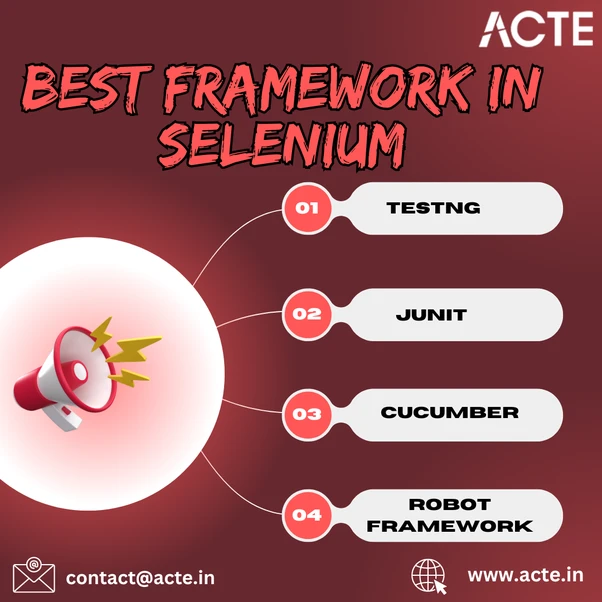
TestNG: Empowering Test Automation Excellence
Introduction
TestNG, inspired by JUnit and NUnit, is a versatile testing framework designed to cover various test categories, from unit tests to end-to-end scenarios.
Key Features
- Parallel Execution: TestNG allows parallel test execution, reducing the time needed for large test suites.
- Comprehensive Reports: It generates detailed reports providing insights into test execution and results.
- Annotations: TestNG offers a rich set of annotations such as @Test, @BeforeMethod, and @AfterMethod for efficient test management.
- Data-Driven Testing: With the @DataProvider annotation, TestNG simplifies data-driven testing by enabling the execution of tests with multiple datasets.
Benefits
TestNG\'s flexibility and comprehensive features make it ideal for handling complex testing scenarios. Its support for parallel testing and detailed reporting saves time and offers valuable insights into test performance.
JUnit: Where Simplicity Meets Effectiveness
Introduction
JUnit is a widely used testing framework known for its simplicity and ease of use, particularly in Java applications.
Key Features
- User-Friendly: JUnit\'s straightforward approach simplifies test case creation and execution.
- Annotations: Essential annotations such as @Test, @Before, and @After help organize and execute test cases efficiently.
- Integration: JUnit seamlessly integrates with various development tools and CI/CD pipelines, enhancing workflow efficiency.
To unlock the full potential of Selenium and master the art of web automation, consider enrolling in the Top Selenium Online Training.
Benefits
JUnit\'s simplicity and effectiveness make it an excellent choice for projects of varying complexities. Its integration capabilities streamline the testing process and ensure quality.
Cucumber: Enhancing Collaboration with Behavior Driven Development (BDD)
Introduction
Cucumber is a Behavior Driven Development (BDD) framework that fosters collaboration between technical and non-technical stakeholders.
Key Features
- Plain Language Syntax: Cucumber uses Gherkin syntax, making test cases readable and understandable by all stakeholders.
- BDD Focus: Cucumber promotes collaboration between developers, QA engineers, and business stakeholders.
- Multi-Language Support: It supports multiple programming languages, adapting to diverse project environments.
Benefits
Cucumber\'s BDD approach ensures a shared understanding of requirements and promotes effective collaboration across teams. Its support for multiple languages enhances versatility and adoption.
Robot Framework: Simplifying Test Automation with Keywords
Introduction
Robot Framework is an open-source automation framework known for its keyword-driven testing approach.
Key Features
- Keyword-Driven Testing: Robot Framework simplifies test case creation and maintenance with its keyword-driven approach.
- Library Support: It offers extensive library support, including SeleniumLibrary for web testing.
- Language-Independent: Robot Framework\'s modular architecture supports various tools and libraries.
Benefits
Robot Framework\'s keyword-driven approach simplifies test case creation and maintenance, making it accessible to testers with varying levels of expertise. Its language-independent nature enhances versatility across different testing scenarios.
Conclusion
Traversing the Selenium framework landscape may seem overwhelming, but understanding the strengths and capabilities of each framework can empower you to optimize your testing efforts. Whether you\'re handling complex scenarios or streamlining processes for smaller projects, there\'s a Selenium framework tailored to meet your needs and elevate your testing capabilities.


























Sign in to leave a comment.