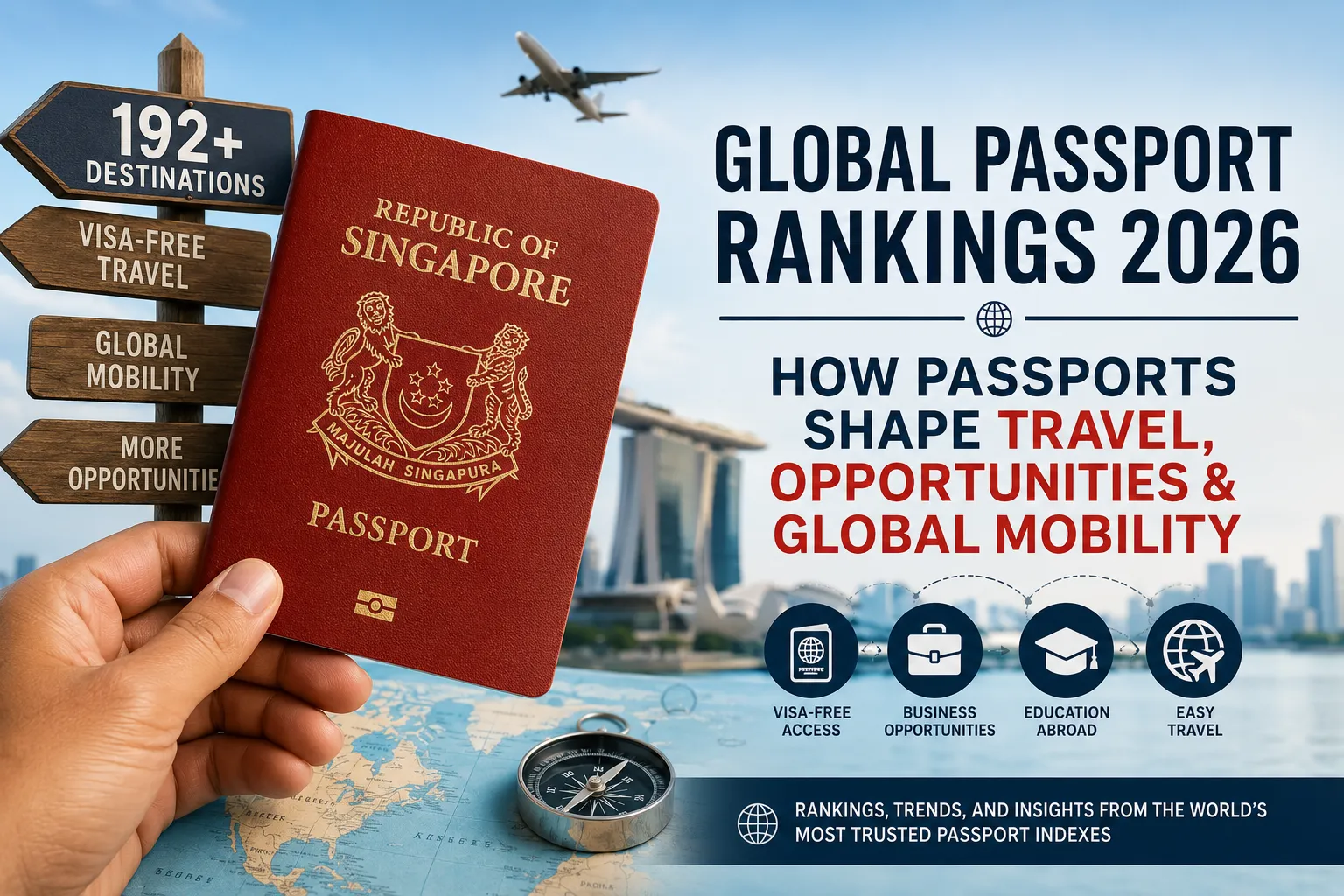

In 2026, Singapore's passport was ranked the most powerful globally, with visa-free access to over 190 destinations. It is also the second consecutive year that Singapore's passport is considered the Strongest passport in the world. On the other hand, Afghanistan ranks last, with the passport holders able to visit only 24 destinations without a prior visa. You must be wondering why there is such a drastic difference between 2 countries in terms of travel and global opportunities.
To know more, you can read the blog below to understand how a country's passport is deemed strongest while also learning your country's ranking on the Global Passport Rankings.
How is a passport deemed powerful?
A passport is more than just a travel document. It also carries the weight of a country's political, economic and diplomatic might. Based on the global index power ranking, a passport's power is defined mainly by the number of countries a passport holder can access without a visa.
The more destinations a passport can access without a visa, the higher it will rank on the Global Passport Rankings. The reverse is also true.
Given below are a few factors that impact the number of visa-free destinations a passport has:
- Diplomatic Relations
If a country has strong diplomatic ties or international trade relations with other countries, they are more likely to have promising visa policies for its citizens. This, in turn, increases the number of visa-free travel destinations.
- Economic Factors
Countries with a stable economy and a high GDP are said to present a lower risk of overstaying. Hence, more countries are willing to allow their citizens visa-free access to their country.
What is a Global Passport Power Rank?
The Global Passport Index usually ranks passports based on the number of countries passport holders can visit visa-free and the diplomatic reasons. A few indices also consider the desirability of each country's accessible destinations for economic mobility, investment and quality of life.
- A country's passport rank denotes the ease or difficulty of global mobility and international trade for its citizens.
- The citizens of countries with powerful passports enjoy a simplified means of travel for short-term business, tourism, education or work.
- Processing long-term resident visas is easy for citizens of countries with powerful passports. This is because consular and immigration authorities often consider passport strength when assessing visa applications.
- Applicants from low-ranking countries may face stricter scrutiny, more documentation requirements and lower visa approval rates.
- Countries will climb up the rankings as they gain access to more destinations and strengthen diplomatic influence. The reverse is also true.
What are the most popular Global Passport Rankings firms?
There are several investments, global mobility and immigration firms that publish passport rankings. However, two firms are considered popular for Global Passport Rankings.
These are:
- Henley Passport Index
- Arton Capital Passport Index
The most used between the two is the Henley Passport Index, which is also one of the oldest. It releases quarterly global rankings, while Arton uses data from individual governments' portals to rank passports in real time all year-round.
What is the Henley Passport Index?
The Henley Passport Index was launched by Henley Global Partners in 2005 as Henley and Partners' Visa Index, but was renamed Henley Passport Index in 2018. It ranks passports based on the number of destinations their holders can access without a prior entry permit or visa.
- This index uses data from the International Air Transport Association (IATA), which is the largest travel information database.
- It evaluates 199 passports against 227 destinations and ranks them based on the number of destinations each passport can access without a visa.
- This index is updated monthly and is used as one of the primary reference tools for assessing the ranks of other countries.
- Henley Global combines the index data with the World Bank GDP data to get the Henley Passport Power (HPP), which is the percentage of global GDP a passport grants its holder visa-free access to.
History of Passport Power Rankings
The strength of a passport changes over time in terms of visa-free and visa-on-arrival access. These changes are due to shifts in global diplomacy and geopolitical alliances.
- In the early days of passport rankings, the US, UK, and European countries held the first spot due to their strong diplomatic influence and economic strength.
- The US and UK together held the first rank as the most powerful passports in 2014, while the UK ranked number one in 2015.
- Asian countries like Japan, Singapore and South Korea have begun to climb the rankings since 2010 after strengthening their economies.
- By the late 2010s, Japan had occupied the top spot on the Henley Passport Index multiple times.
- Asian countries are continuing to reach the top in the 2020s. Singapore reached the number one spot for the first time in 2019. It held the spot again in 2024 through 2025.
- South American countries have also improved their rankings through regional agreements and broader trade alliances.
What is the method of Passport Rankings?
The Henley Passport Index gets the official data from the International Air Transport Association (IATA). It monitors government portals and major news agencies for changes in visa policies.
To calculate scores for the Index:
- Only normal passports are evaluated. Diplomatic, emergency and temporary passports do not count towards this.
- Visa-free means that a country's passport holder can travel to a destination without a visa.
- Destinations that require an ETA (Electronic Travel Authorisation) or that grant a visa-on-arrival are also considered visa-free destinations.
- A passport holder must spend at least 3 days in the destination and not simply transit through.
- The passport holders must be adult citizens of each country travelling alone and not as part of a tourist group.
What are the Top 10 Most Powerful Passports in 2026?
The Points below highlight the global passport rankings of the top 10 countries for 2026.
- Rank 1: Singapore — Visa-free score: 192
- Rank 2: Japan and South Korea — Visa-free score: 188
- Rank 3: Denmark, Luxembourg, Spain, Sweden, and Switzerland — Visa-free score: 186
- Rank 4: Austria, Belgium, Finland, France, Germany, Greece, Ireland, Italy, Norway, and the Netherlands — Visa-free score: 185
- Rank 5: Hungary, Portugal, Slovakia, Slovenia, and the United Arab Emirates — Visa-free score: 184
- Rank 6: Croatia, Czech Republic, Estonia, Malta, New Zealand, and Poland — Visa-free score: 183
- Rank 7: Australia, Latvia, Liechtenstein, and the United Kingdom — Visa-free score: 182
- Rank 8: Canada, Iceland, and Lithuania — Visa-free score: 181
- Rank 9: Malaysia — Visa-free score: 180
- Rank 10: United States — Visa-free score: 179
What is the importance of Passport Rankings for Immigration and Global Mobility?
Your passport's global mobility ranking determines how easily you can travel and access global opportunities. The stronger the passport is, the easier your access to international work, business and educational opportunities is. If your passport is weak, you will face difficulties in accessing these opportunities.
- Citizens of countries with low-ranking passports often go through strict procedures to obtain visas to visit countries for only three days. It also has low approval rates.
- This process is even more difficult when applying for long-term visas since they may face further scrutiny during the application process.
- If you are a citizen of a country with limited global mobility, you can enhance your access to global opportunities by obtaining another citizenship in a country with a stronger passport.
- You can do this by getting an employment offer in your desired destination, through family sponsorship, provided you have a close family member in the destination country.
- Another way is through citizenship or residency by means of an investment program. This is the quickest way to obtain a second citizenship.
- Since it is designed for high-net-worth individuals, it is very expensive.
- Family sponsorship is a comparatively easy route. However, this only applies to those individuals having close family members with permanent residence status or citizenship in the country.
- In most cases, the work visa to permanent residency to naturalisation route is the best way to get citizenship.
- Even though this is slower and has strict eligibility requirements, it is available to everyone having skills and qualifications, regardless of their net worth or family ties.
For Indian citizens planning to travel, study or work abroad, having a valid passport is essential. You can apply for an Indian passport online to begin your international journey.
Conclusion
In today's world, the strength of a passport goes far beyond being a means of identity or a travel document. Nowadays, it reflects a country's global influence, diplomatic relationships, economic stability and international trust. The most powerful passports in the world are a means of great business opportunities, education and tourism across continents. Even though the rankings may change over time but a strong passport will always offer unmatched convenience and mobility.



























Sign in to leave a comment.