

Are you an international student moving to Australia for your education? While you might be excited about your new adventure, there are a few challenges that you should be aware of prior to arrival. However, with the right study tips and strategies, you will feel confident in your ability to succeed in your education in Australia.
Australia attracts hundreds of thousands of international students from countries like India, China, Nepal, Vietnam, and Bangladesh. Australian universities encourage students to think independently and find solutions to problems rather than just memorizing information.
This article provides practical advice and actionable insights to help you study smarter and make the most of your university experience in Australia.
Why Studying in Australia Is Different
When international students arrive in Australia, they are often surprised by the structural differences between Australian universities and the educational systems in their home countries.

Where many schools rely solely on end-of-year exams to test knowledge, Australian universities use continuous assessment throughout the semester, evaluating students through:
- Assignments and essays
- Research reports
- Group projects and presentations
- Quizzes and lab practicals
- Final examinations
Lecturers and tutors expect students to think independently and participate actively in classroom discussions. All ideas must be supported by evidence from peer-reviewed research and presented in strict accordance with referencing rules and submission deadlines.
While these requirements may seem challenging at first, they allow students to acquire practical, critical-thinking skills highly valued by global employers.
Prepare Before Your Semester Starts
A successful semester begins before your official classes start. Proper advance preparation ensures a smooth transition into Australian university life.
Understand Your Course Structure
Log into your university’s Learning Management System (LMS)—such as Canvas, Moodle, or Blackboard—at least a week before orientation.
Within the portal, review:
- Unit outlines and course syllabi
- Assessment schedules and weighting
- Assignment submission deadlines
- Recommended textbooks and reading lists
- Assessment marking rubrics
Create a digital calendar connected to your primary device and input all key assessment deadlines immediately.
Example Workflow for a 2,000-Word Essay:
- Week 3: Research topic and gather peer-reviewed academic sources.
- Week 4: Create a structured outline and begin writing the initial draft.
- Week 5: Complete the draft, then edit and proofread thoroughly.
- Week 6: Run your paper through Turnitin to verify originality and submit before the deadline.
Learn the Australian Education System
In Australian universities, lecturers do not simply provide answers to exam questions. Instead, academics act as facilitators who teach you how to analyze and discover solutions independently. Tutors expect you to:
- Read all assigned texts prior to attending lectures.
- Contribute your personal perspectives during tutorial discussions.
- Perform independent library research beyond the provided lecture slides.
- Take full responsibility for managing your daily study schedule.
Study Tips Every International Student Should Follow
In Australia, trying to cram the night before an exam rarely yields good results. Developing consistent, daily study habits is the most reliable path to long-term academic achievement.
Create a Weekly Study Plan
Maintaining a structured schedule keeps you organized and prevents multiple assignment deadlines from overwhelming you at once.
| Activity | Suggested Time Commitment |
| Lectures & Tutorials | As scheduled on your official course timetable |
| Lecture Review | 30–45 minutes following each class |
| Assignment Preparation | 1–2 hours daily (research and drafting) |
| Assigned Readings | 30–60 minutes daily |
| Weekly Revisions | 2–3 hours on weekends |
| Rest & Recreation | Scheduled daily breaks for balance |
Study Every Day Instead of Cramming
Waiting until the week before exams creates unnecessary stress and hinders long-term information retention. To build deep understanding:
- Review daily: Go over today’s lecture notes on the day they are delivered.
- Revise weekly: Set aside 30–60 minutes each week to review topics covered across all units.
- Self-Test: Practice recalling lecture concepts without looking at your notes.
- Prepare early: Complete assigned tutorial exercises before attending class.
Use Active Learning Techniques
Passive reading is an inefficient way to study. Engage directly with your course material using these proven strategies:
- The Feynman Technique: Explain complex concepts in plain language as if teaching a beginner.
- Active Recall: Cover your materials and write down everything you can remember about a topic from memory.
- Spaced Repetition: Use flashcards to review concepts at increasing time intervals (e.g., after 1 day, 3 days, 1 week, 1 month).
- Mind Mapping: Draw visual diagrams to link core concepts, theories, and examples.
Take Better Notes
Avoid attempting to transcribe every word your lecturer says. Focus on capturing main ideas and analytical frameworks:
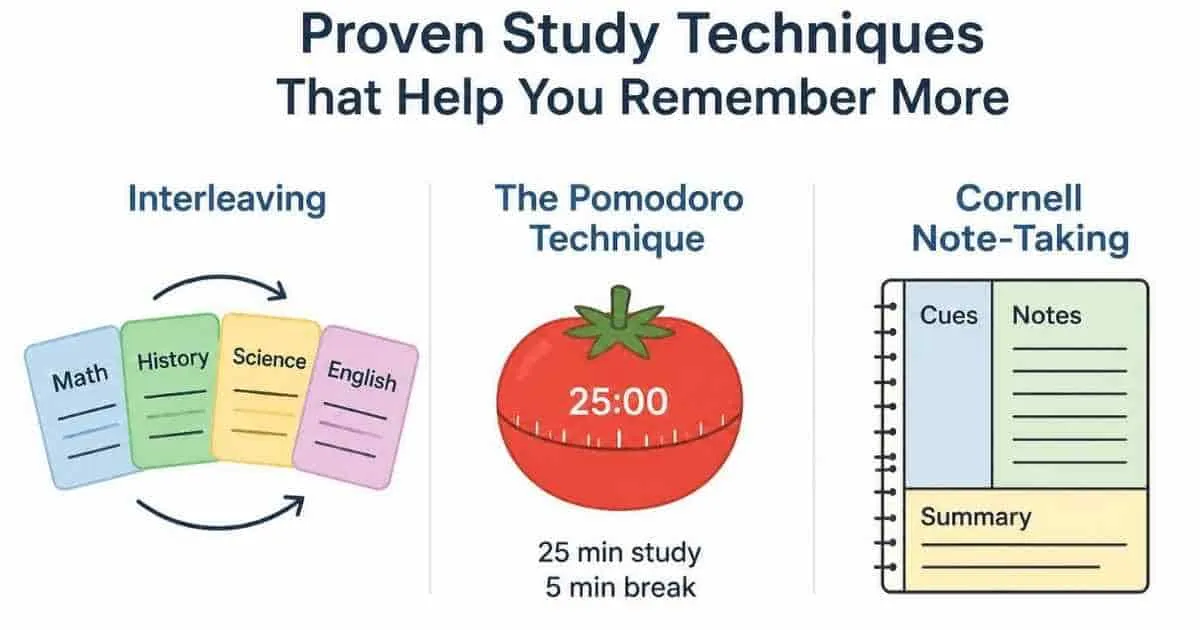
- The Cornell Method: Divide your page into three sections: main class notes, key cues/questions, and a 2-sentence summary at the bottom.
- Digital Organization: Use tools like Microsoft OneNote or Notion to store notes categorized by unit and semester, making keywords easily searchable during exam prep.
Improve Your English Every Week
Strong language skills allow you to read research papers faster and write academic essays more efficiently:
- Read one peer-reviewed journal article or academic abstract every day.
- Note down 5 unfamiliar academic words daily and practice using them in sentences.
- Converse in English regularly with domestic students and peers.
- Take advantage of free academic English workshops offered by your university.
Ask Questions During Class
Asking questions during lectures and tutorials demonstrates active engagement with your coursework. If a concept is unclear:
- Raise your hand during tutorials.
- Speak to your lecturer or tutor immediately after class.
- Attend your professor’s scheduled consultation hours.
- Post your query on your unit’s official LMS discussion forum.
Build Good Relationships with Classmates
Studying with peers offers both academic and social support. Join university clubs, societies, or unit-specific study groups to discuss coursework, share perspectives, and build lasting professional networks.
Master Assignment Writing in Australia
Assignments typically account for 60% to 100% of your total unit grade in Australia. Mastering academic writing standards is critical for high performance.
Understand Assessment Rubrics
Always review the assignment rubric before writing your first draft. The rubric outlines the specific expectations of your marker, including:
- Formatting specifications and strict word counts
- Required depth of critical analysis
- Number and type of academic sources needed
- Designated referencing style (e.g., APA 7th, Harvard, IEEE, Chicago)
Research Before Writing
Base all academic arguments on credible, high-authority sources:
- University Library Portals: Search academic databases for peer-reviewed journal articles.
- Google Scholar: Look for verified books, studies, and scholarly papers.
- Official Reports: Utilize government databases (such as the Australian Bureau of Statistics) for empirical data.
Note: Do not cite commercial blogs, opinion forums, social media, or Wikipedia in academic assignments.
Plan Before You Write
Establish a clear structural outline before drafting your paper:
Plaintext
- Introduction (10% of total word count)
├── Background context
├── Clear thesis statement
└── Main arguments outline
- Body Paragraphs (80% of total word count)
├── Topic sentence (core argument)
├── Critical analysis & explanation
├── Academic evidence / Literature citations
└── Concluding or linking sentence
- Conclusion (10% of total word count)
├── Restatement of thesis
├── Summary of key findings
└── Concluding thought (no new information introduced)
Learn Referencing Early
Australian universities maintain strict referencing standards across all disciplines:
- In-text Citations: Include correct citations for every idea, quote, or statistic paraphrased from outside sources.
- Reference List: Append a full bibliographic reference list at the end of your assignment.
- Citation Management: Use software like Zotero or Mendeley to automatically organize references and generate citations.
Understand Academic Integrity
Academic integrity requires you to complete all work honestly. Australian higher education institutions use detection software like Turnitin to identify instances of plagiarism, collusion, or improper sourcing.
- Always express arguments and ideas in your own words.
- Cite every quote, idea, or dataset that is not your original work.
- Never submit work completed by another individual or unauthorized service.
Use AI Tools Responsibly
Artificial Intelligence tools can assist your learning workflow when used ethically and according to university guidelines.
- Permitted Uses: Brainstorming broad essay topics, generating practice exam questions, summarizing dense research papers, and checking basic grammar.
- Prohibited Uses: Composing entire essays, copying AI-generated text directly into assignments, or fabricating academic references.
Always check your university’s specific Generative AI policy prior to using these tools for marked coursework.
How to Balance Study, Part-Time Work, and Personal Life
Under the Australian Subclass 500 Student Visa, international students are permitted to work up to 48 hours per fortnight while their course is in session, with unlimited working hours allowed during official study breaks.
To maintain balance and prevent academic burnout:
- Track Work Hours: Carefully monitor your shifts to ensure full compliance with visa conditions.
- Prioritize Assessment Peaks: Request reduced work shifts or shift swaps during heavy assignment and exam weeks.
- Maintain Healthy Habits: Aim for 7–9 hours of sleep per night, eat balanced meals, and schedule regular physical activity.
Best Productivity Tools for Students
Leverage modern digital tools to streamline your daily workflow:
| Tool | Primary Purpose |
| Google Calendar | Scheduling lectures, tutorials, deadlines, and work shifts |
| Notion | Mapping out degree plans, project notes, and assignment progress |
| Microsoft OneNote | Free digital note-taking categorized by unit and subject |
| Grammarly | Editing sentence structure, clarity, and basic grammar |
| Zotero / Mendeley | Storing academic research and automating bibliographies |
| Forest | Gamified focus timer to reduce smartphone distractions while studying |
| Todoist | Managing daily task lists and study goals |
Common Mistakes International Students Should Avoid
Steer clear of these frequent errors to stay on track throughout your studies:
- Leaving Assignments to the Last Minute: Late starts lead to rushed research, poor referencing, and lower marks.
- Skipping Tutorials: While lectures provide theoretical background, tutorials focus on practical application and critical analysis.
- Ignoring Tutor Feedback: Always review feedback on returned papers to learn where you lost marks and how to improve future submissions.
- Isolating Yourself: Waiting until you are failing before seeking help causes unnecessary hardship. Reach out to student support services early.
- Relying on Unverified External Templates: Using unauthorized external templates or services can lead to severe academic integrity breaches.
Sample Weekly Study Routine
A consistent weekly routine eliminates the need for emergency exam cramming:
| Day | Primary Focus | Key Activity |
| Monday | Planning & Organization | Review upcoming deadlines, arrange your study schedule, and organize lecture slides. |
| Tuesday | Research & Reading | Search the university library portal for assignment sources and complete unit readings. |
| Wednesday | Application & Tutorials | Attend scheduled classes, take structured notes, and ask tutors clarifying questions. |
| Thursday | Assignment Drafting | Spend 1–2 hours writing body paragraphs for upcoming research papers. |
| Friday | Review & Active Recall | Self-test on the week’s concepts and complete designated tutorial exercises. |
| Saturday | Deep Study & Revisions | Work on complex tasks and participate in group study sessions. |
| Sunday | Planning & Rest | Review weekly progress, update your schedule for the next week, and rest. |
Pre-Submission Checklist for Assignments
Complete this final check before submitting any assignment:
- [ ] Does your paper fully answer every component of the assignment prompt?
- [ ] Have you met all criteria specified in the assessment rubric?
- [ ] Is your assignment within $\pm 10\%$ of the required word count?
- [ ] Are all cited sources peer-reviewed, academic, and current?
- [ ] Do all in-text citations follow your unit’s required referencing style?
- [ ] Does your reference list contain every source cited in the body text?
- [ ] Have you run your paper through a grammar and spell checker?
- [ ] Is the document file named correctly according to unit instructions?
- [ ] Have you saved a secure backup copy to your cloud storage (e.g., OneDrive, Google Drive)?
When Should You Get Academic Support?
Seeking academic assistance from university staff is a normal part of tertiary education. Reach out for support if:
- You require clarification regarding an assessment prompt or rubric.
- You have multiple major deadlines falling within the same week.
- You need guidance on academic writing structure or referencing conventions.
- Language barriers make expressing complex critical analysis difficult.
Most Australian universities offer free support via Academic Skills Units, Library Consultations, and Writing Labs. If you utilize any external study resources, ensure they strictly adhere to your university’s academic integrity policies.
Frequently Asked Questions
How many hours should international students study each day?
On average, university students spend 2 to 4 hours of independent study outside of class for every hour spent in lectures or tutorials. The total required time varies depending on course complexity and assessment schedules.
How can I quickly adjust to the Australian accent and classroom style?
Listen to local news channels or podcasts (such as ABC News Australia), watch educational media with captions enabled, and participate actively in tutorial sessions. Do not hesitate to ask tutors or lecturers to clarify points when necessary.
How do I balance part-time work with heavy assessment weeks?
Inform your employer about your assessment schedule well in advance. Request reduced working hours or shift swaps during peak assessment weeks (typically Weeks 6–7 and 11–12) and final examination periods.
What happens if I accidentally plagiarize in an assignment?
Unintentional referencing mistakes can lead to mark deductions, a requirement to resubmit, or failing the assessment depending on severity. Using your university’s draft Turnitin portals to verify your citations prior to official submission helps avoid these issues.
Final Thoughts
Studying at an Australian university offers an enriching path to world-class qualifications and personal growth. Success relies on establishing strong daily routines: planning your workload early, actively participating in classes, mastering proper referencing, utilizing helpful digital tools, and maintaining your personal health. Leverage available campus support services whenever needed to maximize your educational journey in Australia.


























Sign in to leave a comment.