
In today’s data-driven business world, organizations rely heavily on business intelligence (BI) tools to make informed decisions. One such tool that has gained immense popularity is Tableau. Whether a business is in retail, healthcare, finance, or any other sector, Tableau's powerful data visualization and analytics capabilities can transform raw data into actionable insights. However, to maximize Tableau’s potential, many organizations seek Tableau Consulting Services to get the most value from their investment.
This article aims to provide decision-makers with a comprehensive technical guide on Tableau Consulting. We’ll explore why these services are essential, what they include, and how businesses can benefit from professional expertise in Tableau implementation and customization.
What Are Tableau Consulting Services?
Tableau Consulting Services encompass a wide range of professional services designed to help organizations optimize their use of Tableau software. These services are typically provided by consulting firms or independent experts with deep knowledge of Tableau’s features and capabilities.
Consultants help businesses implement Tableau, integrate it with various data sources, create complex dashboards, and ensure that the tool aligns with the organization's specific needs and goals. They also assist with training internal teams, optimizing performance, and offering ongoing support.
Offerings of Table Key au Consulting Services
1. Tableau Implementation and Deployment
Consultants help businesses set up Tableau on their infrastructure or in the cloud. This includes installing the software, configuring servers, and connecting Tableau with data sources.
2. Custom Dashboard Development
A critical aspect of Tableau Consulting is creating dashboards tailored to the business’s unique requirements. Consultants work with stakeholders to understand their needs and design interactive and insightful visualizations.
3. Data Integration and ETL
One of the most powerful aspects of Tableau is its ability to integrate with various data sources. Tableau Consultants help connect Tableau with data warehouses, relational databases, spreadsheets, and cloud-based platforms, ensuring seamless data flow.
4. Performance Optimization
Tableau’s performance can be influenced by data size, server configuration, and dashboard complexity. Consultants analyze performance issues and provide solutions to optimize speed and usability.
5. Training and Knowledge Transfer
Consultants don’t just implement solutions—they also train teams to use Tableau effectively. Training sessions may focus on basic functionalities, advanced features, and best practices for data analysis and visualization.
6. Ongoing Support and Maintenance
After the initial setup, businesses often require ongoing support. Consultants provide maintenance services to ensure Tableau continues to perform at its best and evolves with the organization’s needs.
Why Businesses Need Tableau Consulting Services
Many organizations face significant challenges when it comes to utilizing Tableau to its full potential. While Tableau is user-friendly, it can be complex to master, especially when it comes to advanced features and integration. Here are a few reasons why companies turn to Tableau Consulting services:
1. Complex Data Environments
Organizations often deal with multiple data sources, including cloud-based platforms, on-premises databases, and spreadsheets. Integrating all these data sources into Tableau can be challenging. A Tableau consultant can streamline this process by ensuring data is properly formatted and ready for analysis.
2. Customized Dashboards for Specific Needs
Tableau's real power lies in its ability to create custom dashboards that answer business-specific questions. However, building these dashboards requires both technical expertise and an understanding of the business. Consultants can help create dashboards that are not just visually appealing but also informative and useful for decision-making.
3. Optimization and Scalability
Over time, data grows, and performance can degrade. Tableau consultants ensure that your infrastructure can scale as data volumes increase. They can also optimize dashboards and reports to load faster, improving the user experience and overall productivity.
4. Maximizing ROI on Tableau Investment
The initial cost of Tableau may seem high, especially for smaller organizations. However, with the help of consulting services, businesses can ensure they are using Tableau efficiently, thereby maximizing their return on investment (ROI).
5. Expertise and Industry Knowledge
Tableau consultants bring industry-specific knowledge and technical expertise that in-house teams may lack. By leveraging this expertise, businesses can quickly implement Tableau in ways that align with industry best practices.
How Tableau Consulting Works
1. Initial Assessment and Discovery
The first phase in a Tableau Consulting engagement typically involves an assessment of the business’s current data landscape. Consultants work closely with stakeholders to understand the data sources, key performance indicators (KPIs), and business goals.
During this phase, consultants may ask questions like:
- What are the primary business challenges you’re trying to solve with Tableau?
- What data sources do you have, and how is the data structured?
- Who are the primary users of Tableau, and what kind of reports or dashboards do they need?
2. Tableau Architecture and Design
Once the business requirements are clear, consultants design a Tableau architecture that suits the organization’s needs. This may involve:
- Selecting between Tableau Server or Tableau Online for deployment.
- Designing an appropriate data model to ensure efficient reporting.
- Defining user access levels based on roles within the organization.
3. Dashboard Development
Consultants then move on to building custom dashboards. They ensure that these dashboards:
- Display relevant KPIs and metrics.
- Are interactive and easy to use.
- Align with the organization’s branding and design guidelines.
Consultants also focus on optimizing the performance of dashboards to ensure fast data loads, especially for larger datasets.
4. Integration and Testing
Next, Tableau consultants integrate the software with existing data sources and systems. This process includes:
- Connecting Tableau to various databases, APIs, or cloud platforms.
- Testing the integration for data accuracy and consistency.
- Ensuring that Tableau dashboards update in real-time or on a scheduled basis.
5. Training and Knowledge Transfer
Once the system is live, consultants typically conduct training sessions. These sessions may cover:
- Basic functionalities like creating basic charts and reports.
- Advanced features such as calculated fields, Tableau Prep, and Tableau Server administration.
- Best practices for creating effective visualizations and avoiding common pitfalls.
6. Ongoing Support and Maintenance
After deployment, Tableau consultants provide ongoing support to address any issues, implement updates, and help users troubleshoot. They may also assist with scaling Tableau as the business grows.
Key Benefits of Tableau Consulting Services
1. Enhanced Data Insights
With the right Tableau dashboards and reports, businesses can gain valuable insights into their data. Custom dashboards enable decision-makers to spot trends, monitor performance, and make informed decisions based on real-time data.
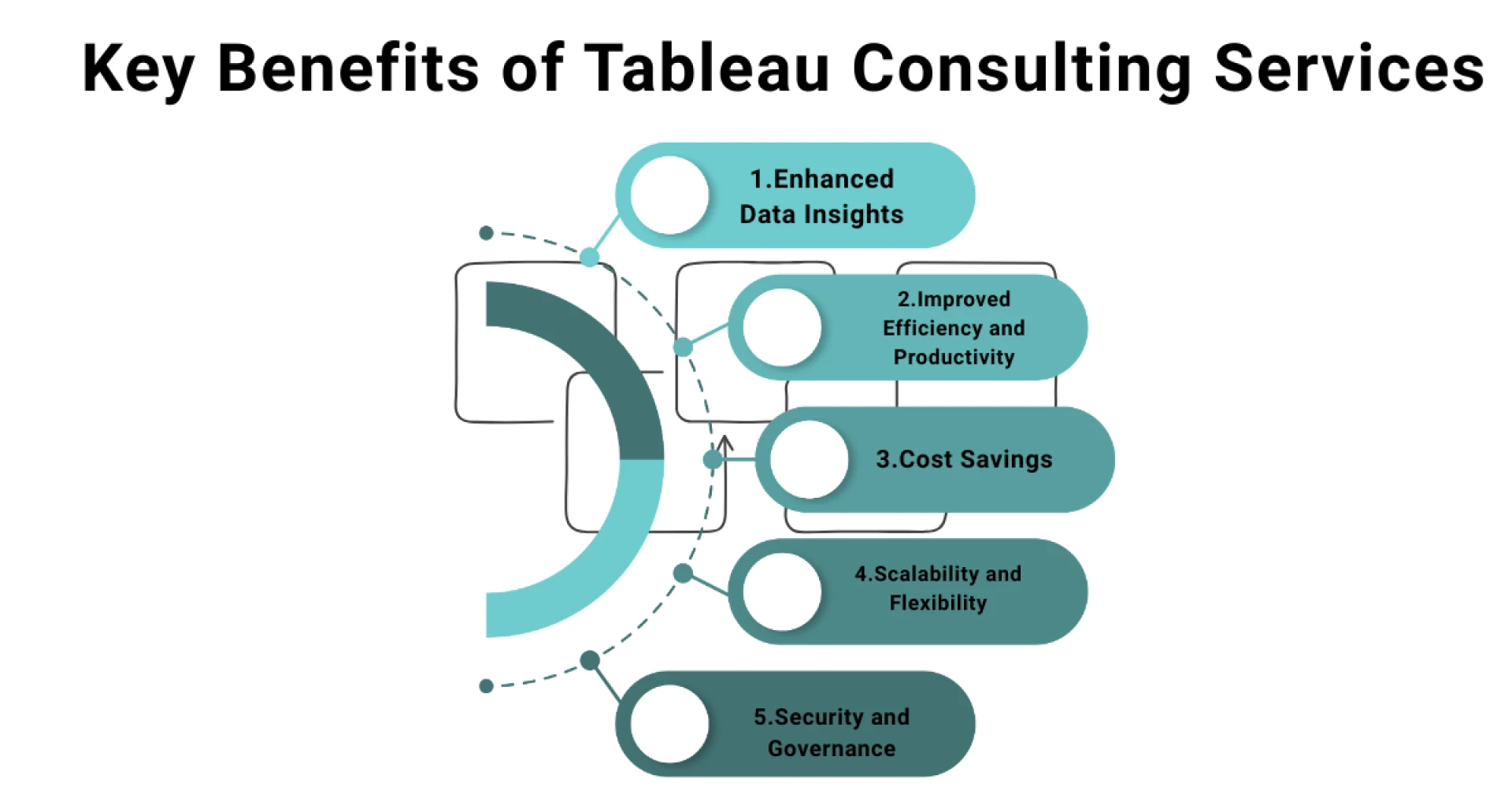
2. Improved Efficiency and Productivity
Tableau makes it easier to analyse large datasets and extract meaningful information. Consulting services ensure that your team can use Tableau effectively, resulting in faster decision-making and improved productivity.
3. Cost Savings
By working with experienced Tableau consultants, businesses can avoid the trial-and-error process of learning Tableau on their own. This helps reduce the time spent on troubleshooting and rework, leading to overall cost savings.
4. Scalability and Flexibility
As businesses grow, their data needs evolve. Tableau consultants help organizations scale their Tableau environment by optimizing data models, dashboards, and server configurations. This ensures that the tool remains effective even as data volumes increase.
5. Security and Governance
Consultants ensure that Tableau adheres to best practices in data security. This includes setting up proper access controls, ensuring data privacy, and maintaining compliance with regulations.
Tableau Consulting Statistics: A Snapshot of Its Impact
According to a 2023 survey by Gartner, over 40% of businesses worldwide use Tableau for data analytics and visualization, a figure that is steadily increasing. Among these businesses, 58% reported improved decision-making speed after adopting Tableau, while 52% cited enhanced data accessibility for non-technical staff.
In terms of ROI, Forrester Research found that Tableau users experienced an average return of $3.4 million per year after implementation, citing time savings, improved operational efficiency, and better decision-making as key drivers.
Conclusion
Investing in Tableau Consulting Services is a smart decision for businesses looking to leverage the full potential of Tableau’s data visualization and analytics capabilities. By working with expert consultants, organizations can ensure smooth implementation, customized dashboards, and optimized performance.
Whether you’re looking to improve data integration, design custom reports, or train your team on Tableau’s advanced features, Tableau Consulting can significantly improve the way your organization interacts with data. With the right guidance, businesses can make data-driven decisions faster, gain deeper insights, and ultimately achieve better business outcomes.






























Sign in to leave a comment.