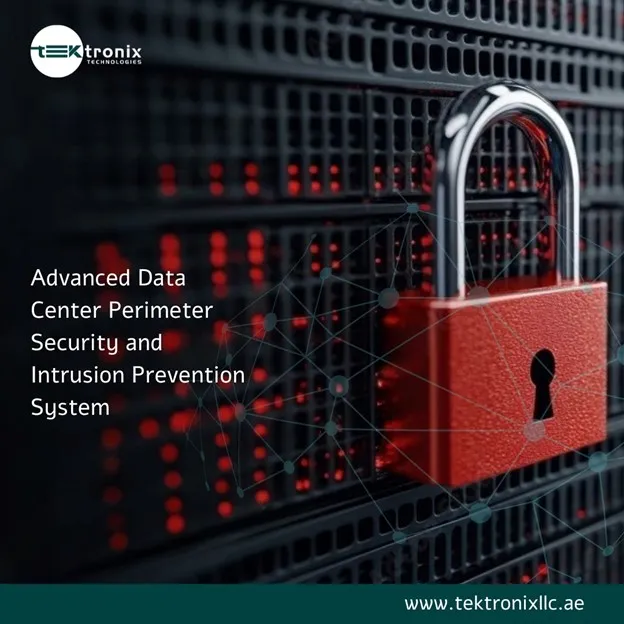

Data Center Security is the single most consequential investment a UAE enterprise can make in its technology infrastructure. Every gigabyte of financial data processed in a DIFC trading system, every patient record stored across a DHA-regulated hospital network, and every barrel-equivalent of production data flowing through an ADNOC upstream facility ultimately resides in — or transits through — a data centre. The physical and cyber integrity of that facility is therefore not merely an IT concern; it is a board-level business continuity imperative.
The UAE has emerged as the Middle East's pre-eminent digital infrastructure hub, hosting a dense concentration of Tier III and Tier IV carrier-neutral colocation facilities, hyperscaler points of presence, and private enterprise data halls. This concentration makes the region an increasingly attractive target for nation-state threat actors, ransomware syndicates, and insider threats simultaneously. Organisations that treat data centre protection as a checkbox exercise — rather than a continuously evolving, layered discipline — are one breach away from regulatory sanction, reputational collapse, and operational paralysis.
Tektronix LLC designs and deploys tailored, end-to-end data centre protection frameworks that address every threat vector — from the perimeter fence to the hypervisor layer. This guide outlines the architecture, technologies, and regional compliance considerations that define best-in-class data centre defence for UAE enterprises in 2025 and beyond.
1. The UAE Data Centre Threat Landscape: What You Are Actually Defending Against
Effective Data Center Threat Detection begins with a clear-eyed understanding of the adversary. UAE data centres face a threat matrix that is simultaneously broader and more sophisticated than almost anywhere else in the world, shaped by the country's geopolitical position, its role as a global financial gateway, and the sheer density of high-value data concentrated within its borders.
The primary threat categories confronting UAE data centre operators include:
- Advanced Persistent Threats (APTs): State-sponsored actors conducting long-dwell reconnaissance against government, energy, and financial sector targets
- Ransomware-as-a-Service (RaaS) syndicates: Encrypting production workloads and demanding cryptocurrency ransoms, with average demand values in the Gulf region exceeding USD 4.5 million per incident
- Supply chain infiltration: Compromising hardware or software components upstream of installation to establish covert persistence
- Insider threats: Privileged employees, contractors, or third-party maintenance engineers exploiting physical or logical access
- Physical intrusion: Targeted theft of storage media, hardware implantation, or sabotage of cooling and power infrastructure
- DDoS amplification attacks: Exploiting UAE's high-bandwidth transit capacity to overwhelm internet-facing services
A detection framework that cannot identify and respond to all six categories simultaneously provides only a false sense of security.
2. Data Center Firewalls: The First and Most Critical Line of Cyber Defence
Modern Data Center Firewalls bear little resemblance to the stateful packet inspection engines that defined network security a decade ago. Today's enterprise-grade platforms combine next-generation firewall (NGFW) capabilities — deep packet inspection, application-layer visibility, TLS/SSL decryption, and user-identity awareness — with AI-driven threat intelligence feeds that update threat signatures in near-real-time.
2.1 North-South and East-West Traffic Segmentation
The most sophisticated breaches of recent years — including the attacks targeting Gulf Cooperation Council (GCC) critical infrastructure — exploited the relative flatness of internal data centre networks. Once a threat actor compromised a single endpoint, lateral movement across the east-west traffic plane was largely unimpeded. Tektronix LLC designs firewall architectures that enforce micro-segmentation between every workload tier: web, application, database, management, and storage — ensuring that a compromise in one zone cannot cascade to another.
2.2 Distributed Denial of Service Mitigation
UAE data centres hosting internet-facing services must integrate purpose-built DDoS mitigation platforms — either on-premise scrubbing appliances or upstream cloud-based mitigation services — capable of absorbing volumetric attacks measured in terabits per second. Integration with UAE-based Internet Exchange Points (UAE-IX) scrubbing infrastructure adds a layer of domestic traffic cleaning that reduces latency impact during active mitigation events.
2.3 Zero-Trust Network Architecture
The zero-trust model — 'never trust, always verify' — is rapidly becoming the mandatory architecture framework for UAE government and regulated-sector data centres. Under zero-trust principles, every connection request, whether from an internal server, a remote administrator, or a third-party service, is authenticated, authorised, and encrypted regardless of its network origin. Tektronix LLC implements zero-trust frameworks aligned with NIST SP 800-207 and the UAE National Cybersecurity Strategy guidance issued by the UAE Cybersecurity Council.
3. Data Center Encryption: Protecting Data at Rest, in Transit, and in Use
Data Center Encryption is the foundational control that renders stolen data operationally useless to an adversary. A comprehensive encryption strategy must address three distinct data states, each requiring different technologies and key management disciplines.
3.1 Encryption at Rest
All storage media — SAN/NAS arrays, backup tapes, and decommissioned drives — must be protected with AES-256 encryption managed through a Hardware Security Module (HSM). For UAE government and financial sector facilities, HSMs must be FIPS 140-2 Level 3 or Level 4 validated, a requirement explicitly referenced in the UAE Information Assurance Standards published by the UAE Cybersecurity Council. Tektronix LLC works with Thales, Entrust, and nCipher HSM platforms to deliver compliant key management architectures.
3.2 Encryption in Transit
All data traversing internal data centre networks — including storage replication traffic, management plane communications, and inter-application API calls — should be encrypted using TLS 1.3 or IPSec tunnels. Legacy TLS 1.0/1.1 and unencrypted protocols such as Telnet, FTP, and HTTP must be formally decommissioned, a requirement that routinely surfaces as a finding in UAE Central Bank (CBUAE) technology risk examinations and NESA compliance assessments.
3.3 Encryption in Use — Confidential Computing
The emerging frontier of confidential computing — using Intel TDX, AMD SEV-SNP, or ARM Confidential Compute Architecture to encrypt data while it is actively being processed in CPU memory — is gaining traction in UAE financial institutions and healthcare operators who need to protect sensitive workloads even from the hypervisor layer. Tektronix LLC's advisory team guides clients through confidential computing readiness assessments and pilot deployments.
4. Cybersecurity for Data Center: A Unified Defence-in-Depth Framework
True Cybersecurity for Data Center environments cannot be achieved through point products alone. It requires a coherent defence-in-depth architecture in which each layer compensates for the limitations of the layers above and below it. Tektronix LLC deploys a seven-layer framework aligned with the CIS Critical Security Controls v8 and the UAE National Cybersecurity Authority (NCA) Essential Cybersecurity Controls:
- Perimeter Security: NGFW, IPS/IDS, DDoS mitigation, and web application firewalls (WAF)
- Network Segmentation: Micro-segmentation, VLANs, and software-defined networking (SDN) policy enforcement
- Identity and Access Management: Privileged Access Management (PAM), multi-factor authentication (MFA), and just-in-time access provisioning
- Endpoint and Server Hardening: CIS benchmark-aligned OS hardening, EDR/XDR agent deployment, and patch management automation
- Data Protection: HSM-managed encryption, DLP policy enforcement, and secure backup with immutable storage
- Security Monitoring: SIEM correlation, UEBA, and a 24/7 Security Operations Centre (SOC) with sub-15-minute mean time to detect (MTTD)
- Incident Response: Pre-agreed playbooks, regular tabletop exercises, and documented recovery time objectives (RTOs) aligned with business continuity plans
5. Data Center Access Control: Governing Who Can Physically Enter Your Most Sensitive Spaces
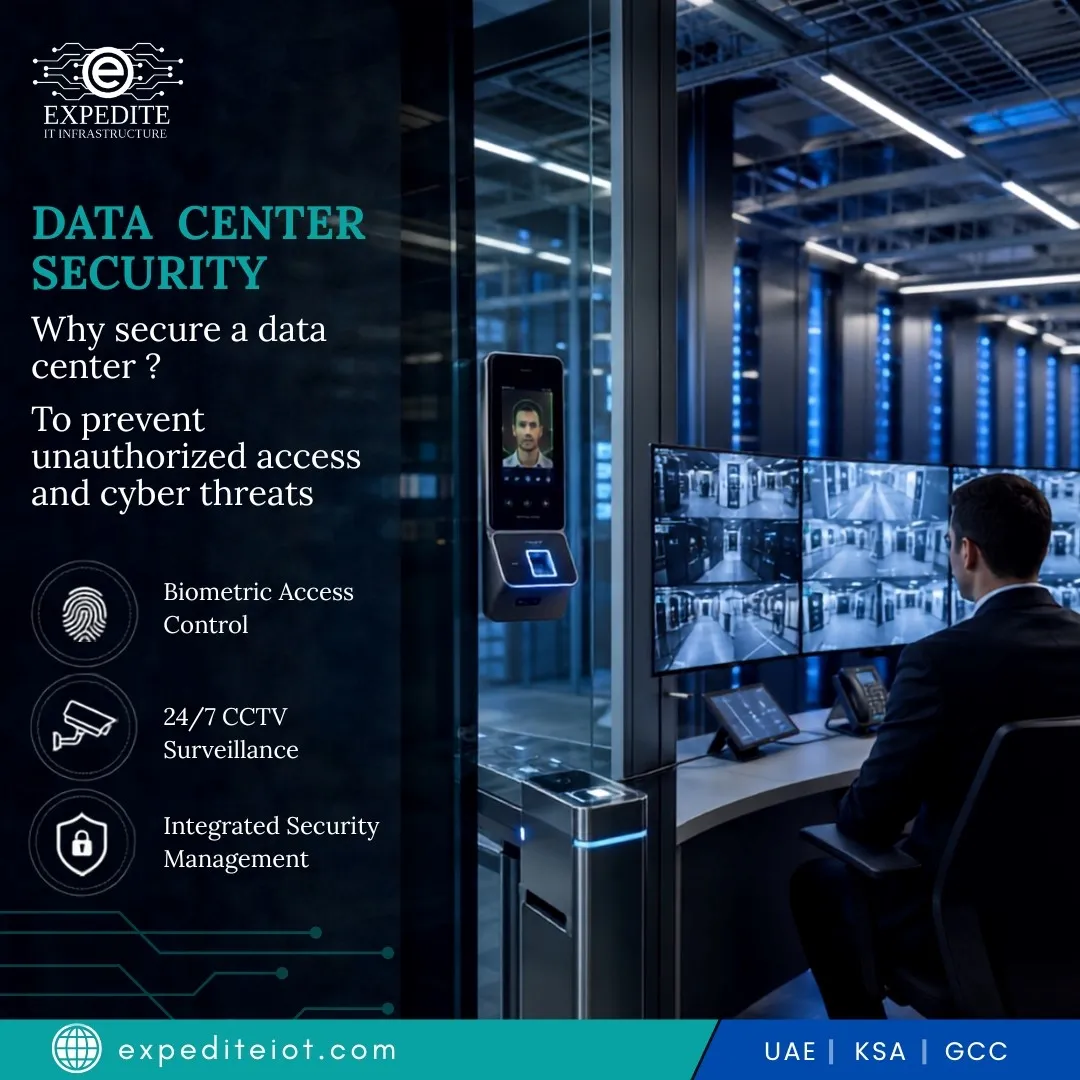
Physical Data Center Access Control is where cybersecurity and physical security converge. The most sophisticated cyber defences can be circumvented in minutes by a threat actor with uncontrolled physical access to server hardware, storage arrays, or network patch panels. Tektronix LLC designs multi-perimeter physical access architectures that enforce progressive security zones — from the building lobby to the individual server cage.
A best-practice data centre physical access architecture implements:
- Mantrap / airlock entry systems at primary access points to prevent tailgating
- Multi-factor authentication combining smart card credentials with biometric verification (fingerprint or facial recognition) for all secure zone entries
- Full-body turnstiles with weight sensors at computer room access points to detect simultaneous entry attempts
- Cabinet-level electronic locking with individual user authentication and event logging for colocation environments
- Continuous CCTV coverage with AI-based video analytics detecting loitering, mask-wearing anomalies, and after-hours movement
- Visitor and contractor management integration requiring escorted access and real-time host approval
All physical access events are fed into the centralised SIEM platform, creating a unified audit trail that correlates physical presence with logical system access — a critical capability for detecting insider threats and supporting post-incident forensic investigations.
6. Data Center Security UAE: National Compliance and Regulatory Framework
Operating a data centre in the UAE means navigating a multi-layered compliance landscape. Data Center Security UAE-wide requirements are governed by a combination of federal legislation, emirate-level authority mandates, and sector-specific regulatory frameworks:
- UAE Cybersecurity Law (Federal Decree-Law No. 34 of 2021): Establishes baseline cybersecurity obligations for critical information infrastructure operators
- UAE Personal Data Protection Law (PDPL — Federal Decree-Law No. 45 of 2021): Governs data processing, residency, and breach notification for facilities handling personal data
- CBUAE Cyber Risk Management Framework: Prescribes specific security architecture and incident response requirements for licensed financial institutions
- NESA UAE Information Assurance Standards: Comprehensive controls framework applicable to government and strategic sector data centres
- Dubai Electronic Security Centre (DESC) Cloud and Data Classification Standards: Applies to all Dubai government entities and their hosting providers
- Abu Dhabi Digital Authority (ADDA) ICT Security Policy: Governs Abu Dhabi government entity data centre security posture
Tektronix LLC's compliance advisory practice maps client environments against all applicable frameworks, identifies control gaps, and delivers a prioritised remediation roadmap — ensuring that security investments simultaneously satisfy operational requirements and regulatory obligations.
7. Data Center Security Dubai: The Middle East's Digital Capital
Dubai hosts the highest concentration of Tier III and Tier IV data centre capacity in the Arab world, with facilities operated by du, Etisalat (e&), Khazna, Gulf Data Hub, and multiple hyperscaler edge nodes. Data Center Security Dubai deployments must therefore address not only the technical requirements of individual facilities but also the interconnection security implications of operating within this dense peering ecosystem.
Dubai Internet City, Dubai Silicon Oasis, and the DIFC financial district each impose additional security baseline requirements on data centre operators and tenants within their jurisdiction. Tektronix LLC maintains current certifications and familiarity with all three free-zone authority security frameworks, enabling clients to achieve and maintain compliance without engaging multiple separate consultants.
High-profile data centre deployments by Dubai Future Foundation-affiliated entities and Smart Dubai initiative programs have further elevated the security baseline expectation, with AI-driven threat detection, automated compliance reporting, and zero-trust network architectures now considered standard rather than advanced features.
8. Data Center Security Abu Dhabi: Sovereign Resilience for the Capital's Critical Infrastructure
Abu Dhabi's data centre ecosystem is characterised by its strategic importance to the UAE's sovereign digital infrastructure. Data Center Security Abu Dhabi requirements are among the most stringent in the region, reflecting the concentration of federal government systems, sovereign wealth fund operations, energy sector control networks, and defence-adjacent workloads hosted within the emirate.
Key Abu Dhabi-specific security considerations include sovereign cloud data residency mandates (requiring that certain data classifications never leave UAE territory), integration with the Abu Dhabi Government's centralised Security Operations Centre, and compliance with ADNOC's Cyber Security Framework for upstream and downstream operational technology environments. Tektronix LLC has developed a standardised Abu Dhabi data centre security deployment framework that addresses all three dimensions and has been validated against ADDA ICT Security Policy requirements.
9. Data Center Security Sharjah: Protecting the Northern Emirates' Growing Digital Economy
Sharjah's emergence as a technology and innovation hub — anchored by Sharjah Research Technology and Innovation Park (SRTIP) and the Sharjah Publishing City free zone — is driving rapid growth in enterprise data centre demand across the emirate. Data Center Security Sharjah deployments serve a diverse client base spanning manufacturing, logistics, education, and government entities that are migrating workloads from on-premise server rooms to purpose-built colocation and private cloud environments.
The Northern Emirates more broadly — including Ajman, Ras Al Khaimah, Fujairah, and Umm Al Quwain — are benefiting from UAE Vision 2031 digital infrastructure investments that are expanding data centre capacity beyond the traditional Dubai-Abu Dhabi corridor. Tektronix LLC maintains a regional presence and project delivery capability across all seven emirates, ensuring that organisations in the Northern Emirates receive the same enterprise-grade security architecture and post-deployment support as flagship capital and emirate projects.
10. Why Tektronix LLC Is the UAE's Trusted Data Centre Security Partner
Tektronix LLC is a UAE-registered systems integrator and security consultancy with over a decade of documented expertise in designing, deploying, and managing physical and cybersecurity solutions for enterprise data centre environments. Our experience and authority credentials in this domain include:
- Certified security architects holding CISSP, CISM, CEH, and vendor-specific credentials from Palo Alto Networks, Fortinet, Cisco, and Thales
- Track record of successfully delivering data centre security projects for clients in BFSI, government, oil and gas, healthcare, and telecommunications verticals across the UAE
- Compliance advisory capability covering NESA, CBUAE, DESC, ADDA, UAE PDPL, and ISO 27001/IEC 27002 frameworks
- 24/7 managed security service (MSSP) capability with UAE-based Security Operations Centre staffed by bilingual (Arabic/English) analysts
- Physical security integration expertise spanning access control, CCTV, perimeter intrusion detection, and environmental monitoring — all converged with cyber defence platforms
Conclusion
The stakes of inadequate Data Center Security have never been higher for UAE enterprises. As the region's digital economy expands, its data centres attract a commensurate increase in threat actor attention — from ransomware operators targeting financial gain to sophisticated state-sponsored actors pursuing strategic intelligence. The organisations that will emerge from this threat environment unscathed are those that treat data centre protection not as a project with a completion date, but as a continuously evolving programme aligned with the threat landscape, the regulatory environment, and the operational realities of their specific industry.
From next-generation firewalls and encryption key management to physical access control and 24/7 SOC monitoring, every layer of a well-designed data centre security architecture plays an indispensable role. Cutting corners on any single layer creates the vulnerability that an adversary will inevitably find and exploit. The question for UAE decision-makers is not whether to invest in comprehensive data centre protection — it is whether to act before or after a breach forces the decision.
Tektronix LLC stands ready to be the trusted partner that guides UAE enterprises from wherever they are today to the resilient, compliant, and continuously monitored posture their business demands. The conversation starts with an honest assessment — reach out to begin yours.
FAQs
Q1. What is the difference between physical and cyber data centre security, and do I need both?
Physical data centre security governs who can physically enter the facility and interact with hardware — covering perimeter fencing, access control, CCTV, and environmental monitoring. Cyber security governs who can access data and systems through logical means — covering firewalls, encryption, identity management, and threat detection. Both disciplines are inseparable: a perfect cyber architecture can be defeated by uncontrolled physical access, and impenetrable physical security cannot prevent a remote ransomware attack. UAE enterprises require an integrated approach that treats the two as a single converged discipline.
Q2. Which UAE regulatory frameworks apply to my data centre security programme?
The applicable frameworks depend on your sector and emirate of operation. Federal obligations applicable to all UAE entities include the UAE Cybersecurity Law and the UAE PDPL. Sector-specific frameworks include the CBUAE Cyber Risk Management Framework for financial institutions, HAAD and DHA standards for healthcare operators, and ADNOC's Cyber Security Framework for energy sector participants. Dubai-based operators must also comply with DESC standards, while Abu Dhabi entities are governed by ADDA ICT Security Policy. Tektronix LLC provides a compliance mapping service that identifies all applicable frameworks and gaps against your current posture.
Q3. How often should a data centre security assessment be conducted?
Industry best practice — and several UAE regulatory frameworks — recommend a comprehensive security assessment at least annually, supplemented by quarterly vulnerability scanning and continuous automated monitoring. Additionally, a full assessment should be triggered by any significant change to the facility's infrastructure, network architecture, or threat landscape. Penetration testing of both physical controls and cyber defences should be conducted at least once per year by an independent, certified third party.
Q4. What is zero-trust architecture and is it relevant to UAE data centres?
Zero-trust architecture is a security model that eliminates the concept of inherent trust for any user, device, or network segment — requiring continuous verification of identity and authorisation for every access request, regardless of whether it originates inside or outside the traditional network perimeter. It is highly relevant to UAE data centres because it directly addresses the lateral movement attack patterns used in the GCC's most damaging breaches. The UAE Cybersecurity Council has explicitly referenced zero-trust principles in its national cybersecurity strategy guidance, and the model is increasingly mandated in government and financial sector procurement requirements.
Q5. How long does it take to deploy a comprehensive data centre security solution, and what does the process look like?
A comprehensive data centre security deployment typically follows a five-phase methodology: (1) Discovery and risk assessment — two to three weeks; (2) Architecture design and solution specification — two to four weeks; (3) Procurement and staging — three to six weeks depending on hardware lead times; (4) Implementation and integration — four to twelve weeks depending on scope and complexity; (5) Testing, commissioning, and staff training — two to three weeks. The full cycle for an enterprise data centre engagement typically runs three to six months. Tektronix LLC provides milestone-based project reporting throughout, with clear acceptance criteria at each phase gate.
For more information contact us on:
Tektronix Technology Systems Dubai-Head Office
+971 50 814 4086































Sign in to leave a comment.