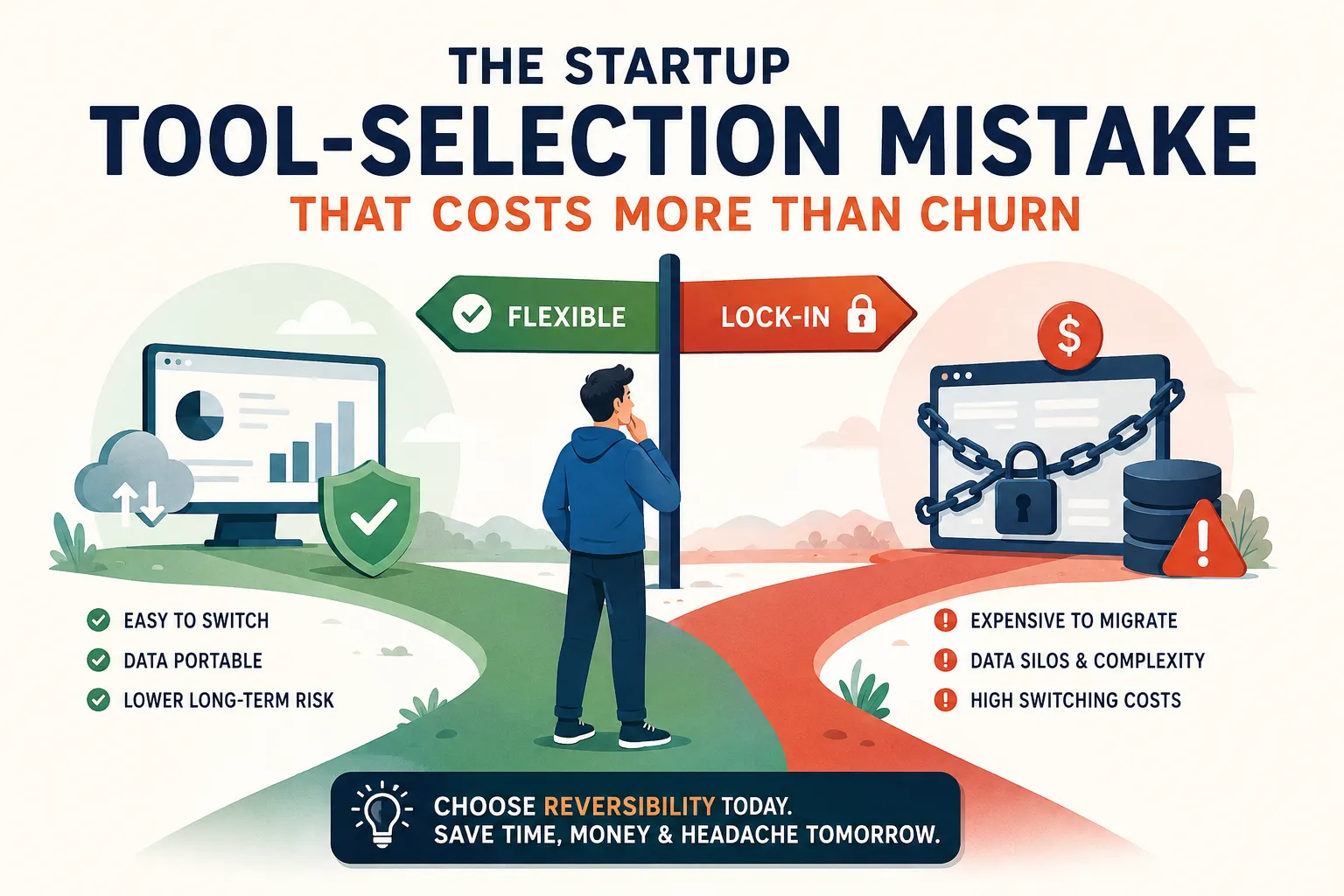

Most startup advice about software selection focuses on choosing the right tool. That framing is wrong. The more useful question is: how reversible is this choice if it turns out to be wrong?
Early-stage companies tend to select software the same way they make most decisions under time pressure: quickly, based on a short evaluation, heavily influenced by what other startups in their network are using. The tools that win those evaluations are usually the ones with the best demos, the most visible brand presence, and the strongest product-led trials. None of those factors reliably predicts whether the tool will still make sense twelve months from now, when your team has grown, your workflow has changed, and your actual usage patterns have diverged from what you assumed at the beginning.
The Cost Everyone Measures and the Cost Nobody Does
Startups track churn obsessively. Losing a customer is painful and visible; it shows up in the MRR graph immediately. But the equivalent problem on the software side, committing early to tools that are wrong for where the company ends up, is rarely measured at all.
Switching costs in SaaS are real and often underestimated before the fact. Migrating data between CRM platforms typically requires custom scripting or a specialized migration service, weeks of engineering time, and a period where historical data is incomplete or inconsistent. Moving from one project management tool to another means re-establishing workflows, training the team, losing historical context that was stored in the old system, and rebuilding integrations. The tools that seem easy to switch away from during the evaluation process are usually the ones where switching costs are the least visible, not the ones where they are genuinely lowest.
For most early-stage teams, the highest-leverage software decision is not which tool to choose. It is how long to delay commitment while the company's actual needs become clearer.
Why Early Commitment Happens Anyway
The structural pressure toward early software commitment is real. Product-led trials create urgency: the free plan has limits, the team is already using it, and upgrading feels like the natural next step. Vendor sales processes are designed to move quickly from evaluation to signature. The opportunity cost of spending more time evaluating software feels high when there are customers to serve and features to build.
There is also social pressure. The tools that dominate early-stage startup communities tend to become defaults, not because they are objectively superior for every use case, but because the network effects of common tooling, shared integrations, accessible advice, and familiar interfaces are genuinely valuable. Choosing a less popular tool means less community support, fewer native integrations, and fewer people who have already solved the implementation problems you are about to face.
None of this means early software commitment is always wrong. It means the pressure toward early commitment is structural, and the costs of committing prematurely are systematically underweighted because they show up later and are harder to attribute.
The Reversibility Framework
A more useful way to evaluate early-stage software choices is through a reversibility lens rather than a feature comparison lens.
Before committing to any tool, ask three questions. First: what does it cost, in time and money, to migrate off this platform in twelve months if our needs have changed? Second: in what format can we export all of our data, and can we do it on demand? Third: what workflows and integrations will we build on top of this tool, and how dependent will those be on this platform specifically?
The answers to those three questions tell you more about long-term risk than any feature comparison matrix. A tool with a slightly inferior feature set but straightforward data export and minimal integration lock-in is almost always a better early-stage choice than a superior tool where the exit path is murky, expensive, or dependent on a migration service the vendor sells.
Where Switching Costs Are Highest
The categories where premature commitment is most expensive are the ones where the tool becomes deeply embedded in operational workflows.
CRM systems are the clearest example. The data that accumulates in a CRM, contact history, deal stages, activity logs, email sequences, custom fields, workflow automations, captures institutional knowledge that cannot easily be reconstructed. The import and export capabilities of CRM platforms vary significantly, and the data model differences between platforms mean that a migration is never clean. Fields that exist in one system need to be mapped to equivalent fields in another, and those mappings are often imperfect.
Data and analytics tools carry similar risk. The instrumentation you build to send events to your analytics platform becomes tightly coupled to that platform's data model. Switching analytics platforms means re-instrumenting your product, re-creating your dashboards, and losing historical data continuity unless you maintain parallel instrumentation during the transition.
This is why the best product analytics tool for startups analytics platforms compare on architecture, not just features, matters before your team writes the first tracking call. The architectural choices you make at instrumentation time determine your switching costs for the next two to three years.
Communication and collaboration tools are also stickier than they appear. The actual messages, files, and decisions stored in a team communication platform represent institutional memory that is effectively inaccessible when you switch platforms, because historical context in a new system without the surrounding conversation is rarely useful.
Tools Where Early Commitment Is Lower Risk
Not every software category carries the same switching cost. Some tools are genuinely easy to replace without significant disruption.
Design and prototyping tools, writing tools, and most single-purpose productivity software have low switching costs because the outputs are usually portable files or formats, and the workflows built around them tend to be individual rather than organizational. A designer switching from one prototyping tool to another carries less organizational risk than an entire sales team migrating CRM platforms.
Infrastructure tools often have standardized interfaces or data formats that reduce lock-in. Cloud storage with standard S3-compatible APIs, databases with standard SQL interfaces, and communication tools with comprehensive data export are all lower-risk early commitments than tools built on proprietary formats.
A Practical Approach for Early-Stage Teams
The practical implication of the reversibility framework is not to delay all software decisions or to build everything yourself. It is to delay high-switching-cost commitments specifically, and to use that delay to gather real usage data before committing.
Run with free tiers and limited commitments longer than feels comfortable. The discomfort usually comes from feature limitations that matter less than the pressure suggests. The actual cost of spending another sixty days on a generous free tier while you understand your real usage patterns is almost always lower than the cost of committing early to the wrong architecture.
When you do commit, negotiate terms that give you more exit optionality. Annual commitments with data export rights clearly specified, renewal notice windows that give you time to evaluate alternatives, and contracts that explicitly guarantee data portability in a usable format are not aggressive asks. They are reasonable baseline terms that vendors who are confident in their product should have no objection to.
Finally, distinguish between tools your team uses and tools your product depends on. Tools your team uses can typically be replaced with some disruption but without product impact. Tools your product is built on, analytics instrumentation, payment processing, customer communication infrastructure, affect the product directly and carry significantly higher switching costs. The evaluation process for those tools deserves substantially more time and rigor than the evaluation for the project management tool your team uses to track internal tasks.
The Honest Version of the "Right Tool" Question
The right tool for an early-stage company is almost never the most powerful tool in the category. It is the tool that serves the current need adequately, keeps options open for how that need might evolve, and does not generate migration debt that the company will pay for years later.
That is a harder question to answer than a feature comparison, and it is rarely how software vendors frame the evaluation. But it is the question that tends to predict long-term satisfaction with software decisions far better than which platform had the most impressive demo.





















Sign in to leave a comment.