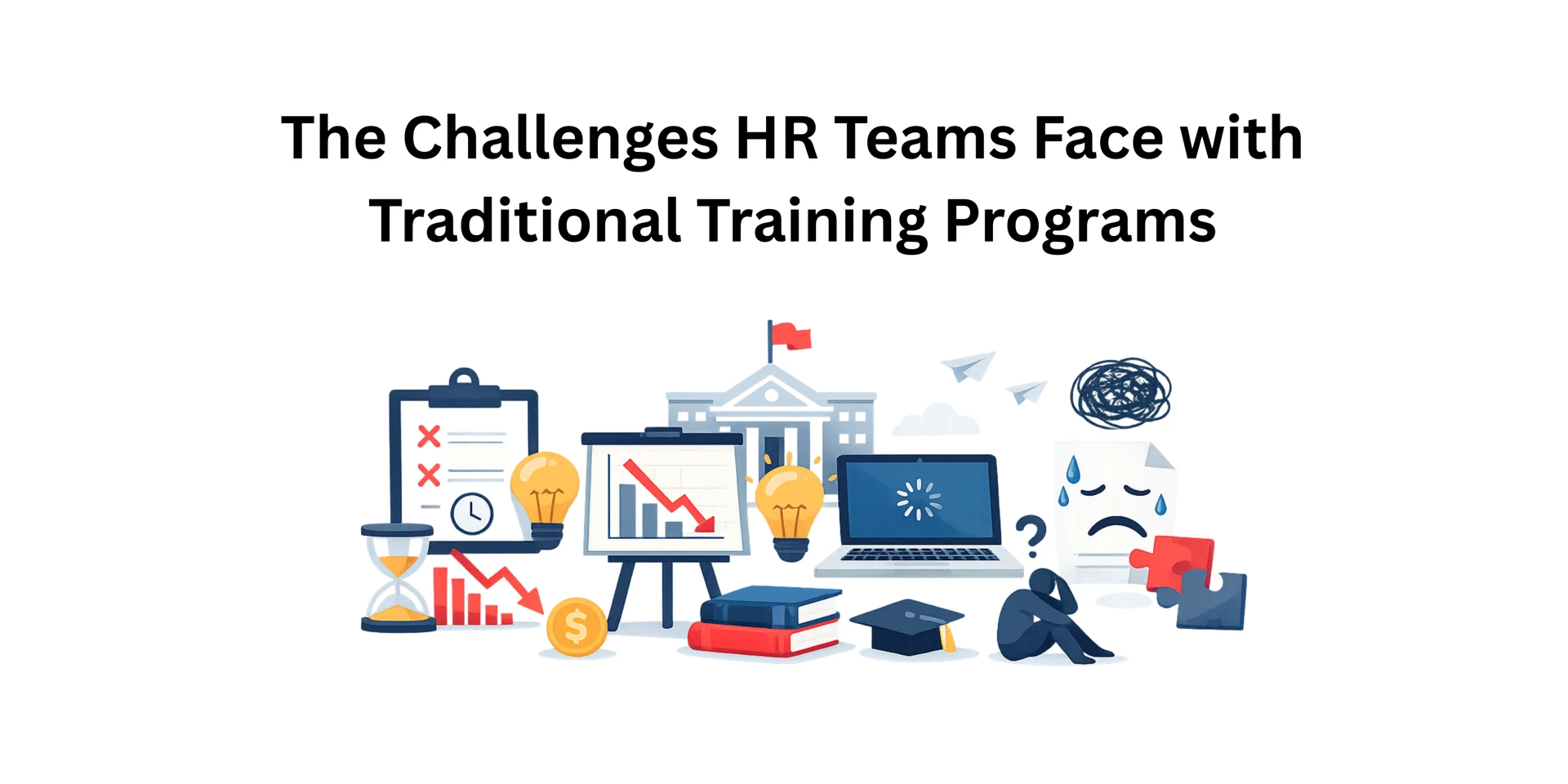

Employee training is no longer a one-time exercise in today's rapidly changing business climate; rather, it is a continual process. However, many organisations continue to rely on traditional training programs that struggle to meet the needs of today's workforce. HR leaders and CEOs face substantial impediments to productivity, engagement, and growth. This is where solutions such as AI LXP for HR are gaining popularity.
Let's look at the primary problems that HR teams encounter with traditional training methods and why transformation is required.
These Are Some Of The Challenges HR Team Faces
1. One-Size-Fits-All Learning Doesn’t Work
Traditional training programs frequently use a standardised approach, giving the same content to all employees regardless of function, skill level, or learning preferences.
Why is this a problem?
- Employees disengaged because of irrelevant content.
- Learning outcomes are inconsistent.
- High performers feel underchallenged.
Modern organisations want personalised learning journeys, which an AI LXP for HR can provide through adaptable material and targeted recommendations.
2. Limited Engagement and Participation
One of the most difficult difficulties that HR teams confront is low interest in training sessions. Long presentations, stagnant modules, and out-of-date information formats fail to pique employee interest.
The impact:
- Low rates of completion
- Poor retention of information
- Very little practical use
An AI LXP for HR, on the other hand, uses interactive formats like gamification, microlearning, and AI-driven nudges to maintain employee motivation and engagement.
3. Insufficient Real-Time Skill Monitoring
Rarely do traditional training systems offer real-time insights into the skill development or advancement of employees. HR departments frequently use handwritten evaluations or out-of-date reports.
Among the difficulties are:
- Finding skill gaps can be challenging.
- Ineffective workforce planning
- Limited understanding of training programs' return on investment
HR directors can access advanced insights through an AI LXP for HR, facilitating data-driven choices and ongoing development.
4. High Costs and Resource Constraints
Traditional training programs are expensive to set up since they require venue reservations, trainers, supplies, and employee downtime.
Principal issues:
- Inefficiencies in the budget
- Problems with scalability
- Logistics that take a long time
By providing scalable, digital-first learning solutions that workers can access from anywhere at any time, an AI LXP for HR lowers these expenses.
5. Slow Adaptation to Changing Business Needs
Businesses need to constantly upskill their employees in a market that is changing quickly. Traditional training programs, however, can take a long time to update and implement.
The drawback:
- Skills rapidly become antiquated.
- Businesses lose their edge over competitors.
- Workers feel unprepared for upcoming challenges.
Businesses can provide dynamic, current material that is in line with corporate objectives and current industry trends by incorporating an AI LXP for HR.
6. Poor Knowledge Retention
Conventional training frequently consists of brief, information-rich sessions. Employees often forget the majority of what they learn in the absence of reinforcement.
Outcomes:
- Minimal long-term effects
- Decreased efficacy of training
- Investment wasted
This is addressed by an AI LXP for HR using continuous reinforcement techniques, individualised learning routes, and spaced repetition.
7. Lack of Employee-Centric Learning Culture
Conventional programs are usually top-down and prioritise compliance over staff development. This lowers motivation and restricts creativity.
Why it's important:
- Workers don't feel involved in learning initiatives
- Reduced rates of retention and satisfaction
- Lost chances to grow as a leader
A learner-centric culture is fostered via an AI LXP for HR, enabling staff members to take charge of their own growth.
Conclusion
Traditional training programs are no longer adequate for today's dynamic workplace. HR teams confront a number of problems that prevent effective learning outcomes, including a lack of personalisation and engagement, as well as excessive prices and limited scalability.
Adopting an AI LXP for HR is more than just a technology update; it is a strategic step toward developing a staff that is prepared for the future. Investing in smarter, AI-driven learning solutions can help firms and CEOs achieve increased productivity, greater employee engagement, and long-term success.






















Sign in to leave a comment.