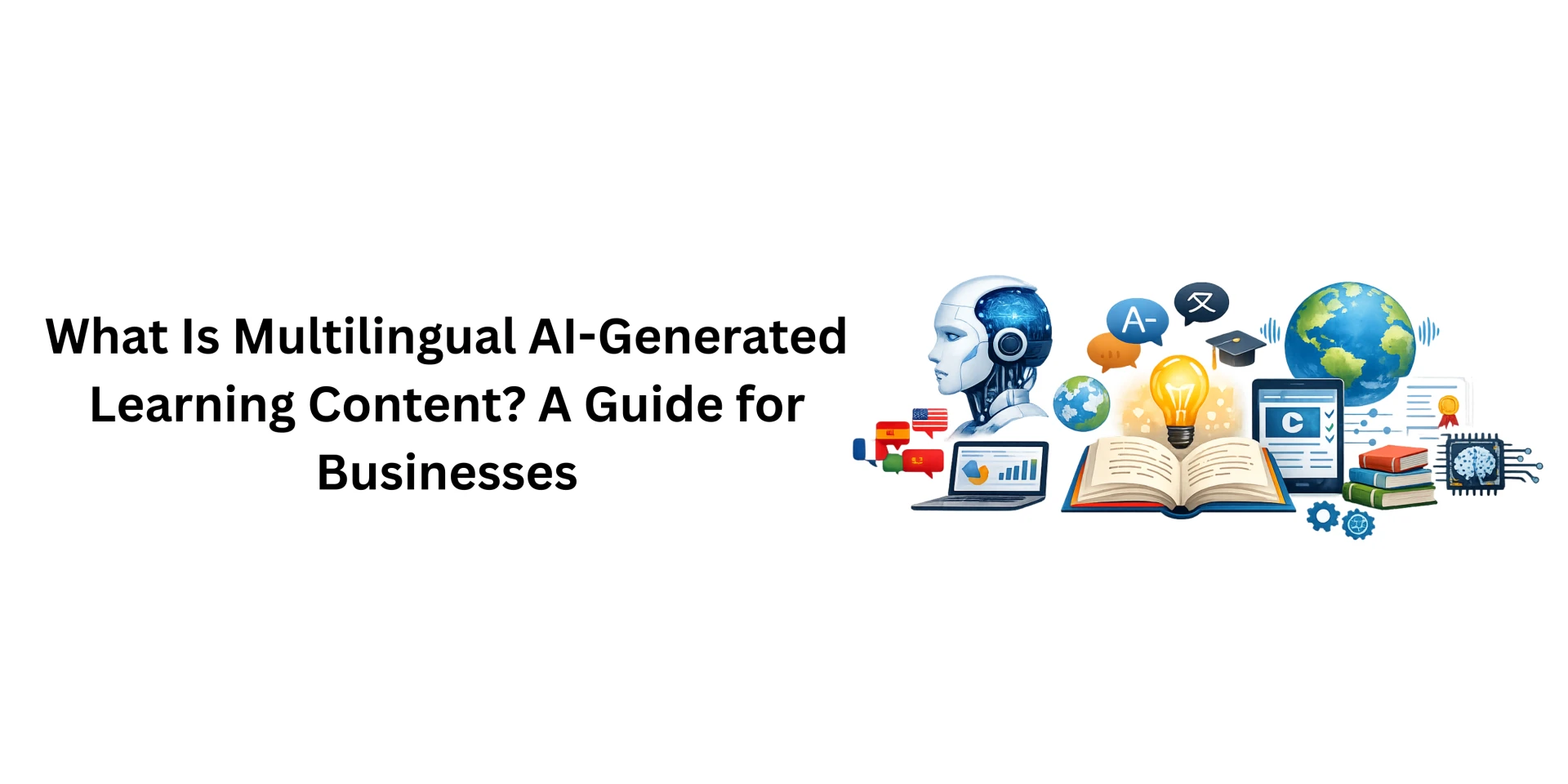

Today's businesses transcend national boundaries, linguistic barriers, and cultural differences. Training staff, partners, and clients in several languages becomes a significant problem when businesses grow internationally. This is where contemporary corporate learning is being revolutionised by multilingual AI-generated learning content. Businesses may provide training materials that are automatically generated or translated. It is also localised for audiences throughout the world by fusing artificial intelligence with language processing technologies.
This strategy provides CEOs and corporate executives with a scalable and economical means of providing uniform learning opportunities across the globe.
Understanding Multilingual AI-Generated Learning Content
The term "multilingual AI-generated learning content" describes instructional or training materials that are produced or modified using AI and presented in several languages. These resources could consist of:
- Corporate training courses
- Online courses
- Programs for onboarding employees
- Resources for customer education
- Training on compliance and regulations
AI systems create the foundational content and translate it into several languages while preserving its meaning, tone, and instructional clarity, as opposed to producing and translating each piece of information by hand.
Faster content creation and a uniform message among international teams are the outcomes.
How Multilingual AI-Generated Learning Content Works
Advanced AI models that can comprehend language structure, context, and meaning are at the heart of multilingual AI-generated learning content.
The typical workflow consists of:
1. AI-Powered Content Production
Based on given subjects, training objectives, or pre-existing papers, AI technologies produce structured learning content.
2. Automated Interpretation
The content is translated into other languages while maintaining its instructional purpose and context.
3. Localisation
Beyond translation, AI modifies vocabulary, instances, and cultural allusions to fit certain locales.
4. Constant Enhancement
AI algorithms examine engagement statistics and student feedback to gradually enhance the quality of material.
Businesses are able to create multilingual educational materials at a scale that would be challenging to accomplish using conventional techniques thanks to this technology.
Why Businesses Are Adopting Multilingual AI Learning
Multilingual AI-generated learning materials are becoming more and more popular in international organisations since they solve a number of significant training issues.
Faster Content Production
It can take weeks or months to manually create training materials for several languages. AI creates and translates content in a matter of hours, drastically cutting production time.
Reduced Training Expenses
Conventional translation and instructional design services are costly. AI-generated learning materials in multiple languages help businesses cut expenses without sacrificing the quality of their instruction.
Regular Educational Experiences
Messaging frequently gets inconsistent when businesses depend on many regional teams to produce training materials. AI makes sure that the same information is appropriately presented everywhere.
Scalable Global Training
Businesses can easily create more language versions when they enter new markets without having to start from scratch with training programs.
Common Use Cases in Enterprises
Multilingual AI-generated learning materials are already being used in many organisations' operations in useful ways.
One of the most prevalent examples is employee onboarding. International businesses may guarantee that all new hires receive the same training by offering standardised onboarding materials in several languages.
Another important use case is compliance training. AI-generated learning content can swiftly modify information to comply with local legal standards because regulations frequently differ by region.
Additionally, customer education is changing. For instance, software firms are able to provide multilingual product documentation and tutorials that aid people all over the world in comprehending their platforms.
Challenges Businesses Should Consider
Organisations should approach multilingual AI-generated learning content strategically, even though the advantages are substantial.
In order to guarantee accuracy, cultural sensitivity, and educational efficacy, AI-generated materials still need human supervision. Before content is distributed, subject matter experts and instructional designers should examine it.
Additionally, while employing AI tools in corporate learning settings, businesses must guarantee data protection and uphold openness.
The Future for International Corporate Education
As organisations become increasingly digital and global, the need for bilingual education will only increase. For businesses looking to expand knowledge sharing across languages and regions, multilingual AI-generated learning content offers a workable alternative.
Investing in AI-powered learning solutions can help CEOs and decision-makers support global expansion, enhance training consistency, and speed up workforce development.
Early adoption of this strategy will give organisations a distinct advantage in creating truly global learning ecosystems.




























Sign in to leave a comment.