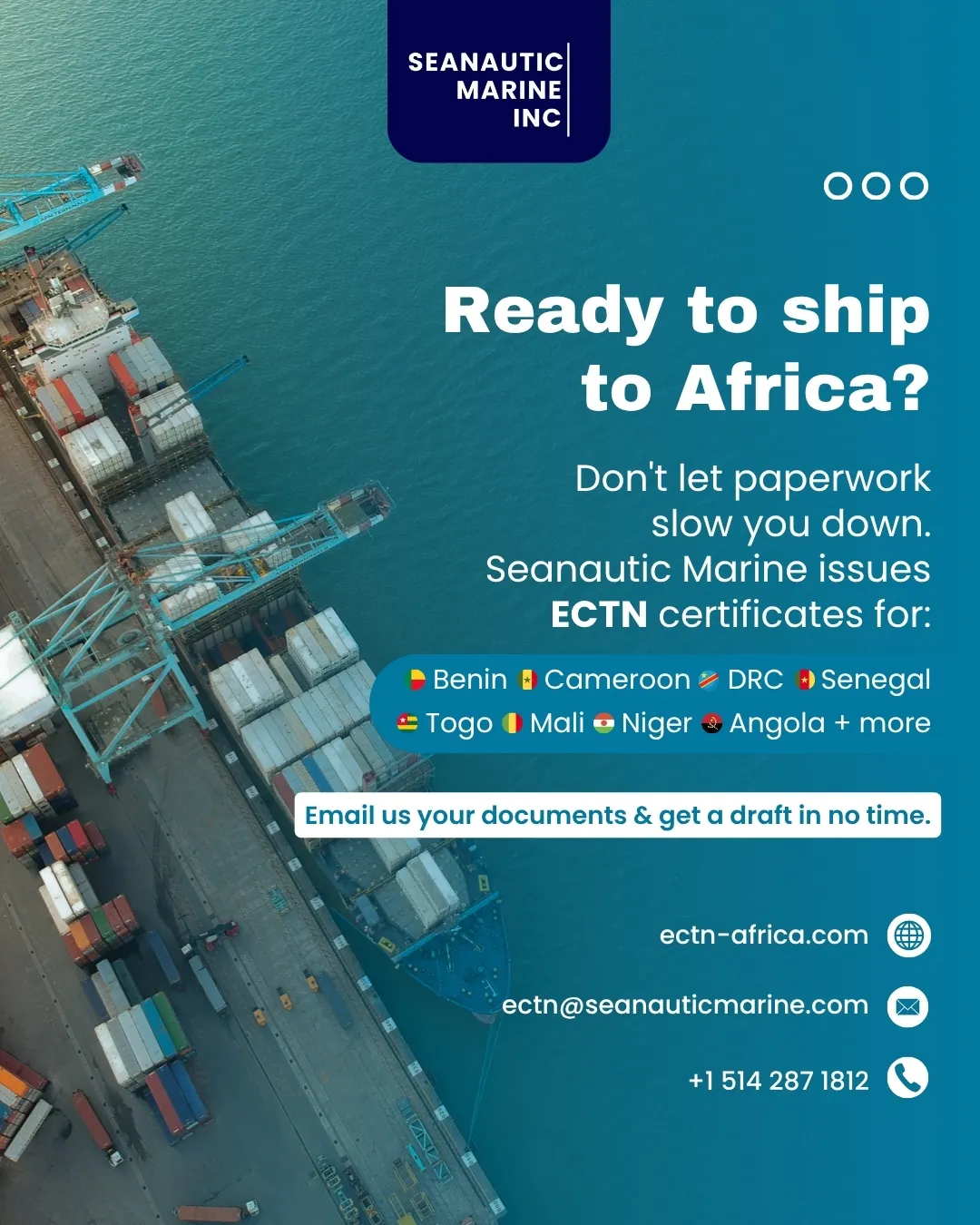

Every day, thousands of containers bound for African ports are loaded without one critical document in place. By the time the vessel arrives at the destination port, customs authorities flag the shipment, dock it, and the importer is left scrambling to regularise paperwork from thousands of miles away — paying penalty fees, losing clients, and watching goods sit idle in a port that was never supposed to be a storage facility.
The document in question is the Electronic Cargo Tracking Note, universally known in the shipping industry as the ECTN. It is not new, it is not obscure, and it is not optional. Yet non-compliance remains one of the most common and most avoidable causes of cargo delays across the African continent.
This guide breaks down everything importers, exporters, freight forwarders, and customs brokers need to understand about the ECTN — what it is, why it exists, which countries require it, what happens when it is missing, and how to build compliance into your pre-shipment workflow without friction.
What Is the ECTN?
The Electronic Cargo Tracking Note is a mandatory customs pre-arrival document required by numerous African nations for all commercial cargo arriving by sea. Depending on the destination country, it may be referred to by different names: the Bordereau de Suivi Cargaison (BSC), the Cargo Tracking Note (CTN), the Billet d’Importation et d’Exportation de Transit et de Cabotage (BIETC), the Billet d’Escale et de Suivi de Cargaison (BESC), or the FERI. Despite the different names, these are all variations of the same instrument — a pre-shipment certificate that captures detailed cargo and party information for customs verification purposes.
The ECTN must be obtained before the vessel departs the origin port. It is not a document that can be obtained upon arrival, applied for retroactively without penalty, or substituted with another shipping document. The certificate number must be endorsed on the bill of lading, making it a formal part of the transport document set.
African governments introduced the cargo tracking system as a mechanism to combat under-invoicing, reduce trade fraud, improve customs revenue collection, and gain advance visibility over incoming shipments. For legitimate traders, this system creates transparency and a level playing field. For non-compliant shippers, it creates significant and entirely avoidable problems.
Why the ECTN Is Strictly Enforced
It is tempting to treat the ECTN as a bureaucratic formality rather than a hard legal requirement. Enforcement realities across African ports make this a costly mistake. Customs authorities in ECTN-mandatory countries have sophisticated cross-referencing systems that verify ECTN data against the bill of lading and shipping manifest. Discrepancies or missing certificates are flagged immediately upon vessel arrival.
The consequences of non-compliance are well-documented and consistently severe:
Cargo is placed on hold at the port pending regularisation. The importer cannot take delivery of goods until a valid ECTN is obtained and presented to customs. In markets where goods are perishable, time-sensitive, or urgently needed for project timelines, this hold translates directly into financial losses that often far exceed the cost of the ECTN itself.
Retroactive ECTN fees are charged at rates significantly higher than the standard pre-shipment tariff. The destination country’s customs authority treats post-arrival regularisation as a penalty rather than a routine service.
The consignee’s commercial relationship with suppliers and clients suffers. Late deliveries trigger contractual penalties, erode trust, and in some cases result in the loss of contracts.
Key Destination Countries and Their ECTN Requirements
Burkina Faso
Burkina Faso is a landlocked country in West Africa that receives its imports through transit corridors running through coastal neighbours — principally Ivory Coast, Togo, Ghana, and Benin. Despite not having its own seaport, the country has long mandated cargo tracking documentation for all commercial shipments.
Shippers routing goods to Burkina Faso must ensure the ECTN Burkina Faso certificate is issued and validated before the vessel departs the origin port. The CTN number must appear on the bill of lading. If the documentation is missing when cargo arrives at the transit port — Abidjan, Lomé, Tema, or Cotonou — onward transit to Burkina Faso can be blocked pending regularisation, which adds both cost and time to the delivery.
For freight forwarders managing consolidated loads or groupage shipments to Burkina Faso, it is important to note that each consignment typically requires its own properly documented ECTN. Confirm the specific requirements with your authorised ECTN provider at the time of booking.
South Sudan
South Sudan is one of Africa’s newest nations, having gained independence in 2011, and its customs infrastructure has been developing steadily since. Commercial cargo entering South Sudan requires a valid ECTN South Sudan certificate obtained before the vessel sails from the origin port.
Given South Sudan’s landlocked geography, most imports arrive overland via Kenya through the Port of Mombasa, or through Uganda. However, the ECTN obligation is triggered at the maritime origin — meaning shippers loading cargo at ports in Asia, Europe, or the Americas must obtain the South Sudan ECTN regardless of how many transit legs are involved.
Enforcement at entry points into South Sudan has become progressively more rigorous in recent years. Freight forwarders and importers who have not previously shipped to the country are strongly advised to work with an experienced, authorised ECTN provider to navigate the specific documentation requirements from the outset.
Republic of Congo
The Republic of Congo — distinct from the neighbouring Democratic Republic of Congo — is a significant West-Central African economy with the Port of Pointe-Noire serving as its primary maritime gateway. All commercial cargo destined for the country must be accompanied by a valid ECTN Congo certificate issued prior to departure from the loading port.
Pointe-Noire port authority and customs work closely together to enforce ECTN compliance on all incoming shipments. The enforcement record in the Republic of Congo is strong, and importers who have experienced cargo detention there consistently cite missing or invalid ECTN documentation as the primary cause. Oil and gas contractors, humanitarian organisations, and general commercial importers are all subject to the same pre-shipment documentation requirements — there are no sector-specific exemptions.
How the ECTN Application Process Works
The ECTN application process is straightforward when managed with an experienced, authorised provider. The general steps are as follows:
Once a shipment is confirmed and booking details are available, the shipper or freight forwarder submits the required documents to the ECTN service provider. These typically include the commercial invoice, the packing list, the bill of lading or sea waybill draft, and any relevant letter of credit or purchase order. Exact document requirements vary by destination country.
The service provider reviews the submitted documents for completeness and accuracy, then prepares a draft certificate for the client’s approval. An invoice is issued at the same time. Once the draft is approved and payment is confirmed, the CTN number is released so it can be added to the bill of lading before the vessel sails.
The final validated certificate is delivered once the original bill of lading is received and matched against the issued certificate. The entire process, when documents are complete and correctly submitted, typically takes 24 to 48 business hours.
Building ECTN Compliance Into Your Pre-Shipment Workflow
The single most effective practice for avoiding ECTN-related delays is treating the certificate as a standard line item in the pre-shipment checklist — not an afterthought triggered by a question from the consignee. Start the ECTN process at the same time you finalise the booking and begin assembling your shipping documents.
Factor the processing timeline realistically. Although 24 to 48 business hours is typical for complete submissions, document collection and any clarification rounds can add time. Initiating the process three to five working days before the intended sailing date is a practical standard for most shipments.
Ensure the CTN number is on the bill of lading before the vessel is loaded. This is the moment that compliance is formally established. A certificate that exists on paper but whose number has not been endorsed on the bill of lading does not satisfy the customs requirement at most ECTN-mandatory destinations.
For multi-country shipments, remember that each destination requires its own ECTN. There is no umbrella certificate that covers multiple nations simultaneously. Work with a single provider that covers all your African destinations to reduce administrative complexity and ensure consistent document standards.
About Seanautic Marine / ECTN-Africa
Seanautic Marine Inc. is an independent, authorised ECTN service provider covering more than 20 African nations, including Burkina Faso, South Sudan, the Republic of Congo, the Democratic Republic of Congo, Cameroon, Togo, Benin, Mali, Niger, Senegal, Ivory Coast, Gabon, Angola, and others.
The company handles the full ECTN application process — from document review and draft certificate preparation to final validated certificate delivery. All shipment data is handled with strict confidentiality. The team is experienced with the specific requirements of each African customs authority they serve, and the CTN number is provided in advance wherever possible to ensure smooth bill of lading finalisation.
Seanautic Marine serves importers, exporters, freight forwarders, customs brokers, project cargo operators, and logistics companies worldwide, processing certificates for cargo departing from origin ports across Asia, Europe, North America, and beyond.
Conclusion
The ECTN is a non-negotiable component of any shipment entering an ECTN-mandatory African country. It protects the importer’s ability to clear customs, keeps supply chains moving, and ensures compliance with the trade regulations of the destination country. Skipping or delaying it is never worth the risk.
With the right service provider and a properly organised pre-shipment workflow, ECTN compliance adds minimal time and cost to a shipment while eliminating the very real risk of port detention, penalty fees, and damaged commercial relationships.
Ready to ship to Africa without the stress of last-minute document problems? Seanautic Marine / ECTN-Africa is your authorised, single-source solution for Electronic Cargo Tracking Notes across more than 20 African countries.
Visit ectn-africa.com to check requirements for your destination country, request a quote, or contact the team directly.
Do not let a missing certificate hold your cargo at port. Apply before you sail.























Sign in to leave a comment.