
In the rapidly evolving landscape of commercial and industrial lighting, the conversation often fixates on the efficacy of the LED light source itself. While achieving high lumens per watt at the chip level is foundational, it is merely the starting point of a high-performance lighting system. A raw LED chip, without intervention, emits light in a wide, uncontrolled Lambertian distribution—typically 120 degrees. For professional applications, this results in significant energy waste, with light spilling into areas where it isn't needed or creating uncomfortable glare.
To transform raw photon output into usable, safe, and efficient illumination, engineers must rely on precision engineering. This is where secondary optics become the defining factor. By manipulating the path of light through refraction and reflection, secondary optics ensure that energy is delivered exactly where it is required, maximizing lux levels on the target surface while minimizing power consumption.
The Engineering Behind Precision Light Control
The primary function of an LED lens or reflector is to collimate the light source, altering the beam angle to suit specific environments. This process involves complex physics and material science to maintain high transmission rates while shaping the beam.
Material Science: PMMA vs. PC
The choice of material for an optical lens is not arbitrary; it dictates the longevity and performance of the fixture.
- PMMA (Acrylic): Known for its exceptional optical clarity and resistance to UV yellowing, making it ideal for architectural and general lighting.
- PC (Polycarbonate): Chosen for its high impact resistance and thermal stability. In outdoor environments where lenses are exposed to hail, vandalism, or extreme heat, polycarbonate is often the superior choice.
Managing Glare (UGR)
Visual comfort is as important as brightness. In office and retail environments, a low Unified Glare Rating (UGR) is essential for occupant well-being. Advanced optical designs utilize micro-structures on the lens surface to diffuse the light source, reducing the "hot spot" effect of the LED die while maintaining a focused beam.
Application-Specific Optical Solutions
One size does not fit all in lighting design. The geometry of the lens must be tailored to the specific height, spacing, and purpose of the installation.
Roadway and Area Lighting
Outdoor lighting faces the dual challenge of illuminating long stretches of pavement uniformly while adhering to strict dark-sky compliance regulations. A standard clear cover is insufficient for these tasks. Instead, engineers must utilize street light lenses with specific beam angles, such as Type II or Type III distributions. These asymmetric designs push light forward and laterally along the road, preventing "zebra striping" patterns and reducing light trespass into neighboring residential properties. The integration of IP66-rated gaskets directly into the lens module further protects the LED board from moisture and dust ingress.
Industrial High Bay Efficiency
Moving from the streets to the warehouse floor, the requirements shift dramatically. In industrial settings with ceiling heights ranging from 10 to 20 meters, the priority is punching light down to the working plane to ensure safety and productivity. Here, wide-angle dispersion is the enemy.
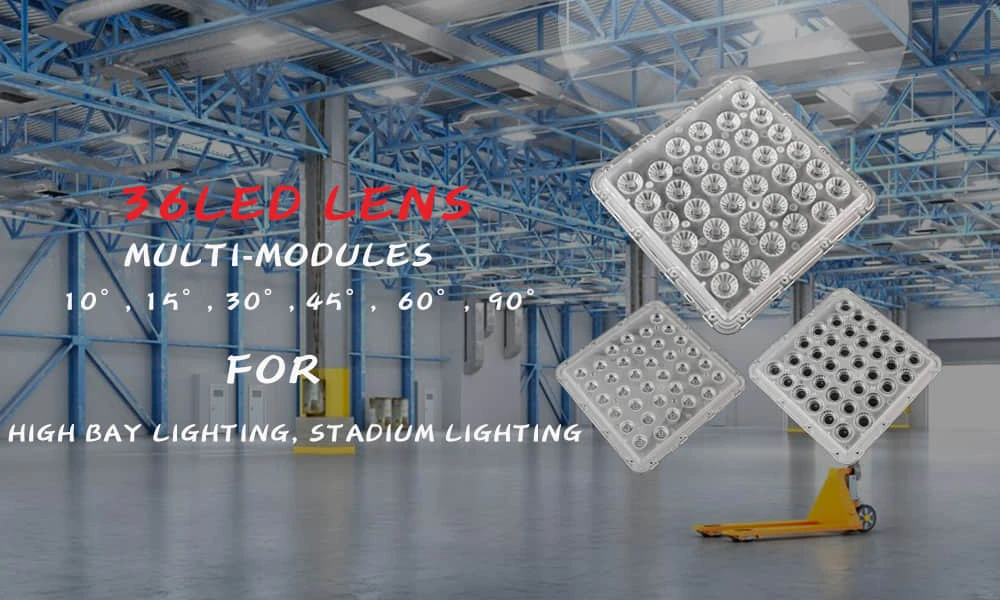
To combat this, modern industrial fixtures employ specialized UFO high bay lenses that concentrate the beam (typically 60°, 90°, or 120°) to reduce light loss in the upper rafters. By narrowing the beam angle through optical precision, facility managers can often reduce the total number of fixtures needed to achieve the required foot-candles, leading to substantial upfront and operational savings.
The Future of Optical Standardization
As the LED industry matures, the demand for modularity and interchangeability is growing. This is driven by standards such as Zhaga, which aims to simplify the supply chain for LED luminaire manufacturers.
Linear and Modular Designs
In supermarkets, offices, and trunking systems, linear lighting is replacing traditional fluorescent tubes. The latest generation of Zhaga standard linear lenses allows manufacturers to easily swap out optical distributions without redesigning the entire fixture. This flexibility means a single fixture body can be used for aisle lighting (double asymmetric beam), general open area lighting (wide beam), or high-rack lighting (narrow beam) simply by changing the lens.
Conclusion
Ultimately, the performance of an LED fixture is a synergy between the light source and the optical control system. As energy codes become stricter and the demand for visual comfort rises, the industry is moving away from "brighter is better" to "smarter is better."
Whether designing for architectural aesthetics, automotive safety, or industrial productivity, investing in customized LED optical design is the most effective way to unlock the full potential of LED technology. By prioritizing high-quality secondary optics, manufacturers can deliver products that are not only energy-efficient but also visually superior and built to last.


























Sign in to leave a comment.