
Most drivers are diligent about engine oil changes, brake checks, and fuel efficiency. We obsess over the dashboard lights and the sounds under the hood. Yet tires, the only component of a vehicle in constant contact with the road, are routinely overlooked.
The dangers of driving on worn-out tires are well-documented and serious, but they tend to go unaddressed until a problem is already visible.
By then, the risk has been present for far longer than most people realize. It’s a silent degradation that waits for the worst possible moment to reveal itself.
Why Preventive Maintenance Starts with Tires
Tire degradation is gradual. There is no warning light, no sudden noise, and no obvious "snap" when a tire crosses from acceptable to unsafe. This is precisely why preventive maintenance matters; it addresses problems before they become emergencies.
Tires are responsible for grip, braking, steering response, and stability. When their condition deteriorates, every one of those functions is compromised. A car with worn tires may feel perfectly normal at highway speeds until it doesn't.
During an emergency stop, a sharp turn, or a sudden rainstorm, your reaction time becomes irrelevant. At that point, the tire’s physical ability to perform is what determines the outcome.
What Worn Tire Risks Actually Look Like
The core problem with worn tires is reduced grip. As tread depth decreases, the tire loses its ability to maintain firm contact with the road surface. The consequences of poor grip tires include longer stopping distances, reduced steering precision, and a much higher likelihood of skidding.
How worn tires affect braking distance is one of the most important and underappreciated risks. Studies in road safety consistently show that increased stopping distance in tires with low tread can add several additional meters to a stop.
In a situation where a child, a cyclist, or a stopped vehicle appears suddenly, those extra meters are the margin between safety and a collision. Worn tire risks do not require high speeds or reckless driving; they manifest in ordinary situations like routine stops and gentle curves.
Low Tread Depth Dangers and the Legal Standard
Tire tread exists to channel water away from the contact surface. As the tread wears down, this function fails. Low tread depth dangers begin well before a tire reaches the legal minimum.
- The Legal Limit: 1.6 mm. At this point, your tires are legally "bald" and unsafe.
- The Safety Recommendation: 3 mm. Most manufacturers suggest replacement here, as performance drops off a cliff long before you hit the legal limit.
Tire tread wear problems are not always uniform. Uneven wear, heavier on one side or in patches, can indicate pressure imbalances or suspension issues. If you see "balding" on only one edge, your tires are screaming for an alignment.
Bald Tires: Safety Issues in Rain
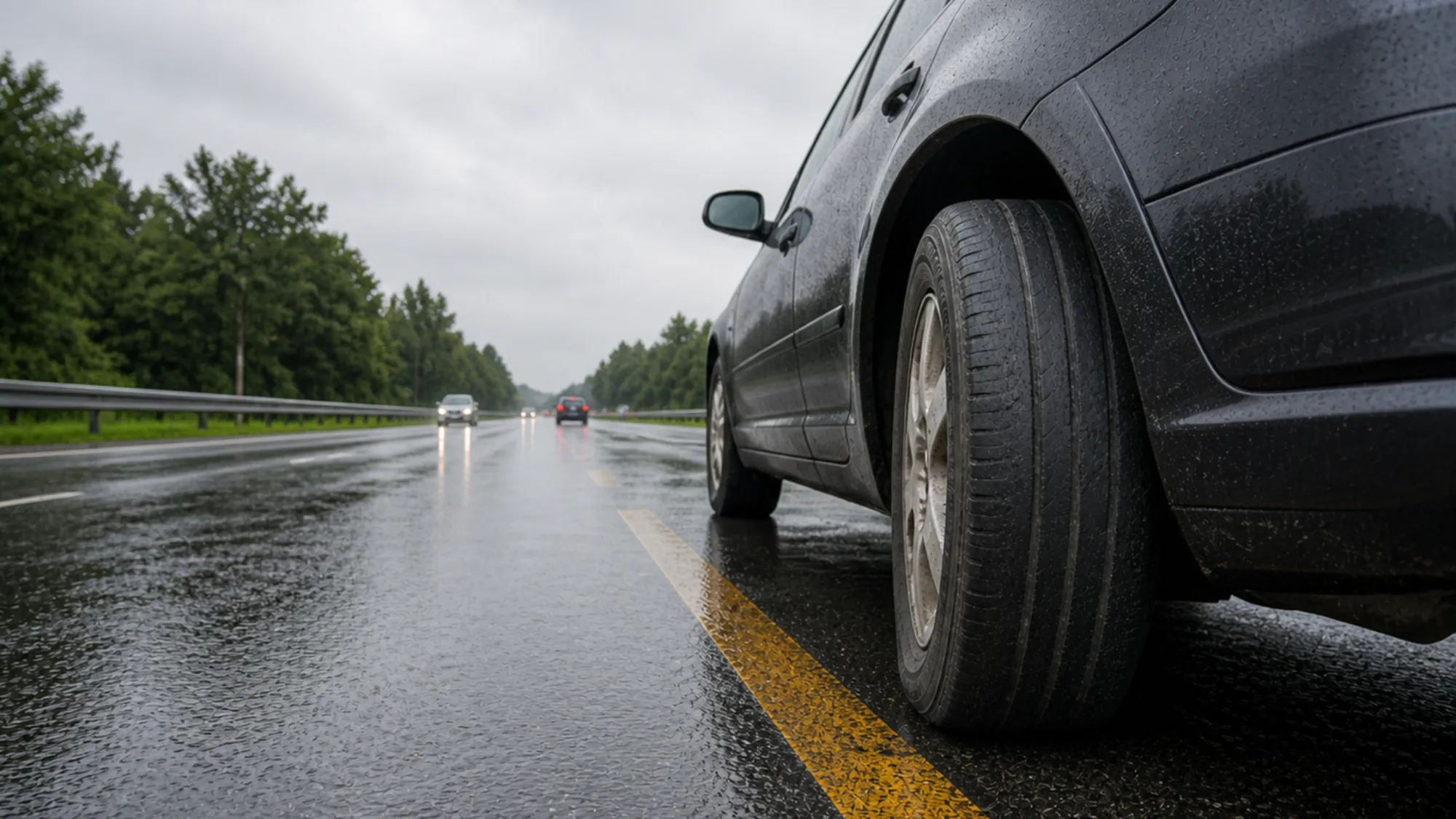
Driving in the rain with worn tires is a high-stakes gamble. Water creates a layer between the tire and the road. Tread channels are designed to displace that water, but when the tread is shallow, the tire begins to ride on top of the water film. This is known as hydroplaning.
Hydroplaning worn tires results in a near-complete loss of steering and braking control. The vehicle continues in its direction of travel regardless of driver input. Bald tires safety issues in rain are not a matter of driver skill; no amount of experience compensates for a tire with no tread.
Even without full aquaplaning, wet stopping distances increase dramatically. A vehicle that stops in 30 meters on dry roads may require 50 meters or more on wet roads with worn tires.
Signs Your Tires Are Too Worn to Drive Safely
Identifying wear before it becomes critical requires a quick periodic inspection. Look for these tire replacement warning signs:
- Tread Wear Indicators: These small raised bars in the grooves become flush with the tread surface at 1.6 mm. If you can see them clearly, you’re in the danger zone.
- Visible Damage: Look for cracking or "dry rot" along the sidewall, surface discoloration, or a glazed appearance.
- Physical Deformations: Any visible bulge or "bubble" in the sidewall is a structural warning that the tire could blow out at any moment.
Other signs your tires are too worn to drive safely include a persistent pull to one side or a new vibration at highway speeds. These aren't just annoyances; they are signals that your connection to the road is failing.
When Should You Replace Worn Tires?
When should you replace worn tires? The answer depends on more than just the "penny test."
- Replace at 3 mm for optimal safety in wet conditions.
- Replace at age alone after six years. Rubber compounds degrade and become brittle over time, even if the vehicle isn't driven often.
- Replace immediately following any significant impact or sidewall damage.
The Foundation of Maintenance: Rotation and Alignment
Proper tire maintenance extends the life of your investment. Check your pressure monthly; under-inflated tires wear faster and overheat.
Tire rotation redistributes wear by moving tires between axle positions, typically every 8,000 to 10,000 km.
Many drivers search for tire rotation near me only after they notice a problem, but rotation is most effective as a scheduled preventive measure. Similarly, wheel alignment ensures your tires make contact with the road at the correct angle, preventing premature wear and saving you money at the pump.
Conclusion
Understanding the dangers of driving on worn-out tires is the first step; addressing them is the necessary one. For drivers in West Texas, navigating heat-soaked highways and sudden storms, visiting reputable tire stores in Lubbock, TX, for an inspection is a 30-minute task that provides peace of mind.
Tires do not fail dramatically in your driveway. They degrade quietly until the moment you need them most. The time to address your tires is now—before the rain starts and the road disappears.


























Sign in to leave a comment.