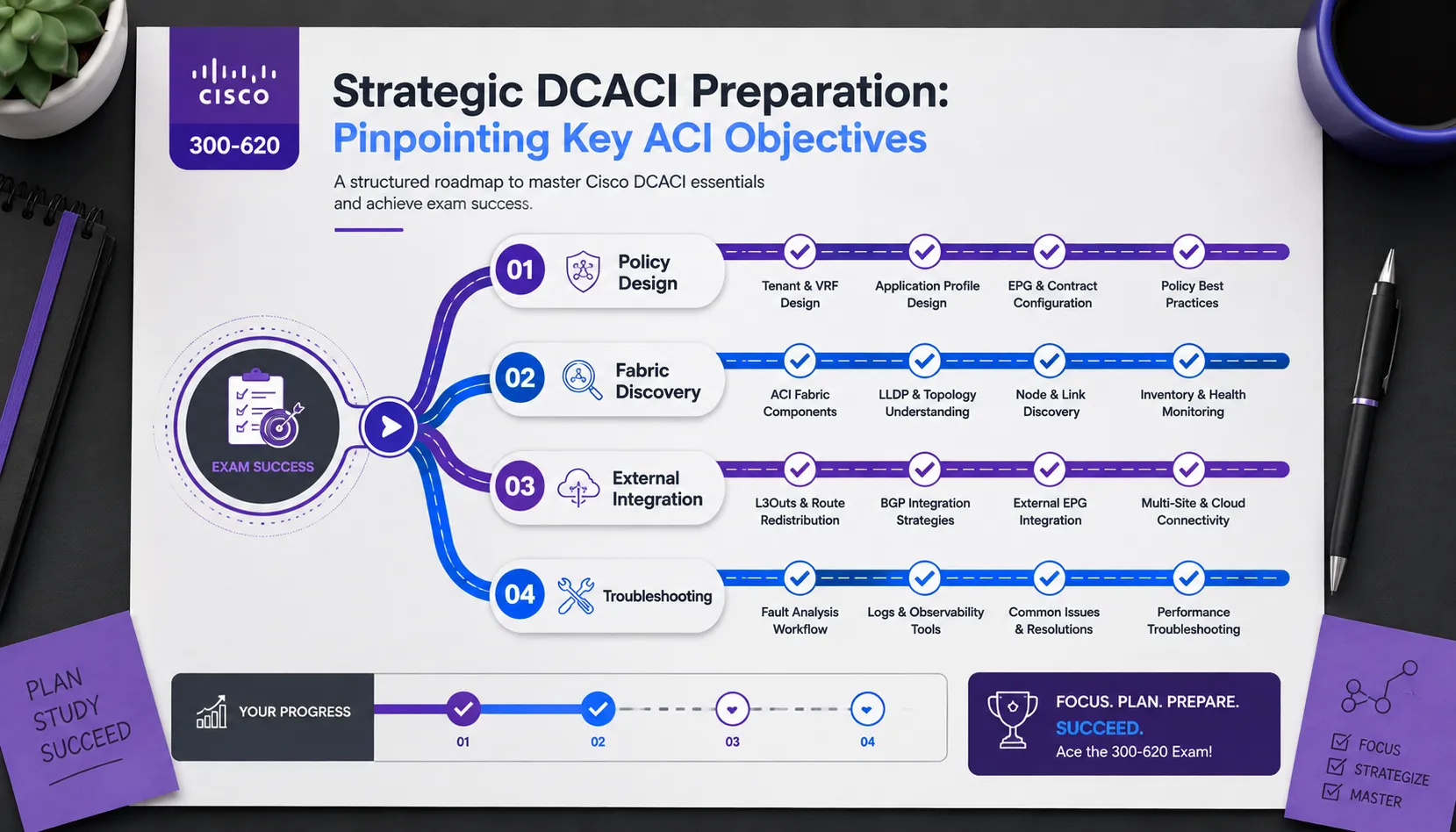

The Implementing Cisco Application Centric Infrastructure (DCACI) certification, identified by exam code 300-620, validates a professional's expertise in deploying, configuring, and managing Cisco ACI solutions. This certification is crucial for data center engineers and architects working with Cisco ACI, confirming their ability to implement and troubleshoot this advanced SDN solution. This article unveils a crucial oversight many candidates make when approaching the DCACI exam, offering guidance to ensure your preparation is both thorough and effective, ultimately helping you avoid common missteps and enhance your understanding of Cisco Application Centric Infrastructure.

Clarifying the Overlooked DCACI Challenge
Many candidates preparing for the DCACI exam focus heavily on memorizing configurations and syntax, overlooking the fundamental paradigm shift that Cisco ACI represents. The primary pitfall is failing to deeply internalize the "application-centric" philosophy and how it fundamentally alters traditional networking concepts. ACI is not just another network device; it's a policy-driven architecture where applications define network requirements, rather than the network dictating application constraints. This conceptual gap often leads to difficulties in troubleshooting complex scenarios or adapting to variations outside of standard lab exercises.
Understanding Policy-Driven Abstraction
At its core, Cisco ACI introduces an unprecedented level of abstraction, moving from device-level configuration to a holistic, policy-driven model. The exam assesses your ability to think in terms of Endpoint Groups (EPGs), contracts, and tenants, rather than VLANs, ACLs, and interface configurations. This mental shift is pivotal. Candidates often struggle when presented with scenarios requiring them to translate application needs into ACI policies, indicating a lack of grasp on this foundational principle. Merely knowing what an EPG is isn't enough; you must understand why it exists and how it interacts within the broader policy framework.
The Integration of Networking and Security
Another common mistake is compartmentalizing networking and security within ACI, as one might do in traditional environments. ACI inherently unifies these domains through contracts. Security policies are not tacked on; they are an integral part of how EPGs communicate. The Cisco 300-620 exam syllabus emphasizes this convergence. Many struggle to fully appreciate how a single contract can define both connectivity and security postures between application tiers. This integrated approach, while powerful, demands a comprehensive understanding that goes beyond fragmented knowledge of each component. For deeper insights, consider exploring the comprehensive Cisco ACI certification guide available for aspiring professionals.

Architectural Concepts Beyond Surface Knowledge
A significant portion of the DCACI exam dives into the underlying architecture of Cisco ACI. While many can identify components like APIC, leaf, and spine switches, a true understanding requires grasping their interdependent roles and the data plane, control plane, and policy plane interactions. The overlooked pitfall here is a superficial understanding of how these components collaborate to enforce application policies and facilitate communication.
Deep Dive into APIC Functionality
The Application Policy Infrastructure Controller (APIC) is the central nervous system of ACI. It's where all policies are defined and pushed to the network devices. Candidates frequently underestimate the depth of knowledge required regarding APIC clusters, high availability, and REST API interactions. The Implementing Cisco Application Centric Infrastructure exam topics delve into APIC's role in policy distribution, health scores, and operational states. A common oversight is not exploring APIC's role in fabric discovery, inventory management, and even integration with external orchestrators. A solid grasp of the APIC's capabilities, limitations, and operational best practices is essential for success in the DCACI exam.
Fabric Discovery and Node Roles
The process by which leaf and spine switches join the ACI fabric is a fundamental concept. Many memorize the steps but lack a deeper understanding of the underlying mechanisms, such as LLDP-based discovery and certificate exchange. Understanding the nuances of node registration, controller registration, and how TEP addresses are assigned is critical. The Cisco ACI architecture exam objectives demand more than rote memorization; they require an understanding of how these initial configurations lay the groundwork for the entire policy infrastructure. The interaction between the APIC, spine switches (acting as VTEP routers), and leaf switches (hosting endpoints) forms the backbone of the ACI data plane, and a weak grasp here can be detrimental.
Practical Implementation vs. Theoretical Recall
The DCACI exam is not merely a test of theoretical knowledge; it assesses your ability to apply ACI concepts in practical scenarios. A major pitfall is an over-reliance on theoretical learning without sufficient hands-on practice. The complexity of ACI means that certain configurations and troubleshooting steps are best learned through direct experience, reinforcing the theoretical knowledge gained through study guides. This practical gap often reveals itself in questions that require detailed knowledge of specific configuration parameters or the implications of certain policy choices.
Translating Requirements into ACI Constructs
One of the most challenging aspects for candidates is taking a set of business or application requirements and accurately translating them into ACI constructs. This involves decisions such as when to use a bridge domain vs. an external routed network, how to scope contracts, and the appropriate use of VRF instances. The Implementing Cisco ACI concepts are deeply intertwined with these practical translation skills. Without adequate practice in designing and implementing small ACI solutions, candidates may find themselves guessing rather than confidently applying their knowledge. This skill is critical not only for passing the exam but also for real-world deployments.
Troubleshooting Methodology and Tools
Another area where practical experience is invaluable is troubleshooting within an ACI fabric. The exam often presents scenarios requiring you to identify misconfigurations or connectivity issues. Simply knowing what each ACI component does isn't enough; you need to understand how to use the various tools available within the APIC GUI, such as the operational tab, health scores, faults, and events, to diagnose problems effectively. Lack of experience with these tools, which are extensively covered in Cisco Application Centric Infrastructure training, is a common pitfall. Effective troubleshooting relies on a systematic approach that combines theoretical knowledge with practical diagnostic steps.
Crafting a Robust DCACI Study Strategy
The journey to passing the DCACI exam requires a well-structured and comprehensive study plan. The pitfall here often lies in a disorganized approach, jumping between topics or neglecting crucial areas due to perceived difficulty. A methodical strategy ensures all exam domains are adequately covered, and knowledge is built incrementally.
Leveraging the Official Resources Effectively
Many candidates overlook or underutilize the official resources provided by Cisco. The Cisco 300-620 study guide, along with the detailed exam topics outline available on the Cisco Learning Network, should form the bedrock of any preparation strategy. These resources offer the most accurate reflection of the exam's scope and depth. It's not enough to skim these documents; they should be meticulously reviewed, with each objective serving as a checklist for your learning. For the most current information on exam objectives, candidates should refer to the Cisco Learning Network topics.
- Review the Exam Topics: Break down each major domain and subtopic. Ensure you can explain each concept thoroughly.
- Utilize Cisco Documentation: The official Cisco documentation for ACI is extensive and provides definitive answers for implementation details.
- Engage with the Cisco Learning Network: This platform offers forums, webinars, and additional resources that can clarify complex topics.
Strategic Use of Practice Questions
While dumps are strongly discouraged and unethical, high-quality 300-620 DCACI practice questions are an indispensable part of preparation. The pitfall is using practice questions solely for memorization rather than as a diagnostic tool. Good practice questions, especially those offering detailed explanations, help you identify knowledge gaps and understand the rationale behind correct answers. They should simulate the exam's format and challenge your understanding of complex scenarios, pushing you beyond simple recall. When using practice questions, focus on understanding the underlying concept for each question, rather than just memorizing the answer, to genuinely reinforce your knowledge.
Engaging with reputable practice exams, such as those found on NWExam, allows candidates to test their readiness in a simulated environment. This helps in familiarizing oneself with the question styles and time management aspect of the exam, which is vital for success.
Navigating Common Misconceptions in ACI
Cisco ACI, being a software-defined networking solution, introduces several concepts that can be easily misinterpreted, leading to significant pitfalls for exam candidates. These misconceptions often stem from trying to map traditional networking paradigms directly onto the ACI framework, a practice that can hinder a complete understanding of its unique benefits and operational model.
The Role of Bridge Domains and Subnets
A common misconception revolves around the role of bridge domains and subnets in ACI. In a traditional network, a subnet is tightly coupled with a VLAN and an IP interface. In ACI, a Bridge Domain: is a broadcast domain that contains one or more subnets. The subnets can be configured for IP address management, but the routing and gateway functions are often handled by a distributed routing model within the fabric. Overlooking this distributed nature and thinking of subnets in ACI purely as traditional gateway interfaces can lead to errors in policy design and troubleshooting.
Understanding Multi-Pod and Multi-Site
As ACI deployments scale, concepts like Multi-Pod and Multi-Site become critical, and they are frequently misunderstood. Multi-Pod: connects multiple ACI pods within a single APIC cluster, sharing a single policy domain. Multi-Site: connects independent ACI fabrics, each with its own APIC cluster, using a Cisco Multi-Site Orchestrator (MSO). The pitfall is confusing these two distinct architectures, especially regarding policy synchronization, disaster recovery, and operational overhead. The Cisco ACI certification path often leads to advanced certifications that build upon these concepts, making a solid understanding essential for career progression.
Maximizing Practice for Exam Readiness
Achieving a passing score on the DCACI exam requires not just theoretical knowledge but also the ability to recall and apply that knowledge under exam conditions. This means dedicating ample time to practical exercises and simulated environments. The most significant pitfall here is underestimating the importance of hands-on practice, which directly impacts confidence and efficiency during the exam.
Building a Personal ACI Lab Environment
One of the most effective ways to solidify ACI concepts is through building and experimenting with your own lab environment. This doesn't necessarily require physical hardware; virtual labs using Cisco Modeling Labs (CML) or even a simple APIC simulator combined with virtual switches can provide invaluable experience. The 300-620 DCACI sample questions often depict scenarios that are best understood by actually configuring and verifying them. Hands-on practice with:
- Tenant and EPG Creation: Configure application networks from scratch.
- Contract Configuration: Define communication policies between EPGs.
- External Network Integration: Connect the ACI fabric to external L2/L3 networks.
- Troubleshooting Exercises: Intentionally introduce errors and practice diagnosing them.
This kind of immersive learning helps transform theoretical knowledge into practical expertise, crucial for mastering Cisco data center ACI exam objectives.
Simulating Exam Duration and Format
Another overlooked aspect of readiness is practicing under timed conditions similar to the actual exam. The DCACI exam duration and format can be demanding, and effective time management is a skill that needs to be honed. Taking full-length practice exams helps you pace yourself, identify areas where you spend too much time, and get comfortable with the pressure. This also helps in understanding the question types, which can range from multiple-choice to drag-and-drop. Simulating the exam environment reduces anxiety on the actual test day and improves your focus, directly impacting your DCACI exam passing score.

The Professional Impact of DCACI Mastery
Beyond the immediate goal of certification, mastering the content of the DCACI exam yields significant professional advantages. Many professionals overlook the long-term benefits of deeply understanding ACI, focusing only on the credential itself. This oversight can lead to a missed opportunity to fully leverage the skills gained for career advancement and strategic contributions to their organizations.
Elevating Your Data Center Expertise
Achieving the DCACI certification immediately elevates your standing as a data center professional. It signifies a profound understanding of modern, software-defined networking principles. In a world increasingly driven by automation and cloud-native applications, ACI skills are highly sought after. The certification confirms your capability to design, implement, and manage a scalable, secure, and agile data center infrastructure. This expertise is critical for organizations transitioning to or operating within advanced data center environments, making you an invaluable asset.
Driving Innovation and Efficiency
With a comprehensive understanding of ACI, certified professionals are better positioned to drive innovation within their organizations. ACI's policy-based automation simplifies network provisioning, reduces human error, and accelerates application deployment cycles. Professionals with Cisco DCACI certification benefits their employers by streamlining operations, enhancing security postures, and optimizing resource utilization. This translates into tangible business value, from faster time-to-market for new applications to improved operational efficiency, directly impacting the organization's bottom line. Understanding the intricacies of ACI allows you to not just manage but also optimize and evolve the data center network.
Sustaining ACI Expertise Post-Certification
Earning the DCACI certification is a significant milestone, but the pitfall for many is considering it an endpoint rather than a stepping stone. Technology evolves rapidly, and ACI is no continuously updated platform. Sustaining expertise requires ongoing learning and engagement with the technology even after passing the Cisco 300-620 exam. Overlooking continuous professional development can lead to skills becoming quickly outdated.
Continuous Learning and ACI Updates
Cisco frequently releases new features, bug fixes, and best practices for ACI. Staying current with these updates is essential for maintaining your expertise. This involves regularly reviewing Cisco's official documentation, participating in community forums, and attending webinars. Many candidates stop active learning once certified, which can be detrimental in the long run. The DCACI certification cost includes the investment in knowledge, which should be continuously nurtured. Regularly engaging with the platform, even through a Cisco 300-620 online course for advanced topics, is crucial for staying ahead.
Active Engagement and Community Contribution
Beyond formal learning, active engagement with the ACI community can significantly enhance and sustain your expertise. Contributing to forums, sharing insights, and even mentoring others can deepen your understanding and expose you to diverse perspectives and use cases. This collaborative learning environment is invaluable for tackling real-world challenges that might not be covered in exam-specific materials. Embracing the ethos of continuous improvement and community involvement is key to long-term success as a Cisco ACI professional, moving beyond just the immediate need for the Cisco 300-620 exam registration.
The DCACI certification is a testament to your capability in managing modern data center infrastructure. However, the path to success is paved not just with rote memorization but with a deep conceptual understanding of Cisco ACI's application-centric paradigm. By acknowledging and actively addressing the overlooked pitfalls – from superficial architectural knowledge to insufficient hands-on practice and a lack of continuous learning – you can transform your preparation strategy. This will not only ensure you pass the 300-620 exam but also empower you to become a truly proficient and invaluable ACI professional.
Ready to validate your expertise and avoid the common pitfalls? Take the proactive step towards mastering Cisco ACI. Explore comprehensive study materials, engage in hands-on labs, and leverage high-quality practice questions to ensure your preparation is second to none. For additional expert insights and resources, including content from experienced author Aakruti Singh, continue your learning journey. Your success in the DCACI exam and your career in data center networking awaits.
Frequently Asked Questions
1. What is the primary focus of the Cisco 300-620 DCACI exam?
The Cisco 300-620 DCACI exam primarily focuses on the knowledge and skills required to deploy, configure, and manage Cisco Application Centric Infrastructure (ACI) solutions, emphasizing the application-centric policy model and various operational aspects.
2. Are there any prerequisites for taking the DCACI exam?
While there are no formal prerequisites required to take the Cisco 300-620 DCACI exam, Cisco generally recommends candidates have a foundational understanding of data center networking technologies and some experience with Cisco ACI deployments to enhance their chances of success.
3. How long is the Cisco DCACI certification valid?
Cisco certifications, including DCACI, typically have a validity period of three years. To maintain certification, professionals must recertify by passing a current qualifying exam, earning continuing education credits, or a combination of both before their certification expires.
4. What kind of preparation is most effective for the DCACI exam?
Effective preparation for the DCACI exam involves a blend of theoretical study from official Cisco resources and hands-on experience with Cisco ACI environments. Utilizing practice questions, reviewing Cisco documentation, and building a lab environment (physical or virtual) are highly recommended to solidify concepts and practical skills.
5. What career benefits can I expect from achieving DCACI certification?
Achieving DCACI certification can significantly enhance your career by validating your expertise in modern software-defined data center technologies, making you a valuable asset for organizations adopting or managing Cisco ACI. It opens doors to roles such as Data Center Engineer, ACI Specialist, or Network Architect, and can lead to increased earning potential and professional recognition.



























Sign in to leave a comment.