
Databases are among the most important aspects of technology today. Banking, healthcare, e-commerce, and education are just some of the many areas where databases are used. However, simply storing data is not enough. Data should also be properly organized to minimize duplication, maintain data integrity, and support efficient database operations.
This is where functional dependency comes into play. Functional dependency is a fundamental concept of Database Management Systems (DBMS) that helps define the relationship between attributes in a database table. It has a significant impact on database design and normalization.
Learning functional dependency helps students, developers, and database professionals design effective databases. It also improves the understanding of how different pieces of information relate to one another.
This article explains functional dependency, its types, its importance in normalization, and its role in managing an efficient database.
What Is Functional Dependency in DBMS?
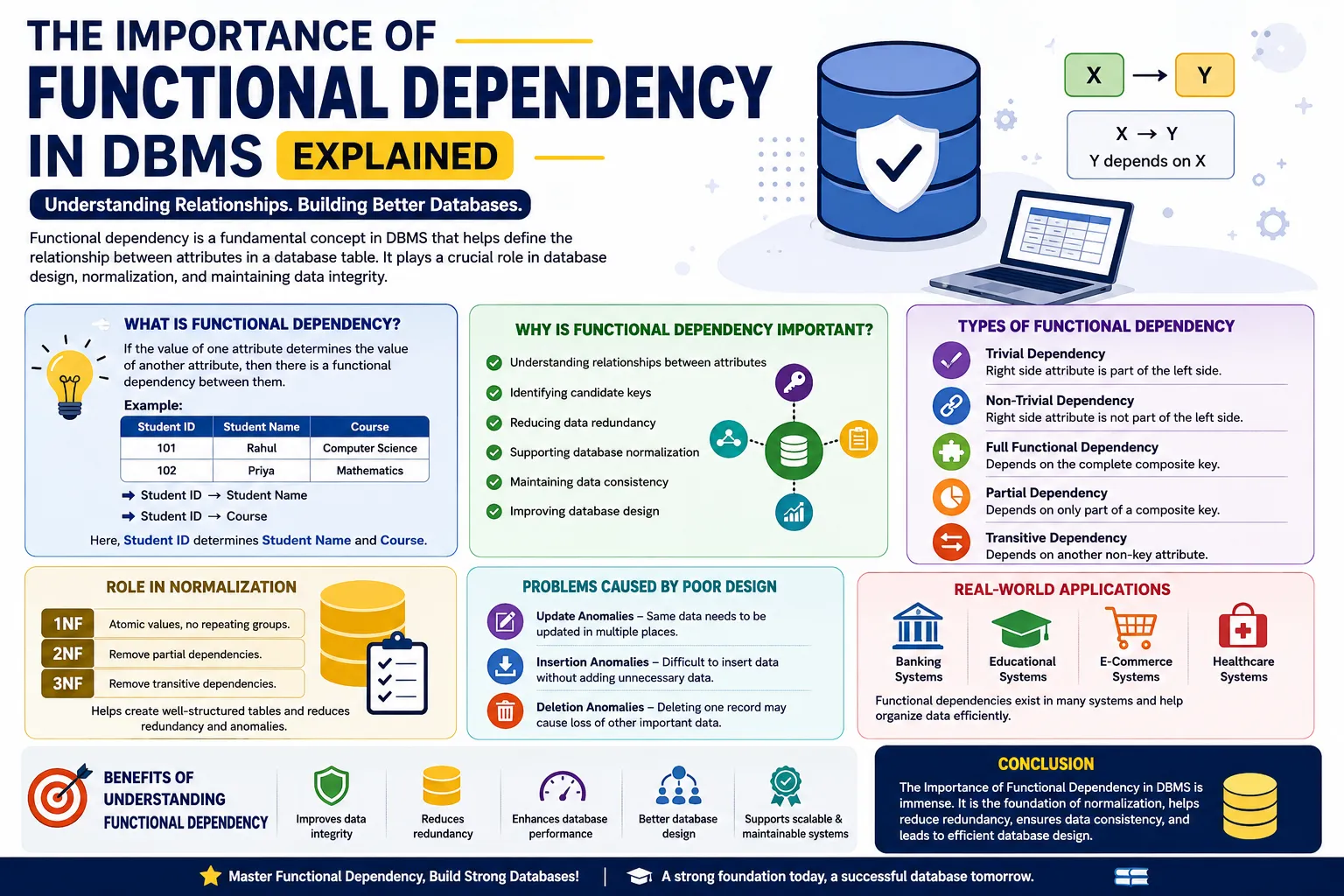
A functional dependency is a relationship between two attributes in a database.
In simple terms, if the value of one attribute determines the value of another attribute, there is a functional dependency between them.
It is commonly represented as:
X → Y
This means that the value of Y depends on X.
For example, consider a student database:
| Student ID | Student Name | Course |
|---|---|---|
| 101 | Rahul | Computer Science |
| 102 | Priya | Mathematics |
In this example:
Student ID → Student Name
Since every student has a unique ID, the Student ID determines the Student Name.
Similarly:
Student ID → Course
Functional dependency helps database designers understand how different attributes are related.
Why Is Functional Dependency Important?
Poor database design can lead to several problems, including:
- Duplicate information
- Inconsistent data
- Unnecessary storage
- Difficult updates
- Data anomalies
By identifying relationships between attributes, database designers can structure information more effectively.
Functional dependency helps in:
- Understanding relationships between attributes
- Identifying candidate keys
- Reducing data redundancy
- Supporting database normalization
- Maintaining data consistency
- Improving database design
These benefits make functional dependency an important concept for anyone studying DBMS.
Understanding Functional Dependency With an Example
Consider an employee table:
| Employee ID | Employee Name | Department |
|---|---|---|
| E101 | Amit | HR |
| E102 | Neha | IT |
| E103 | Ravi | Finance |
The following relationship may exist:
Employee ID → Employee Name
This means that the employee name depends on the Employee ID.
Another dependency may be:
Employee ID → Department
If every employee belongs to one department, the department information can be determined using the Employee ID.
Database designers study these relationships to decide how information should be stored and organized.
Types of Functional Dependency in DBMS
Understanding different types of functional dependency helps learners understand database normalization and table design.
Trivial Functional Dependency
A trivial functional dependency occurs when the attribute on the right side is already included in the attribute set on the left side.
For example:
{Student ID, Student Name} → Student Name
Since Student Name is already part of the left side, this is called a trivial dependency.
Non-Trivial Functional Dependency
A non-trivial functional dependency occurs when the dependent attribute is not part of the determinant.
For example:
Student ID → Student Name
Student Name is not included in Student ID, so this is a non-trivial functional dependency.
Full Functional Dependency
A full functional dependency occurs when an attribute depends on the complete composite key.
For example:
{Student ID, Course ID} → Grade
The Grade depends on both Student ID and Course ID.
Removing either attribute may not be enough to determine the Grade.
Partial Dependency
A partial dependency occurs when a non-key attribute depends on only part of a composite key.
For example:
{Student ID, Course ID} → Student Name
If Student Name depends only on Student ID, then this is a partial dependency.
Understanding partial dependencies is important when studying database normalization.
Transitive Dependency
A transitive dependency occurs when one attribute depends on another attribute through an intermediary.
For example:
Employee ID → Department ID
and
Department ID → Department Name
This creates an indirect relationship between Employee ID and Department Name.
Identifying transitive dependencies is useful when designing normalized databases.
Functional Dependency and Database Keys
Functional dependency helps identify important database keys.
Common database key concepts include:
- Super key
- Candidate key
- Primary key
- Composite key
For example:
Student ID → Student Name, Course
Since Student ID determines other attributes in the table, it may act as a candidate key.
Understanding dependencies helps database designers identify which attributes determine others and which attributes can uniquely identify records.
Functional Dependency in Normalization
Normalization is the process of organizing database tables to reduce redundancy and minimize data inconsistency.
Functional dependency plays an important role in normalization.
First Normal Form (1NF)
First Normal Form focuses on atomic values and avoids repeating groups.
Second Normal Form (2NF)
Second Normal Form focuses on eliminating partial dependencies.
Non-key attributes should depend on the complete key.
Third Normal Form (3NF)
Third Normal Form focuses on eliminating transitive dependencies.
The goal is to ensure that non-key attributes depend directly on the key rather than indirectly through another non-key attribute.
Understanding functional dependencies helps database designers create better table structures and reduce unnecessary duplication.
Functional Dependency and Data Redundancy
Data redundancy occurs when the same information is stored repeatedly without a valid reason.
Consider the following table:
| Employee ID | Employee Name | Department ID | Department Name |
|---|---|---|---|
| E101 | Amit | D01 | Human Resources |
| E102 | Neha | D01 | Human Resources |
The department name is repeated for every employee in the same department.
If the relationship is:
Department ID → Department Name
The database can be normalized by separating department information into another table.
Employee Table
| Employee ID | Employee Name | Department ID |
|---|---|---|
| E101 | Amit | D01 |
| E102 | Neha | D01 |
Department Table
| Department ID | Department Name |
|---|---|
| D01 | Human Resources |
This structure helps reduce repeated information.
Functional Dependency and Data Integrity
Data integrity refers to the accuracy and consistency of data stored in a database.
Functional dependencies help database designers understand how data should be related.
For example:
Product ID → Product Name
If one Product ID is linked to multiple product names without a valid reason, the data may be inconsistent.
Understanding proper relationships between attributes helps organizations maintain a more stable database structure.
This becomes especially important in systems that manage large amounts of business information.
Importance for Database Design
Database design begins with understanding data and the relationships between different attributes.
Functional dependency helps answer questions such as:
- Which attribute determines another attribute?
- Which attributes should be placed together?
- Which information is repeated unnecessarily?
- Which attributes can act as keys?
- How can normalization improve the design?
These concepts help database professionals build structured and logical database systems.
Over time, a well-designed database can become easier to manage and maintain.
Functional Dependency in Real-World Applications
Functional dependencies can be found in many types of database systems.
Banking Systems
A unique account number may determine information related to a particular account.
Educational Systems
A Student ID may determine information related to a student.
E-Commerce Systems
A Product ID can be used to identify information related to a product.
Healthcare Systems
A patient identifier may be linked to relevant patient information according to the database structure and applicable privacy requirements.
These relationships help database systems organize information effectively.
How Functional Dependency Helps Students and Professionals
Functional dependency is an important topic for students learning DBMS.
It is useful in areas such as:
- Database design
- SQL
- Normalization
- Data modeling
- Database administration
- Software development
It is also a topic that may appear during technical interviews and assessments.
If you are preparing for Advanced DBMS Interview Questions, it is important to understand functional dependencies and their relationship with normalization and database keys.
Instead of memorizing definitions, learners should practice identifying dependencies using sample tables.
Ask questions such as:
- Which attribute determines another attribute?
- Is the dependency partial?
- Is there a transitive dependency?
- How can the table be normalized further?
This practical approach can help develop a deeper understanding.
Problems Caused by Poor Database Design
Ignoring functional dependencies can create several database problems.
Update Anomalies
Information may need to be updated in multiple places.
If one record is updated and another is not, the database may become inconsistent.
Insertion Anomalies
A situation may arise where information cannot be added without including unnecessary data.
Deletion Anomalies
Deleting one record may accidentally remove other important information.
Proper database design and normalization can help reduce these problems.
Functional Dependency and SQL
Functional dependency is mainly a database design concept, while SQL is used to interact with databases.
However, understanding functional dependency can help developers work more effectively with database tables.
It helps professionals understand:
- How tables are structured
- Why keys are used
- How tables are related
- Why normalization is important
- How to minimize redundant data
A strong understanding of database concepts can also make SQL easier to learn.
How to Learn Functional Dependency
Learning functional dependency can be easier when approached step by step.
Step 1: Understand Attributes
Learn what attributes and database tables are.
Step 2: Understand Keys
Learn about:
- Primary Key
- Candidate Key
- Composite Key
Step 3: Learn Dependency Relationships
Practice identifying which attribute determines another attribute.
Step 4: Study Different Types
Learn about:
- Trivial dependency
- Non-trivial dependency
- Full dependency
- Partial dependency
- Transitive dependency
Step 5: Learn Normalization
Understand how functional dependencies are used in:
- 1NF
- 2NF
- 3NF
Step 6: Practice With Examples
Use simple examples involving:
- Students
- Employees
- Products
- Customers
Regular practice can make these concepts much easier to understand.
Functional Dependency and Advanced Database Knowledge
As learners progress further into database management, they may encounter more advanced concepts, including:
- Database normalization
- Relational algebra
- Database transactions
- Query optimization
- Indexing
- Data integrity
- Database security
A strong understanding of functional dependency can make it easier to understand how relational database systems are designed.
Students preparing for Advanced DBMS Interview Questions should be able to explain functional dependency with examples rather than simply memorizing a definition.
Interviewers may ask candidates to identify dependencies in a table or explain how normalization reduces redundancy.
Practicing such scenarios can help learners explain their understanding with greater confidence.
Tips for Learning Functional Dependency
Start With Simple Examples
Begin with simple tables before moving to complex database systems.
Identify the Key
Find the attribute that uniquely identifies a record.
Study Attribute Relationships
Observe how one attribute determines another.
Practice Normalization
Apply functional dependency concepts while normalizing database tables.
Avoid Memorization Only
Focus on understanding why a relationship exists rather than only memorizing its definition.
Use Real-Life Examples
Examples involving students, employees, products, and customers can simplify the learning process.
Frequently Asked Questions
What is functional dependency in DBMS?
Functional dependency is a relationship between attributes in a database where one attribute or a set of attributes determines another attribute.
It is commonly represented as:
X → Y
This means that X determines Y.
Why is functional dependency important in DBMS?
Functional dependency is important because it helps identify relationships between attributes. It supports normalization, reduces redundancy, improves database design, and helps maintain data consistency.
What are the basic types of functional dependency?
Common types include:
- Trivial dependency
- Non-trivial dependency
- Full functional dependency
- Partial dependency
- Transitive dependency
What is an example of functional dependency?
A simple example is:
Student ID → Student Name
A Student ID determines the Student Name because each ID uniquely identifies one student.
What role does functional dependency play in normalization?
Functional dependency helps identify relationships between attributes. These relationships are used during database normalization to organize tables and reduce partial and transitive dependencies.
What is the difference between full dependency and partial dependency?
A full functional dependency depends on the complete composite key.
A partial dependency occurs when a non-key attribute depends on only part of a composite key.
Is functional dependency important for DBMS interviews?
Yes. Functional dependency is an important DBMS concept and may be discussed in interviews involving normalization, database keys, and database design.
Conclusion
The Importance of Functional Dependency in DBMS lies in its ability to help developers and database professionals understand relationships between attributes. It plays an important role in database design, normalization, key identification, and reducing data redundancy.
Understanding different dependency types—including trivial, non-trivial, full, partial, and transitive dependencies—helps learners analyze how data should be structured in a relational database. These concepts can also help reduce common database problems such as update, insertion, and deletion anomalies.
Functional dependencies are important for both students and professionals because they provide a strong foundation for DBMS knowledge. With consistent practice and real-life examples, learners can better understand database relationships and design more efficient databases.
Ultimately, understanding the Importance of Functional Dependency in DBMS can provide learners with a strong foundation for database management, SQL, normalization, and other technical concepts.


























Sign in to leave a comment.