

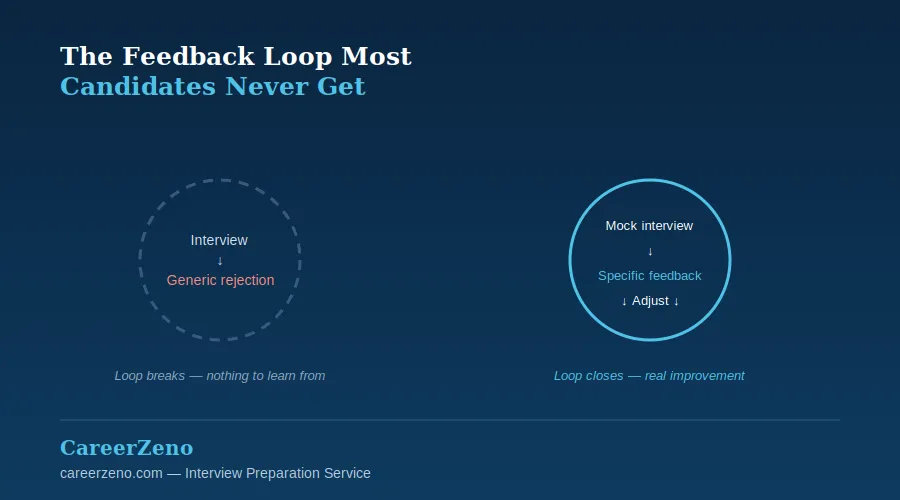
Most job seekers go through interview after interview without ever finding out exactly what went wrong when an offer doesn't come through. A rejection email rarely explains anything specific, which means the same mistakes can repeat across multiple interviews with no real feedback loop in place to catch them. This is one of the more overlooked problems a structured interview preparation service is built to solve.
Why Rejections Don't Teach Anything
A generic rejection — "we've decided to move forward with other candidates" — carries no information about what actually happened in the room. Was the answer too long? Too vague? Did a particular question land poorly? Without that detail, a candidate is left guessing, and guessing rarely produces the same improvement that specific feedback would. Two completely different problems — under-preparation and over-rehearsal — can both result in the exact same rejection email, with no way to tell which one actually occurred.
The Compounding Effect of No Feedback
Without a feedback loop, a candidate can walk into interview after interview making the same mistake, refining nothing because there's nothing concrete to refine. A tendency to ramble, a habit of underselling achievements, a pattern of losing structure under a tough follow-up question — all of these can persist for months or years simply because no one ever pointed them out clearly enough to fix.
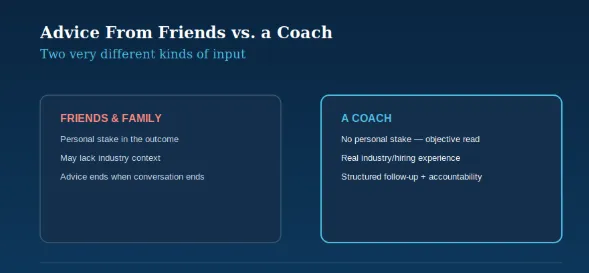
This is different from a lack of effort. Plenty of candidates genuinely try to improve between interviews — reviewing notes, thinking about what might have gone wrong — but self-diagnosis without outside input tends to circle the same blind spots repeatedly, since the person doing the diagnosing is the same person who couldn't see the problem in the first place.
What a Real Feedback Loop Looks Like
Structured interview preparation closes this gap by building feedback directly into the practice process. A mock interview isn't useful primarily because it's practice — it's useful because it comes with specific, honest notes afterward: this answer needed a clearer conclusion, this story didn't establish enough context before the outcome, this pause read as uncertainty rather than thoughtfulness. That kind of detail is exactly what a rejection email never provides.
Repetition matters here too. A single round of feedback helps, but a real feedback loop — practice, feedback, adjustment, practice again — is what actually changes behavior over time, in the same way any skill improves through repeated, corrected attempts rather than a single piece of advice absorbed once.
Why This Matters More With Every Passed-Over Application
Each interview that ends in silence without explanation is a missed opportunity to actually improve, not just try again. Candidates who go through this cycle repeatedly without ever getting real feedback often plateau — not because they're not capable, but because there's no mechanism helping them see what's actually holding them back.
CareerZeno is built specifically to provide the feedback loop that real interviews never offer, turning practice into targeted improvement rather than repeated guessing.
A rejection email closes a door quietly. Good feedback is what actually opens the next one.



























Sign in to leave a comment.