
Every real estate professional has heard some version of the same advice:
"Buy in the right neighborhood and everything else will follow."
The statement sounds reasonable. In many cases, it has guided investment decisions for decades. Developers, lenders, brokers, insurers, and investors often begin their analysis by looking at the reputation of a neighborhood, a city, or a market.
But there is a problem with that approach.
Neighborhoods do not behave as a single unit.
Risk does not respect ZIP codes, city districts, or the lines drawn on market reports. In reality, conditions can change dramatically from one street to the next. Yet many decisions worth millions of dollars are still influenced by broad geographic averages.
That gap between perception and reality is where costly mistakes often begin.
The Neighborhood Trap
Real estate professionals have access to more data than ever before. Demographic reports, traffic studies, market forecasts, economic indicators, and regional crime statistics are readily available.
The challenge is that most of these datasets are designed to describe large areas.
A neighborhood may appear attractive on paper because average income levels are rising and vacancy rates are low. A city may rank favorably on a national list. A market report may suggest strong growth potential.
None of those insights necessarily explain what is happening around a specific property.
A retail location can struggle despite being positioned in a thriving district. A multifamily investment can experience higher operating costs than expected. A commercial asset can face challenges that were never visible during the acquisition process.
The issue is not a lack of information.
The issue is that the wrong information often receives the most attention.
Looking Beyond the Average
Imagine evaluating two properties located within the same neighborhood.
Both share similar demographics. Both benefit from the same market conditions. Both appear equally attractive in traditional reports.
Yet one experiences recurring incidents that affect customer traffic and tenant satisfaction, while the other does not.
From a distance, the locations appear nearly identical.
Up close, they tell completely different stories.
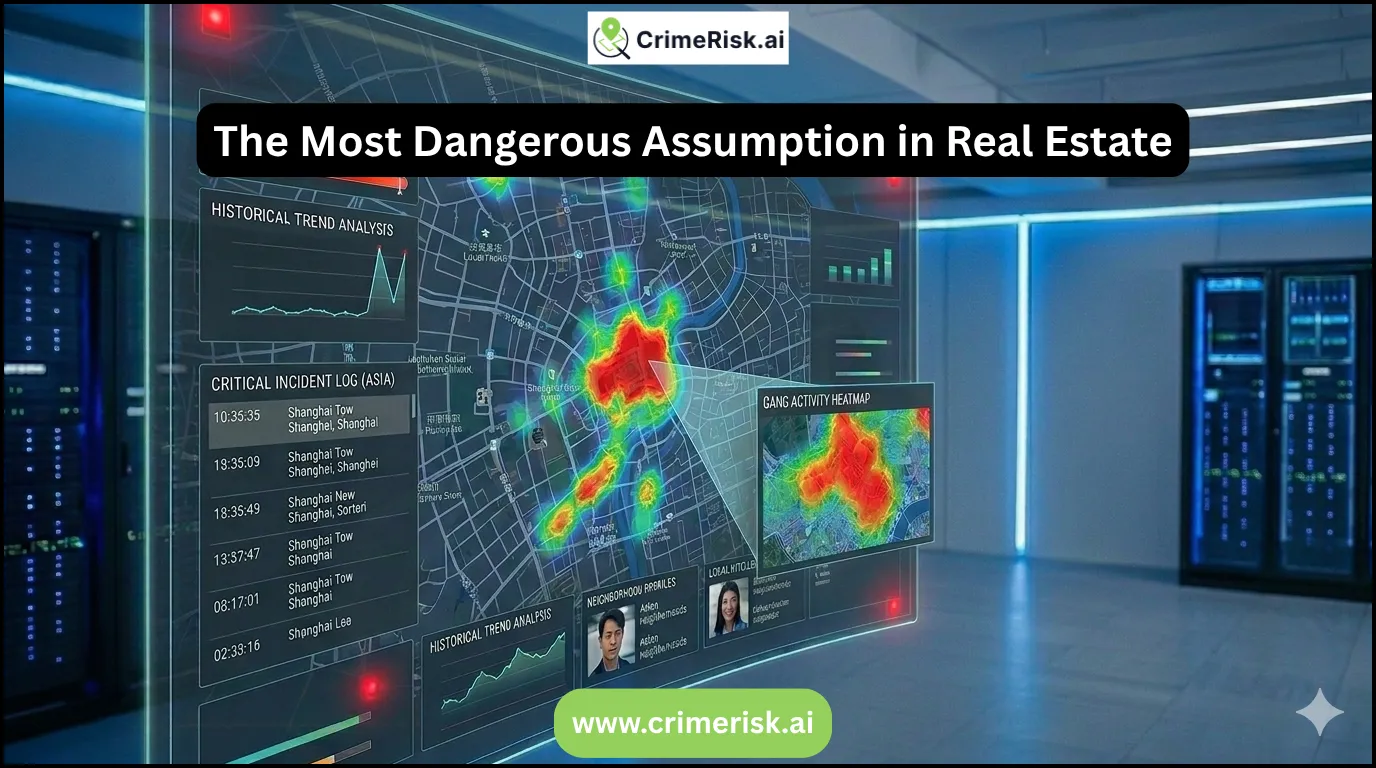
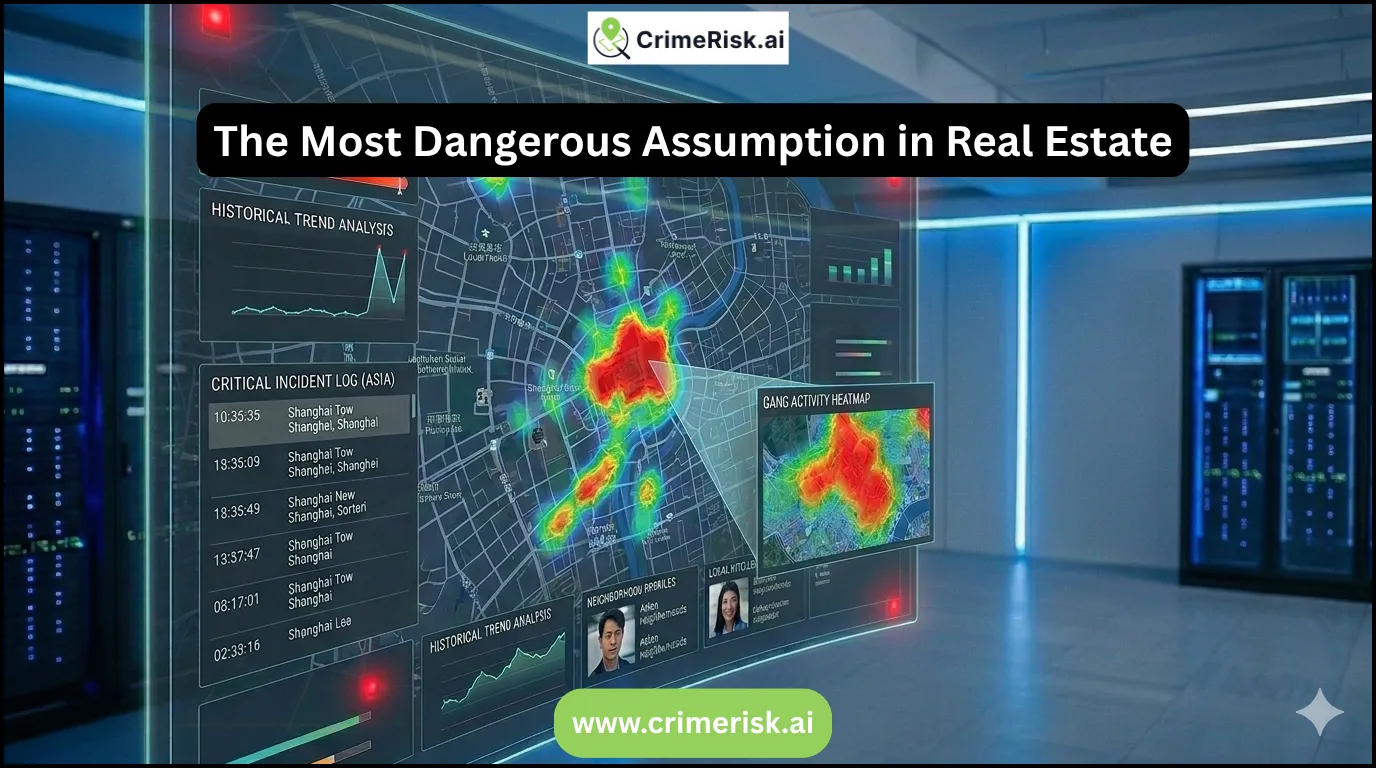
This is why many organizations have started moving away from broad assumptions and toward address-specific crime data (block-level precision).
When analysis becomes more granular, patterns begin to emerge that are often invisible in citywide or neighborhood-level reporting. Small differences in location can create significant differences in exposure, performance, and long-term value.
The Difference Between Data and Understanding
The real estate industry has never suffered from a shortage of statistics.
What has often been missing is context.
Knowing that incidents occurred in a particular area is useful. Understanding how those incidents are changing, where they are concentrated, and how they relate to surrounding locations is far more valuable.
This is where crime risk analytics has become increasingly important.
Organizations are no longer satisfied with static reports that provide a snapshot of the past. They want a clearer picture of what is happening today and where conditions may be heading tomorrow.
Patterns, trends, movement, and concentration frequently reveal more than raw totals ever could.
A location experiencing stable conditions may present a very different opportunity than one showing signs of emerging risk, even if both appear similar in traditional datasets.
Why Rankings Can Create False Confidence
Many professionals use the crime index usa as part of their research process. These rankings can provide helpful comparisons and broad market context.
The problem arises when rankings become substitutes for deeper analysis.
A city with a favorable score is not automatically low risk.
Likewise, a city with a less favorable score is not automatically a poor investment environment.
Every market contains variation.
Some of the most attractive opportunities exist in locations that challenge conventional assumptions, while some of the greatest surprises occur in places that appear secure based on broad averages.
Successful decision-making often comes from understanding what exists beneath the ranking rather than relying on the ranking itself.
A Shift in How Organizations Evaluate Risk
Over the last few years, location intelligence has quietly become part of the due diligence process across multiple industries.
Commercial real estate firms use it to evaluate acquisitions. Retailers use it to support expansion strategies. Insurers use it to assess exposure. Lenders use it to strengthen underwriting decisions.
What these organizations share is a common realization:
Location decisions are rarely improved by less detail.
They are improved by more relevant detail.
This growing demand has increased interest in platforms capable of delivering meaningful crime risk data and intelligence rather than disconnected reports gathered from multiple sources.
Decision-makers want information that helps them understand a location as it actually exists—not as an average, a summary, or a generalized market profile.
Turning Information Into Better Decisions
Collecting data is relatively easy.
Turning data into practical business insight is considerably harder.
That is why many organizations are adopting a dedicated crime risk reporting platform that can transform large volumes of location information into a format that supports real-world decisions.
Instead of spending time assembling data from various sources, teams can focus on evaluating opportunities, identifying concerns, and understanding the factors that may influence future outcomes.
The objective is not simply to know more.
The objective is to make better decisions with greater confidence.
The Future Belongs to the Most Informed Decision-Makers
The real estate industry has always rewarded those who can identify opportunities before others recognize them.
Today, that advantage increasingly comes from understanding location at a deeper level.
The assumption that every property within a desirable neighborhood shares the same risk profile is becoming harder to defend. Markets are more dynamic, information is more accessible, and expectations for due diligence continue to rise.
Organizations that rely solely on broad averages may continue to make decisions.
Organizations that leverage detailed crime risk data and intelligence, advanced crime risk analytics, and address-specific crime data (block-level precision) are positioned to make better ones.
That distinction matters.
Because in real estate, the most dangerous assumption is often the one that everyone else accepts without question.





























Sign in to leave a comment.