
When a business commits to "going green," the initial focus almost always lands on corporate headquarters. We swap out plastic kitchen utensils, transition to digital-only invoicing, and install energy-efficient lighting. These are noble changes, but they barely scratch the surface of a company's actual environmental footprint.
The real epicenter of corporate waste is almost always the warehouse floor.
Every single day, the average distribution center or fulfillment hub generates a staggering amount of plastic waste. From mountains of discarded bubble wrap and plastic air pillows to miles of clear packing tape and heavy-duty strapping, the logistics industry has long been addicted to single-use plastics.
But things are changing fast. Driven by stricter environmental regulations across Australia and a massive shift in consumer expectations, operations teams are under immense pressure to clean up their acts.
The good news? Transitioning toward a plastic-free warehouse doesn’t require a multi-million dollar overhaul or a drop in operational speed. It starts with simple, calculated swaps your team can make today.
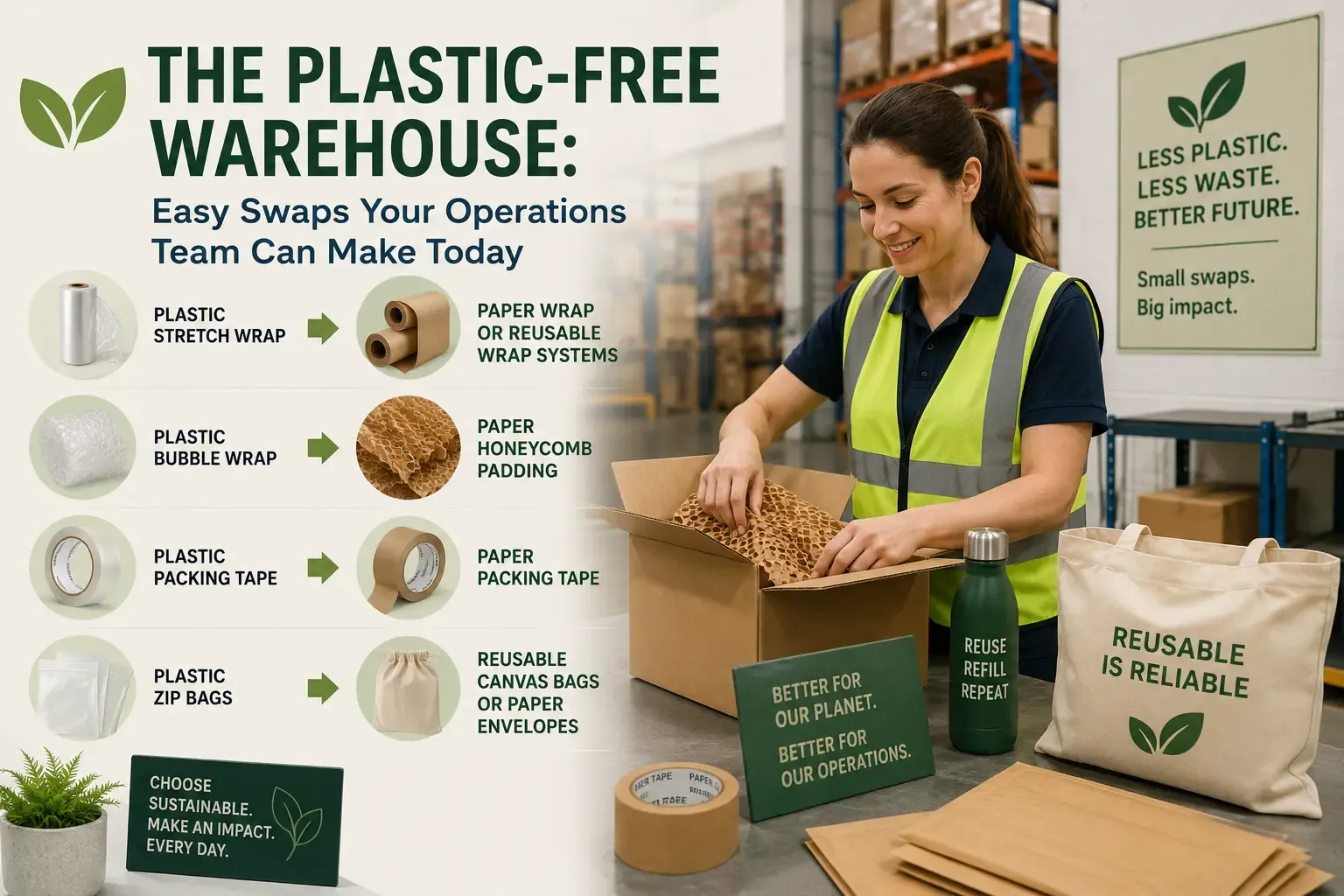
Swap 1: Plastic Bubble Wrap 🔄 Honeycomb and Paper Cushioning
For decades, plastic bubble wrap was the undisputed king of void-fill. It’s lightweight, relatively cheap, and fun to pop. But it is also a recycling nightmare. Most consumers cannot recycle it curbside, meaning it almost exclusively ends up in landfills or polluting waterways.
The Easy Swap: Replace standard bubble wrap with structured, expandable honeycomb paper wrap or automated paper cushioning systems.
When tension is applied to honeycomb paper, it expands into an interlocking, three-dimensional web that provides incredible shock absorption and scratch protection. Not only does it look beautifully premium and artisanal to the end consumer, but it is also 100% biodegradable and recyclable right in the curbside bin. For high-volume pack benches, integrating modular paper void-fill systems—like the advanced Paperfil™ range—keeps packing speeds lightning-fast while removing plastic from the equation entirely.
Swap 2: PP and PVC Packing Tape 🔄 Water-Activated Paper Tape
Standard polypropylene (PP) or PVC packing tape is a silent killer of circular recycling. When a consumer throws a cardboard box wrapped in heavy plastic tape into a recycling bin, the plastic tape must be mechanically separated at the processing plant. If it can't be separated easily, the entire cardboard box can end up rejected and sent to landfill.
The Easy Swap: Switch your packing benches over to Water-Activated Paper Tape (WAT) or self-adhesive paper tapes.
Water-activated paper tape is crafted from natural kraft paper and backed with a starch-based adhesive. When moistened, the adhesive penetrates the fibers of the cardboard box, creating a permanent, tamper-evident structural bond. It makes the box significantly stronger than standard plastic tape ever could, and because it is made of organic materials, the entire box can be thrown straight into the cardboard recycling stream without stripping the tape off.
Swap 3: Plastic Poly Mailers 🔄 Heavy-Duty Kraft Mailing Bags
If your e-commerce operations ship non-fragile goods like apparel, soft furnishings, or packaged documents, chances are you are burning through thousands of grey plastic poly mailers every week. They are incredibly cheap, but they are single-use plastic at its worst.
The Easy Swap: Transition your shipping workflow to heavy-duty, gusseted Kraft paper mailers.
Modern paper mailers are constructed from thick, tear-resistant, and water-repellent kraft paper. Many options feature double peel-and-seal strips, allowing your customers to reuse the exact same bag if they need to process a return. They stack flat, take up minimal warehouse space, and instantly signal to your customer that your brand takes sustainability seriously the moment it hits their doorstep.
Swap 4: Traditional Plastic Pallet Wraps 🔄 High-Yield Nano Films
Let's face it: achieving a 100% plastic-free warehouse is an incredible challenge when it comes to transporting multi-tonne pallet loads on Australian roads. Pallets must be tightly secured to prevent catastrophic transit shifting. Until heavy-duty reusable containment systems become standard, stretch film remains a logistical necessity.
However, you can radically reduce the volume of plastic your warehouse uses by swapping out low-grade, thick films for engineered alternatives.
The Easy Swap: Audit your pallet wrapping stations and upgrade to ultra-thin, multi-layer nano-technology stretch films.
Instead of using a traditional 20-micron plastic film that relies on sheer thickness for strength, switching to advanced high-performance stretch film allows you to drop down to a significantly thinner gauge (such as 10 or 12 microns) without losing any containment force. When paired with a calibrated wrapping machine, this single operational swap can slash your total plastic film usage by up to 50% overnight. You aren't changing your workflow; you are simply engineering the plastic waste out of it.
The Bottom Line: Start Small, Scale Fast
Transitioning to an eco-friendly warehouse doesn't have to be an all-or-nothing mission. The most successful operations teams start by tackling one material at a time—swapping out tape this month, upgrading void-fill the next, and optimizing their pallet wrapping processes down the line.
By collaborating with end-to-end industrial supply experts like Omni Group, businesses across Australia are discovering that sustainable packaging isn't just an environmental win—it’s an efficiency win.
Every plastic piece you eliminate from your warehouse reduces waste disposal costs, streamlines packing workflows, and secures your position as a forward-thinking, responsible brand. Take a walk through your packing lines today, spot the plastic, and make the swap

























Sign in to leave a comment.