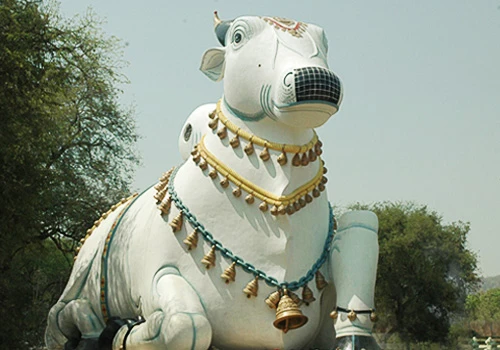

Shiva is one of the Hindu trinity of Gods, which includes Vishnu and Brahma as well.While Brahma is the creator and Vishnu, the Preserver, Shiva is the destroyer.Shiva’s vahana or mount (vehicle) is the bull called Nandi. In Hindu dharma, Nandi represents truth and righteousness.
The Concept of Vahanas in Hindu Mythology
Every deity has his/her own vahana in Hindu mythology. Usually, these vahan as belong to endangered species like tiger, lion, peacock, eagle, swan, etc. Hindus believed that making them the vehicles of the gods would give them some measure of protection from rampant poaching and hunting. Also, each animal/bird represents certain qualities associated with the God, in terms of image and function.
For instance, Garuda, the Eagle, is Vishnu’s vahana. As Vishnu is the protector, he needs to be swift and agile, like the Eagle. Simha or Lion is the vahana of Durga, who is a fierce warrior goddess. Like her, the Lion symbolizes courage and ferocity, qualities required in a warrior. Hamsa or Swan is the vahana of Saraswati, the goddess of knowledge. The Swan stands for qualities like beauty and purity, that are required in knowledge.
History of Nandi
Nandi has been identified as Shiva’s vahana since the Kushan dynasty (1st century CE).The image of Shiva with Nandi is one of the oldest Hindu images. Scholars believe that this image emerged because people in those days wanted a deity to protect their cattle, which were regarded as wealth and property. Ancient civilizations in Egypt and Mesopotamia too considered the bull as a form of God.
Significance of Nandi
Nandi’s most important qualities are strength, virility, load-bearing ability. Shiva is a deity who is mostly engaged in meditation. He has not waged many fierce battles, nor did he have to be quick and agile, like Vishnu. It was more about connecting to people for Shiva. And in the old days, bulls being the mode of transportation in India, he could connect to people through the bull, Nandi.
In many Shiva temples, we can see the sculpted form of a humped white bull facing the entrance door of the shrine and reclining on a raised platform. In this position, he can gaze on Shiva perpetually. Nandi is one of the chief attendants of Shiva. Occasionally is depicted as a bull-headed dwarf figure. In his wholly anthropomorphic form, he is known as Nandikeshvara or Adhikaranandin. The word ‘Nandi’ comes from the Tamil root word, ‘Nandhu’ meaning ‘to grow, to flourish,’ etc. The Sanskrit word ‘nandi’ means ‘happy,joy, and satisfaction’. These are the properties of Shiva- Nandi. Almost all Shiva temples have stone sculptures of Nandi in the sitting position and facing the main shrine.
Nandiis also the gate-guardian deity of Mount Kailasa, the abode of Shiva. In Saivite Saivite siddhantic tradition, he is seen as the chief guru of eight disciples of NandinathaSampradaya.
Theyare Sanaka,Sanandana Sanatana, Sanatkumara, Vyagrapada, Tirumular, Patanjali, and Sivayoga Muni. They were supposedly sent in eight different directions, to spread Shaivism. In Vietnam, the Cham Hindus believe that when they die, Nandi will come to take their souls to India.
Nandi’s Anthropomorphic properties
He protects Hindu morality and the religious way of life
He is the chief of 18 Siddhas of Hindu dharma
He can grant boons. In some temples in south India, people whisper their wishes in Nandi’s ears, believing that their wishes would be fulfilled.
More About Nandi
Nandi is said to be the son of Sage Shilada. Shilada performed rigorous penance to get a child who would be immortal and Shiva’s blessings. Nandi was born as hisson. Supposedly, Nandi was born from a Yagna performed by the sage. It is said that when he was born, his body was covered in an armor made of diamonds. Nandi became an ardent devotee of Shiva and undertook penance to become his gate-keeper and mount. He did penance on the banks of the Narmada river Narmada, near Tripur Tirth Kshetra. This is in present-day Nandikeshwar Temple, in Jabalpur, Madhya Pradesh.
Nandi obtained the divine-knowledge of Agamic and Tantric wisdom from Parvati, who was taught by Shiva. He, in turn, taught it to his eight disciples. Other Puranic tales about Nandi talk about his conflict with Ravana,the demon king of Lanka, the villain of the Ramayana. Nandi cursed that Ravana’s kingdom would be burnt by a monkey. That monkey, of course, turned out to be Hanuman.
The Thiruvilaiyadal Puranam says that Nandi incarnated as a whale. The story goes that Parvati let her attention drift when Shiva was explaining the Vedas to her. She was born as a fisher-woman to atone for this sin. Nandi became a whale to reunite Shiva and Parvati. He began to harass the people, and the fisher-woman Parvati\'s father was informed that the man who killed the whale would marry his daughter. Shiva came there as a fisherman and killed the whale.Then he restored Parvati to her previous form.
Nandi’s white color represents purity and justice. In symbolic terms, the seated Nandi facing the sanctum in Shiva temples represents the individual jiva (soul). The jiva should be focused on the Parameshwara always – this is the message of Nandi’s gaze on Shiva. Nandi represents the mind dedicated to the Absolute, which is Shiva.
Read more : https://www.astroved.com/astropedia/en/festivals/pradosham
















Sign in to leave a comment.