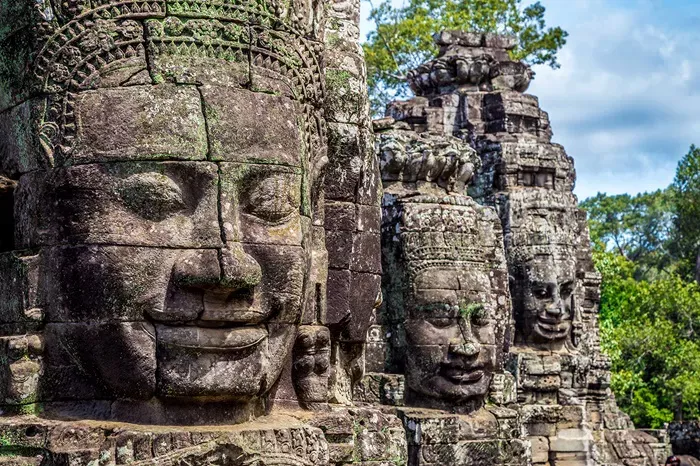

Bayon Temple stands at the spiritual and symbolic center of Angkor Thom in Cambodia. It is one of the most profound expressions of Buddhist philosophy ever carved into stone. Built during the reign of King Jayavarman VII in the late 12th century, the temple reflects the ideals of Mahayana Buddhism, especially compassion, wisdom, and the interconnected nature of all beings.
Unlike many earlier Khmer temples dedicated to Hindu gods, Bayon represents a shift toward a more inward and compassionate spiritual worldview.
Historical Background of Bayon Temple

The Rise of Jayavarman VII
Bayon Temple was constructed under King Jayavarman VII, one of the most powerful and influential rulers of the Khmer Empire. His reign followed a period of turmoil, including invasions by the Cham people. These hardships shaped his vision of leadership. Instead of ruling through fear or dominance, he embraced the Buddhist ideal of the Bodhisattva, a being who seeks enlightenment for the benefit of all.
Jayavarman VII initiated large-scale building projects across his empire. He constructed hospitals, roads, rest houses, and temples, all aimed at reducing suffering. Bayon was his state temple, and it stood as the spiritual heart of his compassionate kingdom. Through it, he expressed his belief that a ruler should serve the people with wisdom and kindness.
Religious Transformation
Before Jayavarman VII, the Khmer Empire was primarily influenced by Hinduism. Temples were dedicated to deities such as Shiva and Vishnu. Bayon represents a turning point. It reflects the adoption of Mahayana Buddhism, which emphasizes compassion and the role of Bodhisattvas.
This transition did not erase earlier traditions. Instead, Bayon incorporates both Buddhist and Hindu elements. This blending reflects the fluid spiritual landscape of the time and shows how different traditions can coexist and influence one another.
Later History and Decline
After the death of Jayavarman VII, subsequent rulers gradually returned to Hindu practices. Some Buddhist images at Bayon were modified or removed. Over time, the temple fell into neglect as the capital shifted and the empire declined.
Nature slowly overtook the structure. Trees and roots spread across the stone surfaces. Despite this, the temple endured. Its calm faces remained, silently observing the passage of centuries. This endurance reflects the Buddhist teaching of impermanence, showing that while all things change, their essence can still be perceived.
Architectural Design and Layout
A Mandala in Stone
The design of Bayon Temple can be understood as a three-dimensional mandala. In Buddhist practice, a mandala represents the universe and serves as a tool for meditation. The central tower symbolizes Mount Meru, the cosmic center in Buddhist and Hindu cosmology. Surrounding galleries represent layers of existence and consciousness.
This layout encourages a journey inward. As visitors move from the outer areas toward the center, they symbolically move from ignorance toward enlightenment. This reflects the Buddhist path of self-discovery and awakening.
Three Levels of Structure
Bayon consists of three main levels, each with its own meaning. The outer gallery contains detailed carvings of daily life and historical events. This level represents the world of ordinary experience. The middle level becomes more symbolic, with fewer carvings and more emphasis on structure. The upper level contains the iconic face towers, representing a higher state of awareness and spiritual insight.
This progression mirrors the Buddhist path. One begins by observing life as it is, then reflects on its deeper meaning, and finally reaches a state of clarity and compassion.
Materials and Construction
The temple was built using sandstone and laterite. Sandstone allowed for intricate carvings, while laterite provided a strong structural base. The combination of these materials reflects both practicality and artistic expression.
The construction of Bayon required immense effort and skill. It stands as a testament to the advanced engineering and artistic abilities of the Khmer civilization.
The Iconic Smiling Faces

Symbol of Compassion
The most recognizable feature of Bayon Temple is its many towers adorned with large, serene faces. These faces are believed to represent Avalokiteshvara, the Bodhisattva of compassion. In Mahayana Buddhism, Avalokiteshvara embodies the ideal of selfless care for all beings.
The gentle smile of the faces conveys peace and understanding. It suggests a mind free from anger and attachment. This expression serves as a silent teaching, encouraging visitors to cultivate compassion in their own lives.
The King and the Divine
Some interpretations suggest that the faces also resemble King Jayavarman VII himself. This reflects the idea that the king embodied the qualities of a Bodhisattva. By combining his image with that of Avalokiteshvara, the temple presents a vision of leadership grounded in compassion and wisdom.
This concept was central to his rule. It reinforced the idea that true power comes not from control, but from service to others.
A Sense of Presence
As visitors walk through Bayon, they often feel as if the faces are watching them. This creates a sense of awareness and reflection. In Buddhism, awareness is essential for understanding the mind and overcoming suffering.
The faces encourage mindfulness. They remind us to observe our thoughts and actions, and to act with intention and care.
Bas-Reliefs and Narrative Art
Depictions of Daily Life
The outer galleries of Bayon are covered with detailed bas-reliefs. These carvings depict scenes from everyday life, including markets, fishing, cooking, and social interactions. Such scenes highlight the importance of ordinary experience in the spiritual journey.
In Buddhism, enlightenment is not separate from daily life. By paying attention to simple activities, one can develop mindfulness and insight. The carvings at Bayon reflect this principle beautifully.
Historical Narratives
Some bas-reliefs depict historical events, especially battles between the Khmer and the Cham. These scenes provide valuable insight into the history of the empire. They also remind viewers of the realities of conflict and the importance of peace.
From a Buddhist perspective, these images can be seen as reflections on suffering and its causes. They invite contemplation on how conflict arises and how it might be resolved through wisdom and compassion.
Myth and Spiritual Symbolism
Other carvings include mythological and religious themes. These often blend Buddhist and Hindu elements, reflecting the cultural diversity of the time. This integration shows that spiritual truth can be expressed in many forms.
The presence of multiple traditions within a single temple highlights the inclusive nature of the Khmer spiritual worldview.
Cultural and Religious Significance

A Living Spiritual Center
Bayon was not only a monument but also an active center of worship. Monks, pilgrims, and scholars gathered here to study and practice. It served as a place where spiritual teachings were lived and shared.
Even today, Bayon continues to inspire visitors from around the world. It remains a powerful symbol of Buddhist philosophy and artistic achievement.
Compassionate Governance
The temple reflects the vision of Jayavarman VII as a compassionate ruler. His projects aimed to reduce suffering and improve the lives of his people. This approach aligns with the Buddhist principle of compassion for all beings.
Bayon stands as a reminder that leadership can be guided by ethical and spiritual values.
Unity of Art and Spirituality
At Bayon, art and spirituality are inseparable. Every carving, structure, and design element carries meaning. This unity reflects a key aspect of Buddhist culture, where artistic expression serves as a vehicle for teaching and reflection.
Conclusion
Bayon Temple is more than a historical site. It is a profound expression of Buddhist philosophy and human creativity. Through its architecture, carvings, and symbolism, it offers insight into the nature of compassion, awareness, and impermanence.
The temple invites us to reflect on our own lives. It reminds us that true understanding comes from observing the world with clarity and acting with kindness. In this way, Bayon continues to teach, even centuries after its creation.
In a rapidly changing world, Bayon stands as a quiet presence. Its faces still smile, offering a timeless message of peace and compassion to all who encounter it.
FAQs
What makes Bayon Temple unique?
Bayon Temple is unique for its many towers with large smiling faces. These faces symbolize compassion and awareness. The temple also features detailed carvings of daily life, making it both a historical and spiritual monument.
Why is Bayon important in Buddhism?
Bayon reflects the teachings of Mahayana Buddhism, especially the idea of compassion. It represents the vision of a ruler who sought to govern with kindness and wisdom.
Who was Avalokiteshvara?
Avalokiteshvara is a Bodhisattva in Mahayana Buddhism who represents compassion. The faces at Bayon are often associated with this figure, symbolizing care for all beings.
What do the carvings at Bayon show?
The carvings show scenes of daily life, historical events, and religious stories. They provide insight into the culture, beliefs, and experiences of the Khmer people.



















Sign in to leave a comment.