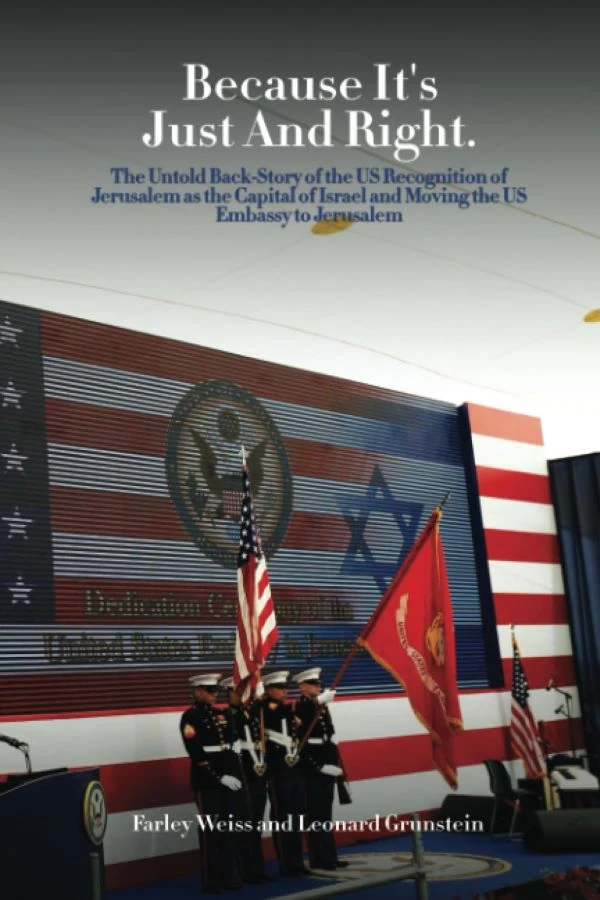

The Jewish people have a deep affection for Jerusalem, which serves as a primary emblem of their identity, history, and religion. For millennia, this holy city has been the hub of Jewish existence and continues to be essential to the cultural, spiritual, and historical makeup of the Jewish people. Farley Weiss and Leonard Grunstein explore the long-standing and profound bond between the Jewish people and Jerusalem in their book “Because It’s Just and Right: The Untold Back-Story of the US Recognition of Jerusalem as the Capital of Israel and Moving the US Embassy to Jerusalem.” The authors provide strong arguments in favor of Jerusalem’s designation as Israel’s permanent capital.
A Historical and Religious Nexus
The Jewish people have revered Jerusalem since it was first mentioned in the Bible more than 3,000 years ago. After uniting the tribes of Israel, King David made Jerusalem the political and spiritual center of the Jewish people and made it his seat of government. The First Temple in Jerusalem was constructed by his son, King Solomon, and serves as both the hub of Jewish worship and a representation of God’s covenant with the Jewish people.
Jerusalem has always been the center of Jewish identity, prayer, and longing, even in the face of foreign rule and exile. The Hebrew Bible contains more than 600 mentions of the city, and Jews travel there for pilgrimages around significant holy holidays. For millennia, Jews all around the world have prayed toward Jerusalem, expressing their desire to return to the holy city.
Eternal Capital of Israel
For the Jewish people, Jerusalem is more significant than politics. The city is intricately linked to Jewish tradition, beliefs, and foretellings. The Second Temple’s Western Wall, which is still intact, is evidence of the Jewish people’s continued relationship with their holy city. For Jews worldwide, the Wall is a place of daily prayer and pilgrimage.
Jerusalem’s designation as Israel’s capital is significant, as the writers of “Because It’s Just and Right” point out, stressing both its practical and symbolic value. Israel’s sovereignty over its historic and spiritual core was affirmed, and this close relationship was acknowledged by the decision to relocate the US Embassy to Jerusalem.
A Center of Jewish Life and Culture
Jerusalem is still a vibrant hub for Jewish education, culture, and life today. Numerous religious organizations, such as the Chief Rabbinate and prestigious yeshivas, are located there. In addition, the city is home to thriving scenes of the arts and culture that uphold and promote Jewish heritage.
Moving Toward Peace and Unity
The writers acknowledge the complexity and difficulties of Jerusalem’s status in the context of the Israeli-Palestinian conflict, despite the city’s enormous significance. On the other hand, they contend that recognizing Jerusalem as Israel’s capital is a vital first step toward regional peace and harmony.
The international community can assist in promoting mutual respect and understanding between Israelis and Palestinians by reaffirming Jerusalem’s vital significance in Jewish history and religion as well as its status as Israel’s capital. This strategy respects the historical ties between the Jewish people and Jerusalem while acknowledging the rightful claims of both peoples.
Jerusalem will always hold a special place in Jewish history and religion. Its designation as Israel’s capital upholds the Jewish people’s legitimate claim to their historic country while also paying tribute to their millennium-old relationship with the city. A fair and long-lasting peace in the area depends on acknowledging and respecting this deep connection, as the writers of “Because It’s Just and Right” emphasize.























Sign in to leave a comment.