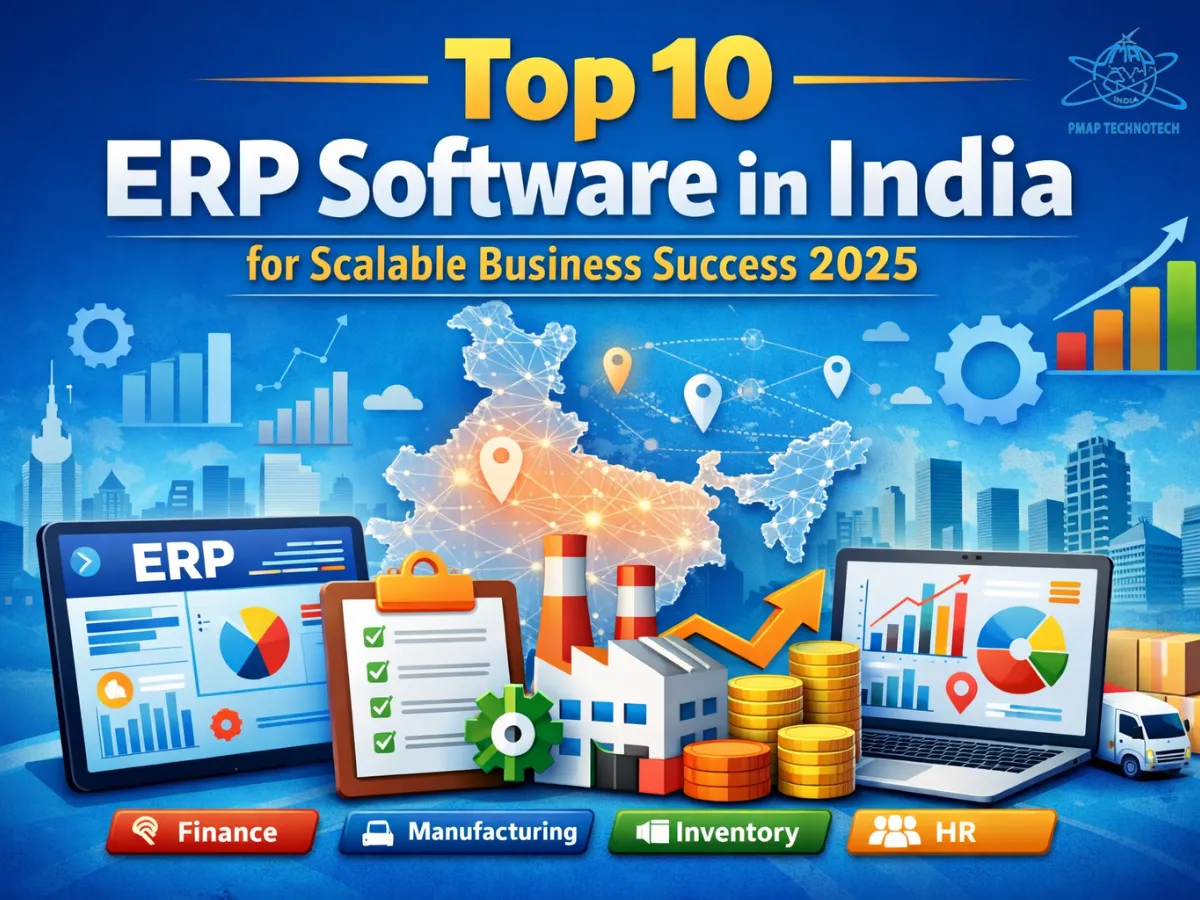

Enterprise Resource Planning (ERP) software has become the backbone of modern businesses in India. From manufacturing and retail to logistics and services, companies rely on ERP systems to manage finance, supply chain, HR, inventory, and customer operations in one integrated platform. As Indian businesses grow rapidly and adopt digital transformation, the demand for scalable ERP solutions continues to rise.
This article explores the Top 10 ERP Software in India, provides a list of top 10 ERP software in India, and explains how the top 10 ERP systems help companies achieve long-term growth and scalability.
Introduction: Why ERP Is Critical for Indian Businesses
The Indian market is highly competitive and dynamic. Businesses must handle GST compliance, multi-location operations, digital payments, supply chains, and real-time analytics. ERP software helps organizations manage all business functions from a centralized platform, reducing manual work and improving productivity.
A well-implemented ERP system can:
- Improve operational efficiency
- Provide real-time data visibility
- Reduce errors and duplication
- Enhance collaboration across departments
- Support business scalability
Choosing the right ERP is essential because the wrong system can limit growth. That’s why companies search for the Top 10 ERP Software in India before making a decision.
How We Selected the Top ERP Systems
To prepare the list of top 10 ERP software in India, we evaluated solutions based on:
- Scalability and flexibility
- Industry adoption in India
- Cloud and mobile capabilities
- Localization (GST, compliance, multi-currency)
- Integration and automation features
Several industry comparisons consistently highlight platforms like SAP, Oracle, Microsoft, Tally, Zoho, Odoo, and others as leading ERP solutions used by Indian businesses.
List of Top 10 ERP Software in India
1. SAP S/4HANA / SAP Business One
SAP is one of the most recognized ERP providers globally. It offers enterprise-grade solutions for large enterprises and mid-size companies.
Best for: Large enterprises, manufacturing, global businesses
Key Features
- Real-time analytics powered by in-memory computing
- Advanced supply chain and production planning
- Financial and compliance management
- Strong industry-specific modules
SAP S/4HANA enables businesses to manage mission-critical operations in real time and scale globally.
2. Oracle NetSuite ERP
NetSuite is a cloud-based ERP widely used by growing companies.
Best for: Mid-size companies and fast-growing startups
Key Features
- Financial management and reporting
- CRM and e-commerce integration
- Cloud deployment and scalability
- Real-time dashboards
NetSuite is popular among companies seeking a unified cloud platform for global operations.
3. Microsoft Dynamics 365
Microsoft Dynamics 365 combines ERP and CRM capabilities in one ecosystem.
Best for: Companies already using Microsoft tools
Key Features
- Seamless integration with Microsoft Office and Azure
- AI-driven insights and automation
- Supply chain and finance management
- Customer relationship management
The platform helps manage finance, inventory, and customer data from a centralized database.
4. TallyPrime
TallyPrime is one of the most widely used ERP and accounting software in India.
Best for: SMEs and accounting-focused businesses
Key Features
- GST compliance and taxation
- Inventory and financial management
- Easy implementation and affordability
- Strong ecosystem of add-ons
Tally remains the go-to finance backbone for many Indian SMEs due to simplicity and compliance support.
5. Zoho ERP (Zoho One)
Zoho has become a major ERP player with its integrated cloud ecosystem.
Best for: Startups and growing businesses
Key Features
- Finance, HR, CRM, and inventory modules
- Built-in AI and automation
- Native banking integration
- Affordable cloud pricing
Zoho’s ERP aims to simplify operations and reduce dependency on multiple tools.
6. Odoo ERP
Odoo is a highly customizable open-source ERP solution.
Best for: Businesses needing flexibility and customization
Key Features
- Modular architecture
- CRM, accounting, HR, and inventory
- Open-source customization
- Scalable and cost-effective
Odoo is popular among SMEs due to affordability and flexibility.
7. ERPNext
ERPNext is an open-source ERP designed for SMEs.
Best for: Small and mid-size companies
Key Features
- Manufacturing and inventory management
- Accounting and HR modules
- Cloud and on-premise deployment
- Easy customization
ERPNext is widely used by growing companies looking for affordable ERP solutions.
8. Ramco ERP
Ramco ERP is a cloud-based ERP focused on enterprise automation.
Best for: Manufacturing, aviation, logistics
Key Features
- AI and machine learning integration
- Workforce and payroll management
- Asset and logistics management
- Multi-country compliance
Ramco is gaining popularity in industries requiring advanced automation.
9. Infor CloudSuite
Infor offers industry-specific ERP solutions for manufacturing and distribution.
Best for: Large manufacturing and supply chain businesses
Key Features
- Industry-specific modules
- Advanced analytics and reporting
- Supply chain optimization
- Cloud deployment
Infor is widely adopted by manufacturing organizations globally.
10. Epicor ERP
Epicor is a strong ERP solution for manufacturing and distribution.
Best for: Industrial and manufacturing businesses
Key Features
- Production planning and scheduling
- Inventory and warehouse management
- Supply chain automation
- Advanced reporting
Epicor helps streamline manufacturing workflows and supply chain processes.
Why These Are the Top 10 ERP for Scalability
Businesses looking for scalable ERP must focus on:
1. Cloud Technology
Cloud ERP allows businesses to expand without heavy infrastructure investment.
2. Automation and AI
Modern ERP platforms integrate AI, analytics, and automation for decision-making.
3. Integration Capabilities
ERP must connect with CRM, HR, and e-commerce tools.
4. Industry-Specific Modules
Manufacturing, retail, and logistics require specialized features.
5. Compliance and Localization
GST and Indian compliance features are essential.
Benefits of Using ERP Software
1. Centralized Data Management
ERP stores all business data in one platform, improving decision-making.
2. Improved Productivity
Automation reduces manual work and errors.
3. Real-Time Insights
Managers can track business performance instantly.
4. Better Customer Experience
ERP improves order tracking, delivery, and service.
5. Scalability
ERP systems grow with the business.
How to Choose the Right ERP
When selecting from the Top 10 ERP Software in India, consider:
- Business size
- Industry requirements
- Budget and implementation cost
- Customization needs
- Integration requirements
Large enterprises often choose SAP or Oracle, while SMEs prefer Zoho, Odoo, or Tally.
Future of ERP in India
ERP adoption in India is growing rapidly due to:
- Digital transformation
- Cloud adoption
- AI and automation
- Government compliance requirements
The future of ERP will include:
- AI-driven analytics
- Mobile ERP
- Industry-specific solutions
- Predictive business insights
Conclusion
Choosing the right ERP system is one of the most important decisions for business success. The list of top 10 erp software in india listed in this article offer powerful tools for finance, supply chain, HR, and operations.
Whether you are a startup, SME, or large enterprise, investing in ERP ensures scalability, efficiency, and long-term growth.
FAQs
1. What is ERP software?
ERP software is an integrated system that helps businesses manage finance, HR, inventory, supply chain, and operations from one platform.
2. Why is ERP important for Indian businesses?
ERP helps businesses handle GST compliance, automate workflows, and improve efficiency.
3. Which ERP is best for small businesses in India?
Zoho ERP, Odoo, ERPNext, and TallyPrime are popular choices for SMEs.
4. Which ERP is best for large enterprises?
SAP, Oracle NetSuite, and Microsoft Dynamics are ideal for large companies.
5. Is cloud ERP better than on-premise ERP?
Cloud ERP is more scalable, cost-effective, and easier to maintain.
6. How much does ERP cost in India?
Costs vary from affordable monthly subscriptions to enterprise-level investments.
7. How long does ERP implementation take?
It can take from 3 months to 1 year depending on business complexity.
8. Can ERP integrate with existing software?
Yes, modern ERP solutions support integration with CRM, HR, and e-commerce tools.
9. Which ERP is best for manufacturing?
SAP, Epicor, and Infor are strong options for manufacturing companies.
10. What is the future of ERP?
AI, automation, and cloud technology will drive the future of ERP systems.

























Sign in to leave a comment.