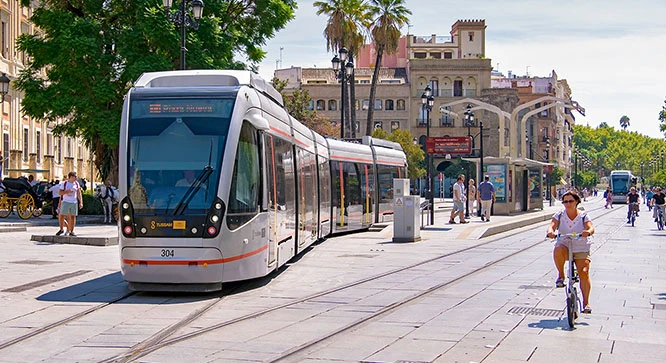

Think about waiting for a train to pass while standing at a railroad crossing. You're sure that when a train arrives, the barriers will drop and the bells will sound. However, have you ever thought about how these mechanisms function perfectly to protect us? Train Detection Sensors and Camera LIDAR Fusion technology, together, provide the answer.
What are Train Detection Sensors?
Train Detection Sensors play a crucial role in railway safety systems. They are designed to identify the presence and motion of trains on the rails. These sensors are necessary for ensuring that railroad crossings operate correctly and that train traffic is effectively managed.
Types of Train Detection Sensors
Train Detection Sensors are of different varieties, each with special characteristics and uses.
Inductive Sensors: In order to locate trains, these sensors use electromagnetic fields. They are often included in the rails and are capable of sensing the metal parts of a train, such as its wheels and axles.Acoustic Sensors: Acoustic sensors detect the sound made by moving trains. They are especially helpful in locations where inductive sensors would not be suitable, such as on wooden or concrete ties.Infrared Sensors: These devices detect heat produced by trains. For increased precision, they are often used in combination with other sensor types.Pressure Sensors: Pressure sensors are used to measure the pressure applied by passing trains. They are positioned between the ties or beneath the ballast. This approach works particularly well for large freight trains.Optical Sensors: These devices look for trains using light beams. They work in a variety of weather situations and are able to detect trains traveling at high speeds.Why is Camera LIDAR Fusion Used?
Camera LIDAR Fusion, also known as sensor fusion, is a cutting-edge technology that combines the strengths of cameras with LIDAR (Light Detection and Ranging) sensors to provide a deeper understanding of the railway environment. Train Detection Sensors are essential for ensuring rail safety, but they have certain drawbacks, particularly when it comes to seeing particular train characteristics or items on the rails. The technique of Camera LIDAR Fusion is used in this situation.
This is how it works:
Cameras: Cameras take high-resolution pictures of the surrounding environment and railroad lines. These pictures may show the kind of train, its speed, and if there are any obstructions.LIDAR Sensors: LIDAR sensors provide a 3D map of the surroundings using laser pulses. They are capable of determining things on or near the rails and measuring distances precisely.Fusion: In order to create a comprehensive image of the railway environment, the data from cameras and LIDAR sensors are fused or integrated. Accurate train detection and object recognition are made possible by this integration.The Benefits of Camera LIDAR Fusion
Camera LIDAR Fusion has a number of benefits over other techniques, including:
Improved Object Recognition: It is essential for safety that Camera LIDAR Fusion be able to identify different items on the tracks, such as people, automobiles, or trash.Weather Resistance: Unlike certain other sensors, cameras and LIDAR sensors operate reliably all year despite inclement weather.High precision: By combining visual and distance data, it is possible to recognize trains and potential impediments with a high degree of precision.Versatility: Camera LIDAR Fusion can be incorporated with current rail safety systems and is customizable.Consider a railroad manager who is in charge of providing reliable train service on a congested rail network. A tree accidentally falls over the tracks one day during a period of severe rain, blocking the route of an approaching train. In this case, the Camera LIDAR Fusion system's visual and distance-measuring capabilities allow it to identify the fallen tree. It promptly alerts the railway operator to the existence of a blockage on the tracks, and the operator acts quickly to halt the train and send out a team to clear the blockage, averting a possible catastrophe.
Conclusion
The combination of Train Detection Sensors and Camera LIDAR Fusion technology makes our railways safer. Together, these advanced technologies can identify trains, objects, and barriers, allowing for smooth railway movement and the avoidance of accidents. The usage of Camera LIDAR Fusion technology is expected to grow as railways continue to develop and upgrade, improving efficiency and safety for both passenger and freight transportation.





















Sign in to leave a comment.