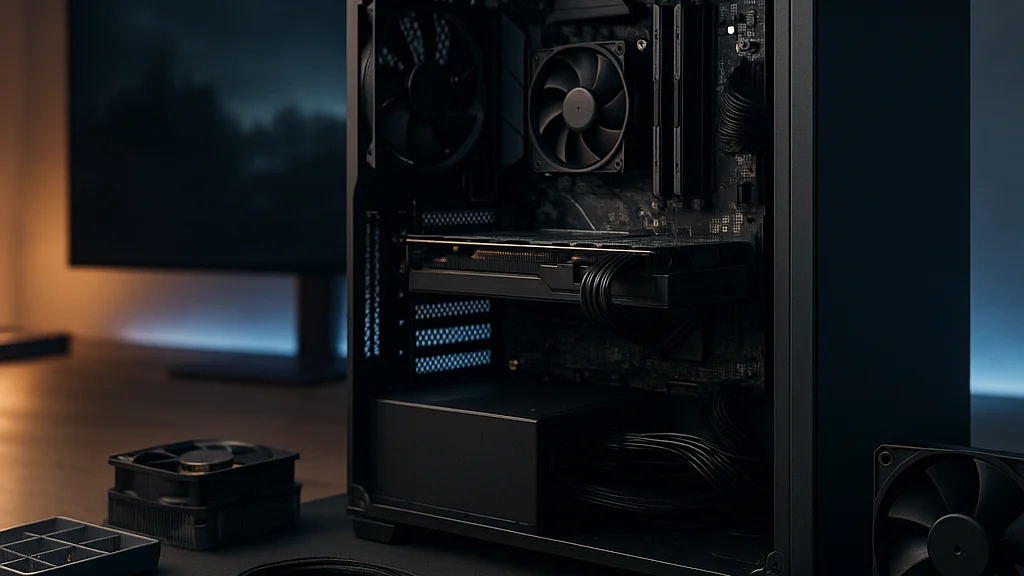

The budget gaming PC scene in 2026 feels a lot like ranked queue at prime time: crowded, chaotic, full of strong opinions, and brutally punishing if you make the wrong pick early. One bad component choice can snowball your whole build. Blow too much cash on RGB-heavy extras, and suddenly your GPU tier drops. Cheap out on the power supply, and you have the hardware equivalent of throwing a match in overtime. That is why a real budget build guide has to do more than list parts. It has to explain trade-offs, timing, and the current market mood.
The good news? Building a gaming PC on a budget is still absolutely viable. The bad news is that the definition of “budget” has shifted. A few years ago, a lot of players treated $700 to $900 as the sweet spot for decent 1080p gaming. In 2026, that same range can still work, but only if you stay disciplined about priorities and accept that not every build is meant for ultra settings in every new AAA release. According to PC World’s take on building a $1,000 gaming PC in 2026, pricing pressure and shifting component value have made the old rules less reliable. That does not mean the dream is dead. It means the strategy matters more than ever.
If you are trying to build a machine for esports, modded single-player games, streaming on the side, or just finally escaping the pain of low-spec laptop life, there are a few truths you need up front. First, your GPU and monitor target should shape almost every decision. Second, platform longevity matters more than flexing on launch-day parts. Third, “future-proofing” is often where budget builds go to die. You are not building a museum piece. You are building a rig that wins frames per dollar right now, while leaving yourself a clean upgrade path later.
A budget gaming PC is not about buying the cheapest parts. It is about spending where performance scales and cutting where marketing hype does not.
That mindset is the whole playbook. And if you want a useful companion read on where people throw away money, Common Mistakes in a Budget Gaming PC Build Guide breaks down the traps that catch first-time builders all the time.
Start with your target, not your shopping cart
The biggest mistake in budget PC building is opening ten tabs, spotting discounts, and assembling a pile of random “good deals” without a clear performance target. That is the hardware version of panic-buying utility items in a MOBA. You need a game plan first. Ask one question: what exactly do you want this machine to do over the next 18 to 24 months?
For most gamers, the real targets fall into three lanes. Lane one is 1080p esports: Valorant, Counter-Strike 2, Fortnite, Rocket League, League of Legends, Overwatch 2. Lane two is 1080p AAA with medium to high settings and stable frame pacing. Lane three is entry 1440p, usually with some compromises in the newest heavy hitters. Those lanes need different budgets, different GPU expectations, and different CPU pairings. A build that crushes competitive shooters at high refresh rates may not be the same build that handles ray-traced open-world games gracefully.
Recent builder guides show how much this matters. Geeky Gadgets’ 2026 budget 1440p build overview focuses on balancing CPU and GPU so players can reach higher resolutions without wasting money on premium extras. Meanwhile, Manchester Evening News highlighted a sub-£1,000 parts list that shows how tight the margin can be once every component is counted, including the unglamorous stuff like storage and cooling.
Here is the practical way to define your target before spending a dollar:
- Esports-first build: prioritize CPU consistency, decent GPU efficiency, and a monitor capable of using the extra frames.
- AAA-first build: push more of the budget toward the graphics card, then make sure the CPU is strong enough to avoid obvious bottlenecks.
- Hybrid build: balance for 1080p high settings now and leave room for a future GPU upgrade.
- Stream-and-play build: check encoder support and core count, not just raw gaming benchmarks.
Once that target is locked, the rest gets easier. Your budget is no longer a vague number. It becomes a resource allocation puzzle. That is where smart builds are won.
Where the money should go in a real budget build
Every budget build has one central boss fight: deciding how to split your money across the GPU, CPU, motherboard, RAM, storage, case, cooler, and power supply. Most first-time builders either overspend on the processor because it sounds “future-ready,” or they get seduced by flashy cases and AIO coolers that do almost nothing for actual frame rates. If your goal is gaming first, the graphics card usually deserves the biggest slice of the pie. Not always, but usually.
A healthy budget allocation for a gaming-first PC often looks something like this:
- GPU: roughly 35 to 45 percent of the total budget
- CPU: around 15 to 20 percent
- Motherboard: 10 to 15 percent
- RAM: 7 to 10 percent
- Storage: 7 to 10 percent
- PSU and case: the remaining 10 to 15 percent combined
That split is not a law, but it is a strong rule of thumb. If your GPU share is too low, your gaming performance suffers immediately. If your motherboard share is too high, you are probably paying for expansion features you will never touch. If your storage budget is tiny, you end up juggling installs like a speedrunner managing inventory space.
Memory and storage have become especially interesting in 2026. For mainstream gaming builds, 32GB of RAM is no longer ridiculous overkill the way it once seemed. It is increasingly reasonable if pricing is close enough, especially for players who keep Discord, a browser, launchers, and recording tools open in the background. Still, 16GB remains workable for stricter budgets if you choose a board with an easy path to upgrade later. On storage, a 1TB NVMe SSD is the comfort baseline now. Modern games are chunky. One or two blockbuster installs can eat space fast, and nobody wants to spend every weekend deleting and reinstalling.
Power supplies are where “budget” gets dangerous. A no-name PSU may look like a bargain until instability, noise, or failure enters the chat. Techtimes, in its PC building basics guide, emphasizes compatibility and power planning as beginner essentials, and that advice holds up. Buy enough wattage for your current parts plus a little headroom. Buy from a reputable line. That is not glamour spending. That is survival spending.
If your budget is tight, cut decorative features before you cut power quality, airflow, or the graphics card tier that actually determines your in-game experience.
For a more performance-focused angle, Budget Gaming PC Build Guide: Smart Parts, Better FPS is a solid internal read on how smarter allocations can squeeze out more value.
The parts that matter most, and the parts people overrate
Let’s talk component hierarchy, because this is where a lot of budget builds either become secret demons or total grief picks. For pure gaming, the GPU is still the star. It determines your settings ceiling, your resolution comfort zone, and often your longevity in newer titles. But the CPU is not just a side character. In esports titles and CPU-sensitive games, a weak processor can tank your lows even if the average frame rate looks decent on paper.
That means pairing matters more than brand tribalism. A balanced midrange CPU with a sensibly chosen GPU will often beat a lopsided build where one premium part is chained to bargain-bin support hardware. Motherboards are a classic place where buyers get baited by feature creep. You do not need the board streamers use in glossy build videos if you are not overclocking aggressively, stacking multiple high-speed drives, or chasing niche I/O needs. You need stable VRMs, enough ports, BIOS support, and a platform that does not trap your future upgrades.
Cases are another trap. Airflow beats aesthetics in budget territory. A clean front mesh design with included fans is usually a stronger play than a flashy glass-heavy case that cooks your components. Cooling follows the same logic. Many budget and midrange CPUs do fine with the stock cooler or a modest air cooler. Spending big on liquid cooling for a locked or low-power chip is pure vibes. Fun vibes, sure, but still vibes.
Here are the most commonly overrated purchases in budget builds:
- High-end motherboards with premium overclocking features you will not use
- Extra-fast RAM kits that cost much more for tiny real-world gains
- RGB-heavy cases with weak airflow
- Oversized AIO coolers for modest CPUs
- Tiny secondary SSDs bought too early instead of one larger primary drive
And here are the underrated wins:
- A quality PSU from a trusted product line
- A motherboard with a realistic upgrade path
- Enough airflow out of the box
- A monitor that matches the kind of performance your PC can actually deliver
- Used or discounted components from reputable sellers when the value gap is meaningful
AOL’s beginner-focused roundup, 11 Essential Gaming PC Tips Every Beginner Should Know, reinforces a lot of these fundamentals: plan first, check compatibility, and do not let spec-sheet hype override practical performance. That sounds basic, but it is exactly how budget builders avoid expensive faceplants.
What has changed recently in 2026
The 2026 market is not the same arena players were dealing with even two or three years ago. Pricing pressure, platform transitions, and the simple fact that modern games are heavier have all changed what “budget” means. One of the biggest shifts is that a build once considered upper-entry now often lands closer to mainstream. That is the context behind PC World’s blunt headline about not building a $1,000 gaming PC in 2026. The point was not that sub-$1,000 builds are impossible. It was that expectations need recalibration.
Another major change is how much more important upgradability has become. Budget builders are increasingly choosing platforms based on how painless the next step will be. Maybe you start with a modest GPU and upgrade later when prices soften. Maybe you begin with 16GB of RAM and move to 32GB once deals appear. Maybe you buy a board that supports a stronger CPU down the line instead of maxing out today. That kind of staged building is not a compromise anymore. It is the meta.
Storage expectations have also moved. Game install sizes remain chunky, and fast SSDs are common enough that loading-time gains are no longer a luxury talking point. They are part of the baseline experience. On the display side, more players are trying to pair budget builds with high-refresh 1080p monitors or modest 1440p panels, which changes the GPU conversation. Chasing 1440p because streamers make it look standard can be a trap if your actual game library includes demanding AAA titles.
Then there is the used market. In 2026, it remains a legit option, but only if you know what you are doing. Ex-mining fears are not the only issue anymore; now it is also about warranty, wear, thermal history, and whether the savings are big enough to justify the risk. A lightly used GPU from a trusted source can be a huge value play. A suspiciously cheap listing with vague photos is the hardware equivalent of accepting a random invite from an obvious scam account.
If you want a broader internal perspective on builds that balance current value with common-sense upgrades, Inside a Budget Gaming PC Build That Actually Makes Sense fits nicely here. The smartest 2026 builds are the ones that understand timing, not just specs.
A practical blueprint for different budget levels
Not every reader has the same wallet, so blanket advice only gets you so far. The smarter way to approach a budget gaming PC is to think in tiers. Not exact parts lists, because pricing moves and regional availability can be weird, but realistic performance tiers. This is the section where the fog clears.
Tier one: entry budget. This is the “I need a real gaming PC, but I cannot overspend” bracket. The target here is strong 1080p esports performance and acceptable 1080p settings in many AAA games. The move is simple: prioritize a value CPU, a decent entry-to-lower-midrange GPU, 16GB of RAM if necessary, and one 1TB SSD if possible. The key is avoiding premium motherboard and cooling costs. This is not the tier for luxury features.
Tier two: sweet-spot budget. This is where many players should aim if they can stretch a bit. You get a better GPU, stronger frame consistency, and more comfort in newer games. Here, 32GB of RAM starts to make more sense if the price delta is not wild. A better PSU and better airflow case are also easier to justify because the build has more long-term value.
Tier three: budget-plus. This is where 1440p starts entering the conversation without turning the whole build into cope. You still need discipline, but now you can think about higher settings, better minimums, and some room for content creation or streaming. The danger here is pretending you are only “slightly” above budget while quietly adding premium extras until the total nukes itself.
Here is a simple framework to keep the tiers honest:
- Pick your monitor resolution and refresh target first.
- Choose the GPU that best fits that target.
- Select a CPU that will not hold that GPU back in your main games.
- Use a motherboard that supports your upgrade plan, not your ego.
- Lock in reliable power and airflow before cosmetic upgrades.
- Only then spend on extras like aesthetics, extra storage, or premium cooling.
This is also where internal guides can help if you want more build-specific thinking. Build a Gaming PC on a Budget: Your 2026 Guide is useful for comparing how current-era expectations line up with practical spending limits.
How to avoid the classic budget-build disasters
Every seasoned builder has war stories. The wrong motherboard BIOS version. A case that blocks GPU clearance by a few cruel millimeters. A cheap power supply that sounds like it is trying to take off. RAM that is technically compatible but refuses to run at advertised speeds without drama. These are not rare edge cases. They are the routine hazards of budget building, and they hit hardest when every dollar matters.
The first defense is compatibility discipline. Check socket support, chipset support, BIOS revision notes, RAM QVL guidance when possible, GPU length, cooler height, case fan support, and power connector requirements. Techtimes stresses this in its beginner guide, and it is not just newbie advice. Even experienced builders get lazy and pay for it. One overlooked clearance issue can eat the savings from a carefully planned deal stack.
The second defense is resisting false economies. The cheapest option is not always the lowest-cost option over time. A low-quality case with poor airflow may force thermal compromises. A tiny SSD may require an early replacement. A bargain PSU may create instability that is maddening to diagnose. Budget builders should be ruthless, yes, but not reckless.
The third defense is understanding your own use case. If you mainly grind esports titles, a build optimized for low-latency 1080p high refresh might feel way better than a weaker 1440p setup chasing prettier screenshots. If you live in giant open-world RPGs, then VRAM, storage space, and GPU strength deserve more love. There is no universal best build. There is only the best build for your queue.
The safest budget build is the one designed around the games you actually play, not the benchmark chart you stared at for five hours on a second monitor.
One more thing: peripherals count. A budget PC paired with a terrible monitor can feel worse than a slightly weaker PC paired with a panel that matches your frame output and has decent motion clarity. Same with a flaky Wi-Fi setup for online games or a headset that ruins spatial cues. The tower is the main event, sure, but the whole setup affects how the build feels in the wild.
The smartest takeaway: build for value now, upgrade with intent later
If there is one lesson that keeps showing up across 2026 guides, market reports, and builder communities, it is this: the best budget gaming PC is rarely the one that tries to do everything on day one. The strongest move is usually a build that handles your current games well, avoids weak links, and leaves a clean path to level up later. That could mean starting with a platform that supports a stronger CPU. It could mean choosing a quality PSU so your future GPU upgrade is painless. It could mean buying one good SSD now and expanding later instead of juggling multiple tiny drives.
That approach also makes emotional sense. Gaming hardware culture can get weirdly performative. Social feeds are full of monster rigs, dual-monitor battlestations, and glowing showcase builds that make normal players feel under-equipped. Ignore the flex meta. A budget build that runs your games smoothly, loads fast, stays cool, and upgrades cleanly is a win. Full stop. Plenty of streamers and competitive grinders care more about stable performance than about turning their case into a neon aquarium.
According to the approved sources from PC World, Geeky Gadgets, Manchester Evening News, AOL, and Techtimes, the broad consensus is not that budget gaming is impossible. It is that careless budgeting is punished faster now. Prices force sharper decisions. Games demand more from storage and memory. Platform choices matter more. Builders who understand those shifts can still put together seriously fun systems without getting farmed by hype.
So what do you really need to know about a gaming PC build guide on a budget? Keep it simple. Set a target. Spend for frames, stability, and upgrade paths. Treat the PSU and airflow like core gear, not afterthoughts. Avoid feature creep. Buy with your actual game library in mind. And if a part looks too good to be true, especially in the used market, pause before you lock it in. That little bit of patience can be the difference between a rig that feels cracked for the money and one that leaves you staring at troubleshooting threads while your squad is already in the lobby.
That is the real budget-builder mindset in 2026. Less fantasy drafting. More smart picks. More FPS where it counts. More GG, less regret.





























Sign in to leave a comment.