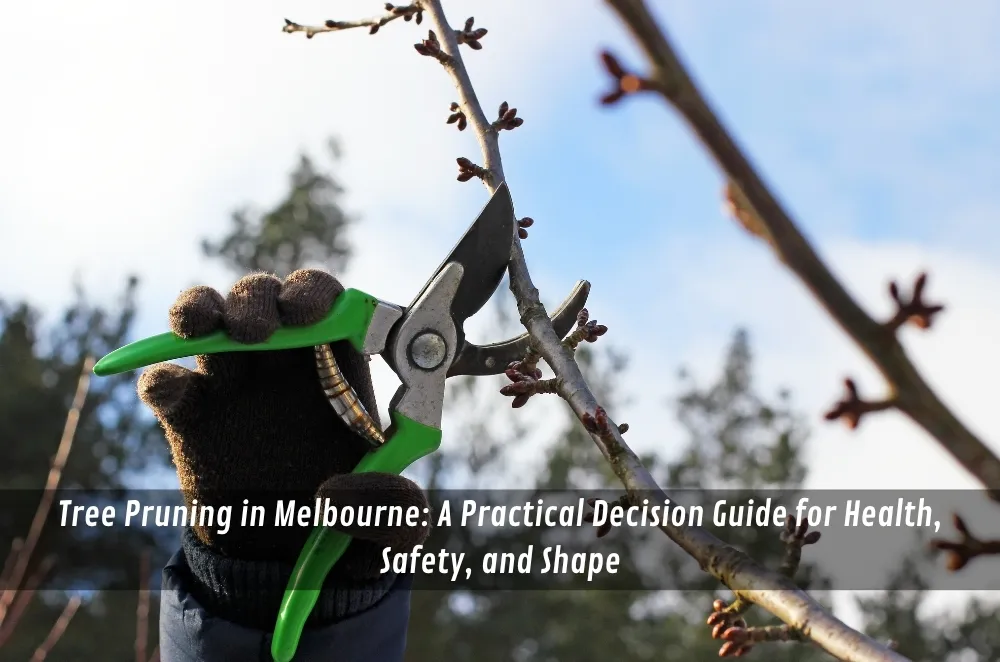

Melbourne yards can be tight, leafy, and a little unpredictable, especially once trees start pushing into fences, driveways, gutters, and neighbour airspace. That’s why pruning is one of those jobs people put off until it feels urgent, then try to solve in a single afternoon.
If you’re weighing up whether you need expert tree pruning help or you can handle a light tidy-up safely, the decision usually comes down to access, targets underneath, and how much you can afford to get wrong.
The trouble is, trees don’t “reset” neatly. One heavy cut can trade today’s clearance problem for next year’s weak regrowth problem.
This guide is designed to help you make cleaner decisions: what you can handle safely, what’s better scoped properly, and what’s worth handing to a qualified operator.
Why “a quick trim” often backfires
Most pruning blow-ups come down to two patterns: removing too much, or removing the wrong thing first. Trees treat pruning as stress. Stress responses aren’t always intuitive.
Big cuts can trigger fast, dense shoots that look vigorous but attach poorly. In the next strong wind, the tree hasn’t “fixed” itself, it’s created new failure points.
Then there’s the quiet damage: bad cut placement that invites decay, or a canopy that ends up uneven and loaded on one side. You might not notice straight away, but you’ll notice later, usually when you’re back up there again.
What good pruning is actually trying to do
“Make it smaller” sounds simple, but it doesn’t tell anyone what success looks like. Better pruning goals are specific and measurable.
Useful objectives often include:
- Reducing risk: removing deadwood, reducing leverage on long limbs, improving clearance over high-use areas.
- Improving structure: managing competing leaders, balancing a lopsided canopy, easing pressure on weak unions.
- Getting light and access back: lifting the canopy for walkways, opening light for gardens without stripping the crown.
- Protecting longevity: avoiding wounds that lead to decay, especially on established trees that add real value to a property.
If one cut would dramatically change the silhouette of the tree, pause. That’s usually a sign the job needs a clearer plan.
Common mistakes that cause long-term grief
Mistake 1: Topping or hacking limbs back to stubs.
This tends to create ugly, weak regrowth and large wounds that don’t recover well.
Mistake 2: Taking “just a bit more” until the canopy is stripped.
Even technically correct cuts can become harmful when there are too many of them in one go.
Mistake 3: Flush cuts, or stubs left hanging.
Flush cuts remove the branch collar the tree relies on to compartmentalise wounds. Stubs die back and invite decay. Neither is a good trade.
Mistake 4: Pruning at the wrong time for the species.
Timing affects stress and regrowth. Some trees cope better in certain windows, and some react poorly when cut at the wrong moment.
Mistake 5: Treating pruning and lopping as interchangeable.
The intention matters. Pruning is selective and outcome-driven; lopping often ends up being “remove whatever’s in the way.”
Mistake 6: Forgetting the drop zone.
Most incidents happen because attention stays on the branch and not what’s underneath, glass, fences, roofs, vehicles, or people.
Decision factors: DIY, gardener, or qualified arborist?
A smarter question than “Can I do this?” is “What happens if I get one cut wrong?” That’s where risk, access, and tree value come in.
When DIY is usually fine
DIY can be sensible when the work is small and controlled:
- You’re using secateurs or a hand saw, not a chainsaw.
- You’re working from the ground (no ladders, no climbing, no roof access).
- There are no meaningful targets under the cut (fence lines count).
- It’s light shaping, dead twig removal, or minor clearance.
If you’re uncertain where to cut, start with deadwood you can safely reach and stop there. Leaving a branch for later is not a failure; it’s restraint.
When a gardener can be the right fit
For smaller trees and general garden maintenance, a capable gardener can sometimes do light pruning well, particularly where the goal is tidiness and form, not structural outcomes.
The key is whether they can explain the limit of their scope. “I’ll tidy it up” isn’t a plan. “I won’t touch anything over X size/height or near services” is closer to a professional boundary.
When you should lean toward an arborist
In most cases, get qualified help if any of the following show up:
- Height/access complications: ladders, climbing, roof work, awkward limb angles.
- Large limb removals: bigger cuts mean higher stakes and more recovery risk.
- Targets underneath: driveways, play areas, sheds, solar panels, tight fence lines, neighbour property.
- Structural concerns: split unions, heavy end-weight, sudden lean, or a history of limb drop.
- Near services: especially overhead lines.
- High-value mature trees: the cost of a mistake is often far higher than the cost of doing it properly.
If it’s helpful to see what a sensible scope looks like before booking anyone, the The Yard tree pruning guide is a practical reference for the kinds of pruning outcomes to discuss.
Questions that reveal the quality of the approach
You don’t need to speak arborist to ask useful questions:
- “What’s the goal here, risk reduction, clearance, structure, or light?”
- “Which limbs are you targeting, and what’s the reason for each?”
- “How do you expect the tree to respond over the next year or two?”
- “What are you specifically avoiding today?”
- “How are you protecting fences, gardens, and the drop zone?”
A careful answer usually sounds calm and specific. A rushed answer usually sounds like confidence without detail.
Operator Experience Moment
A pattern I’ve seen more than once is a big clearance cut made to “solve it for good”, followed by a burst of regrowth that’s fast, dense, and poorly attached. Twelve months later the canopy looks worse, not better, and the same clearance problem returns in a different shape. The quieter approach, selective reduction, deadwood first, and an eye on leverage, rarely looks dramatic on day one, but it tends to age far better.
Practical Opinions
Prioritise risk reduction over aesthetics.
Small, well-placed cuts beat big “reset” cuts almost every time.
If access feels sketchy, it’s already past DIY.
A simple 7–14 day plan to get pruning right
Day 1–2: Walk the tree, not the problem.
Look from two angles. Decide what “done” means: safer clearance, more light, better structure, or a combination.
Day 3–4: Do the no-regrets work.
Remove small dead twigs from the ground where it’s safe. Flag crossing/rubbing branches rather than immediately cutting big sections out.
Day 5–7: Map constraints and targets.
Note what sits under the canopy and what can’t be damaged, fences, roofs, cars, paths, garden beds, and any overhead services.
Day 8–10: Choose the right lane.
If it’s small and ground-based, plan a short DIY session. If height, targets, or services are involved, shift to scoping and getting qualified help.
Day 11–14: Put the scope in writing.
Write 3–5 outcome statements (for example, “remove deadwood over driveway”, “reduce end-weight on limb over shed”, “lift canopy over path”). This avoids misunderstandings and helps prevent over-pruning.
Local SMB mini-walkthrough: a Melbourne yard scenario
A small business owner has a mature tree shading the frontage and a narrow side drive used for deliveries.
One long limb stretches over the driveway, and there’s deadwood closer to the fence line.
The goal is safer clearance without stripping useful shade from the building.
Deadwood is prioritised first because it’s the cleanest risk win.
The driveway limb is assessed for leverage and union strength, not just “how much can go.”
A selective reduction is chosen to keep the canopy balanced and protect the fence and driveway below.
A follow-up check is planned next growth cycle so regrowth is managed early, not left to become the next heavy limb.
How to tell whether the pruning result is actually good
Good pruning usually looks almost underwhelming. The tree still looks like itself.
Signs it’s been handled thoughtfully:
- Cuts are selective, not all concentrated on one side.
- The canopy is balanced, with less obvious end-weight.
- Clearance is improved without a spray of huge wounds.
- There’s enough foliage left for the tree to recover without panic growth.
If the canopy looks spiky, hollowed out, or “tufted” on the ends, it may have been pushed too hard.
Key Takeaways
- Pruning works best when it’s tied to a clear goal: risk, structure, clearance, or light.
- Heavy cuts and topping often create weak regrowth and repeat maintenance problems.
- Keep DIY to small, ground-based work with low consequences if a cut is wrong.
- For height, targets, services, or valuable mature trees, qualified help is usually the safer long-term option.
Common questions we hear from Australian businesses
How often should trees be pruned on a commercial site?
Usually it depends on species, growth rate, and what the tree sits over or beside. A practical next step is to set a simple inspection rhythm (seasonal walk-throughs work for many sites) and log deadwood, clearance issues, and changes in lean or canopy balance. In Melbourne, growth can jump after warm spells and rain, so clearances can tighten quicker than expected.
Is it better to prune in a particular season?
It depends on the species and what you’re pruning for (deadwood, clearance, structure). A useful next step is to identify the tree and decide whether the job is light maintenance or significant structural change, then plan timing around that. In most Melbourne yards, timing matters most when people are tempted to do “big cuts” right before a weather change.
What should be included in a pruning scope before hiring someone?
In most cases, a good scope describes outcomes, not vague instructions like “tidy it up.” A practical next step is to write 3–5 outcomes and walk the operator through what sits underneath and what must be protected. In Melbourne blocks with tight boundaries, fences and neighbour proximity often drive the safest approach.
Can pruning reduce storm damage risk?
Usually it can reduce risk when it focuses on deadwood removal, leverage reduction, and improving structure over time, but it’s not a guarantee. A practical next step is to identify the limbs most likely to fail, long, heavy, or compromised unions, and plan selective reductions rather than aggressive thinning. In Melbourne, exposure varies by street and suburb, so the same species can behave differently depending on wind funnels and site shelter.
























Sign in to leave a comment.