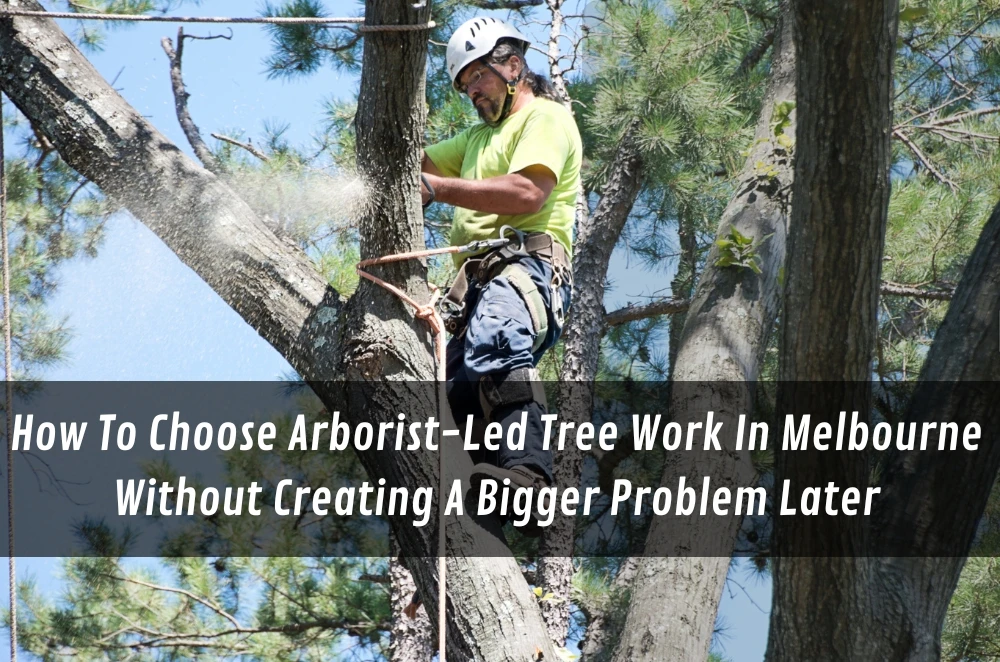

Tree work can feel deceptively simple from the ground: remove a limb, tidy the canopy, clear a hazard.
In Melbourne, the risks are rarely about “can it be cut” and more about what happens to the tree, the site, and everyone around it once the cutting starts.
If you’re managing a home garden, a commercial site, or a shared property, the goal is usually the same: solve the issue now without triggering long-term decline, neighbour disputes, or an insurance headache.
What “Arborist-Led” Actually Means (And Why It Matters)
Not all tree work is the same, even when the end result looks similar.
Arborist-led work is guided by tree health, structure, and risk—rather than just access and speed.
That typically means the person planning the work understands how different cuts affect regrowth, how load changes can stress a trunk, and how to reduce hazards without creating new ones.
It also means the work is scoped with the site in mind: where branches can fall, what needs protection, and what the tree will do next season.
Safe tree removal for Melbourne homes with tight setbacks and mixed planting, that difference can be the line between “sorted” and “we made it worse”.
The Melbourne Reality: Weather, Density, And Trees That Grow Fast
Melbourne’s weather swings can expose weak structure quickly.
Wind events, wet winters, and sudden heat can all change how a tree behaves, especially if it’s been pruned hard in the past.
On denser blocks—inner suburbs, townhouse developments, shared driveways—the margin for error is smaller, because there’s less space to drop material and more assets to protect.
You also get plenty of trees that respond vigorously to poor cuts, throwing out weak epicormic growth that looks fine at first and becomes a failure point later.
If the site is tight, “quick and rough” tends to become “quick and expensive”.
Decision Factors: Picking The Right Approach And Provider
If you only remember one thing, it’s this: good tree work is planned, not improvised.
Here are the decision factors that usually matter most.
1) The outcome you actually need
Is the goal hazard reduction, clearance from a roofline, improved light, deadwood removal, or a long-term structure correction? Each point refers to a different pruning approach.
2) Tree health and structure
A tree with previous heavy lopping, decay, or included bark unions needs different decisions than a healthy specimen.
3) Target zone risk
What’s under the work area—cars, footpaths, powerlines, play areas, glazing, garden beds—should dictate the method and the controls.
4) Access and logistics
Tight side access, overhead obstructions, and fragile landscaping often shape whether the job is a simple climb-and-lower or needs different equipment and sequencing.
5) How the scope is explained
A good provider can explain what will be cut and why, without vague “we’ll just tidy it up” wording.
If you’re comparing quotes, clarity about method and outcomes is more useful than a one-line price.
Common Mistakes That Lead To Poor Regrowth Or Repeat Call-Outs
Tree work has a long memory. Mistakes show up months later.
Over-pruning to “solve it once”. Removing too much canopy can stress the tree and trigger weak regrowth that needs ongoing management.
Topping or lopping because it looks neat. Harsh cuts often cause rapid, poorly attached shoots that create a new hazard cycle.
Ignoring load changes. Removing a major limb can shift wind load in a way that exposes cracks or weak unions.
Not planning for what’s below. Damage to fences, paths, and gardens often comes from poor lowering plans, not bad luck.
Treating tree work like yard clean-up. Some jobs need a tree-care plan, not just a tidy.
Skipping the “what happens next” conversation. If no one discusses aftercare and likely regrowth, you’re guessing about future risk.
Operator Experience Moment
The most common regret isn’t “we spent money on tree work”. It’s “we paid once, and now the tree looks worse and needs more work”.
The jobs that go well usually start with a short, calm discussion about outcomes and constraints before anyone touches a saw.
When the plan is clear, the work is safer, and the tree tends to respond better over the next season.
A Simple 7–14 Day First-Actions Plan
If you suspect a tree needs attention, these steps help you move from worry to a sensible decision.
Day 1–2: Walk the site and note the real problem—deadwood, clearance, limb overhang, visible cracks, or lean.
Day 1–3: Photograph the tree from multiple angles, including the base, unions, and any areas near structures or walkways.
Day 2–5: List constraints: access width, garden features to protect, neighbouring properties, and any shared spaces.
Day 3–7: Book an assessment and ask for a clear scope: what will be removed, what will remain, and the expected outcome.
Day 7–10: Confirm logistics and protections: where material will go, how lowering will be controlled, and what will be cleaned up.
Day 10–14: After the work, check for obvious issues (ragged tears, excessive canopy loss) and confirm if any follow-up is recommended.
If there’s an immediate hazard, escalate the timeline and keep people away from the target zone until it’s assessed.
Local SMB Mini-Walkthrough: A Melbourne Block With Tight Access
A small Melbourne property manager is handling a shared driveway with a large tree overhanging parked cars.
Tenants are complaining about debris, and there’s concern about limb failure in the next wind event.
Side access is narrow, so material can’t simply be dropped and dragged out without damaging fences and gardens.
The manager wants a solution that reduces risk without stripping the canopy and triggering messy regrowth.
They agree on a staged scope, with controlled lowering over the driveway and a clear, clean-up plan.
The result is a safer access corridor and fewer complaints, without turning the tree into a long-term maintenance problem.
Where A Single Good Checklist Makes The Biggest Difference
Most tree issues aren’t solved by one heroic cut. They’re solved by choosing the right work, at the right intensity, with the right controls.
A short checklist can help you sanity-check whether the scope is about outcomes or just about removal.
Before you lock anything in, it can help to compare your notes against something like a professional arborist led tree work so you can confirm the work description, access considerations, and handover expectations.
If you can describe the outcome clearly, you’re much less likely to end up with “tidy for now, worse later”.
Practical Opinions
Clarity of scope beats a cheap “tidy up” every time.
If someone recommends heavy cutting without explaining regrowth, be cautious.
Good tree work is risk management, not just aesthetics.
Key Takeaways
- Arborist-led work focuses on tree health, structure, and site risk—not just cutting.
- Melbourne conditions and tight blocks make planning and controlled lowering critical.
- Avoid over-pruning and vague scopes that create weak regrowth and repeat call-outs.
- A simple 7–14 day plan moves you from concern to a clean, defensible decision.
Common questions we hear from businesses in Melbourne, VIC
Q1) How do I know if I need an arborist or just a tree lopper?
Usually, if the work involves risk (over structures, walkways, or cars) or the tree’s long-term health matters, an arborist-led approach is the safer choice. A practical next step is to ask for the scope to be explained in terms of outcomes and regrowth, not just “cutting it back”. In Melbourne’s tighter suburbs, access and target-zone control often matter as much as the cut itself.
Q2) Can heavy pruning make a tree more dangerous later?
It depends on the species, past pruning history, and how much canopy is removed, but over-pruning can trigger fast, weak regrowth that becomes a future hazard. A practical next step is to ask what percentage of the canopy is planned to be removed and what the tree is likely to do next season. In most cases around Melbourne, wind events expose weak regrowth sooner than people expect.
Q3) What should be included in a proper tree work quote?
In most cases, a good quote describes what will be cut, how it will be done, and what protections and clean-up are included. A practical next step is to request a simple written scope that mentions access, controlled lowering where needed, and the handover condition. In Melbourne, narrow access and shared driveways can change method and cost materially.
Q4) When is the best time of year to do tree work?
Usually, it depends on the tree species, the work type, and whether the driver is safety or aesthetics, but many tasks can be planned around growth cycles and weather risk. A practical next step is to ask what timing best supports the tree’s response and your site’s needs. In Melbourne, scheduling ahead of winter winds or around peak spring growth can make outcomes more predictable.

















Sign in to leave a comment.