
When a sewer line fails in South Florida, the first image that enters a homeowner's mind is a yellow backhoe parked on their St. Augustine grass and a five-figure hole in their life savings. For decades, this was the only reality of excavation. However, modern trenchless (no-dig) technology has fundamentally shifted the math of home maintenance. The choice you make during a plumbing crisis dictates more than just the immediate bill; it determines whether your property remains a home or becomes a long-term construction site.
The Quick Decision: Trench or Liner?
For a homeowner in the middle of a backup, the technical nuances matter less than the immediate path forward. Based on industry standards, here is the "line in the sand" for your decision:
- Choose Traditional Excavation if: The pipe has completely collapsed (pancaked), there is a severe "belly" (dip) in the line that prevents gravity flow, or multiple utility lines are entangled.
- Choose Trenchless Lining if: The pipe is structurally intact but leaking, plagued by root intrusion, or suffering from "channeling" (where the bottom of a cast iron pipe has eroded).
- The Golden Rule: Never sign a repair contract until you have seen the high-definition camera footage yourself.
While a trenchless quote may appear higher per linear foot, it typically eliminates "secondary destruction." In traditional digging, you often pay twice: once for the plumber to fix the pipe and once for the contractor to rebuild your driveway, patio, or landscaping.
The Miami Factor: Why Florida Pipes Die Young
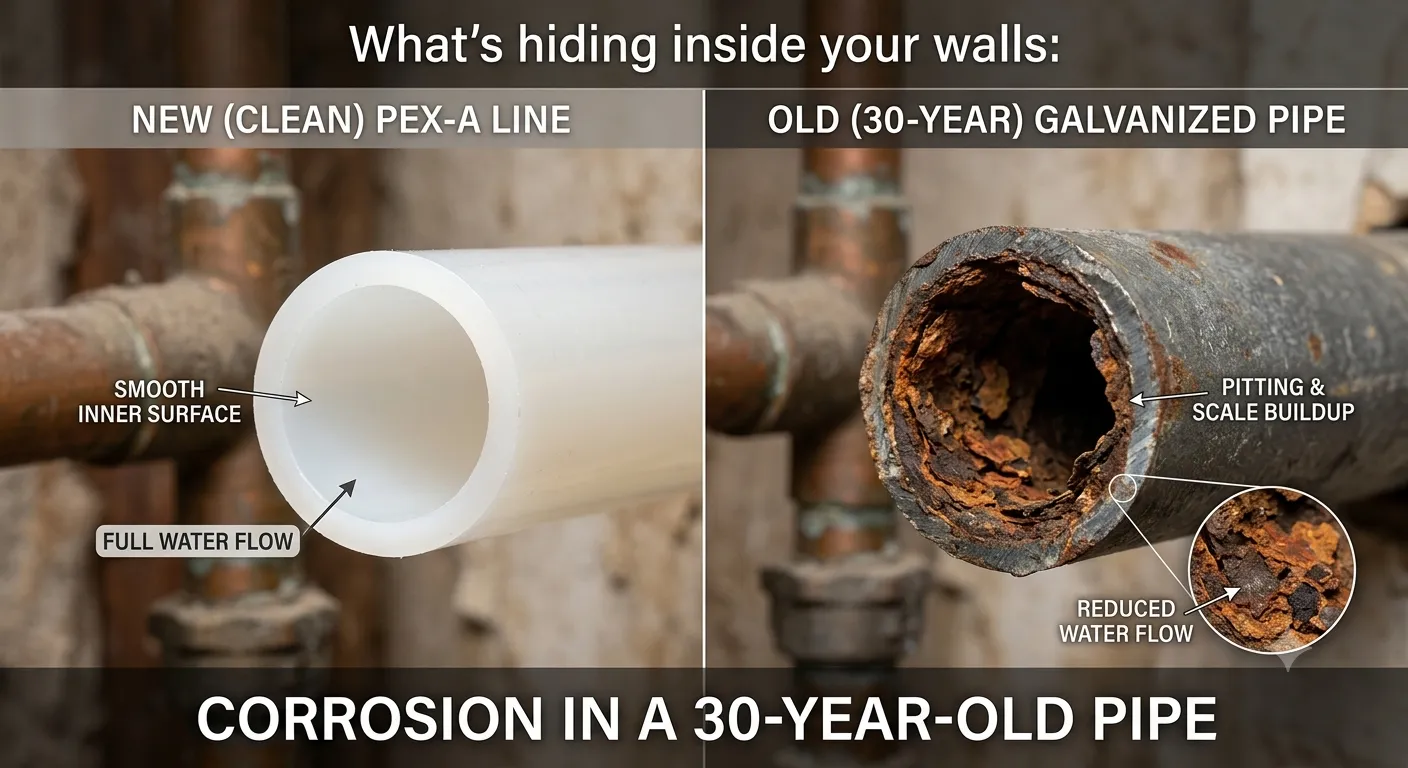
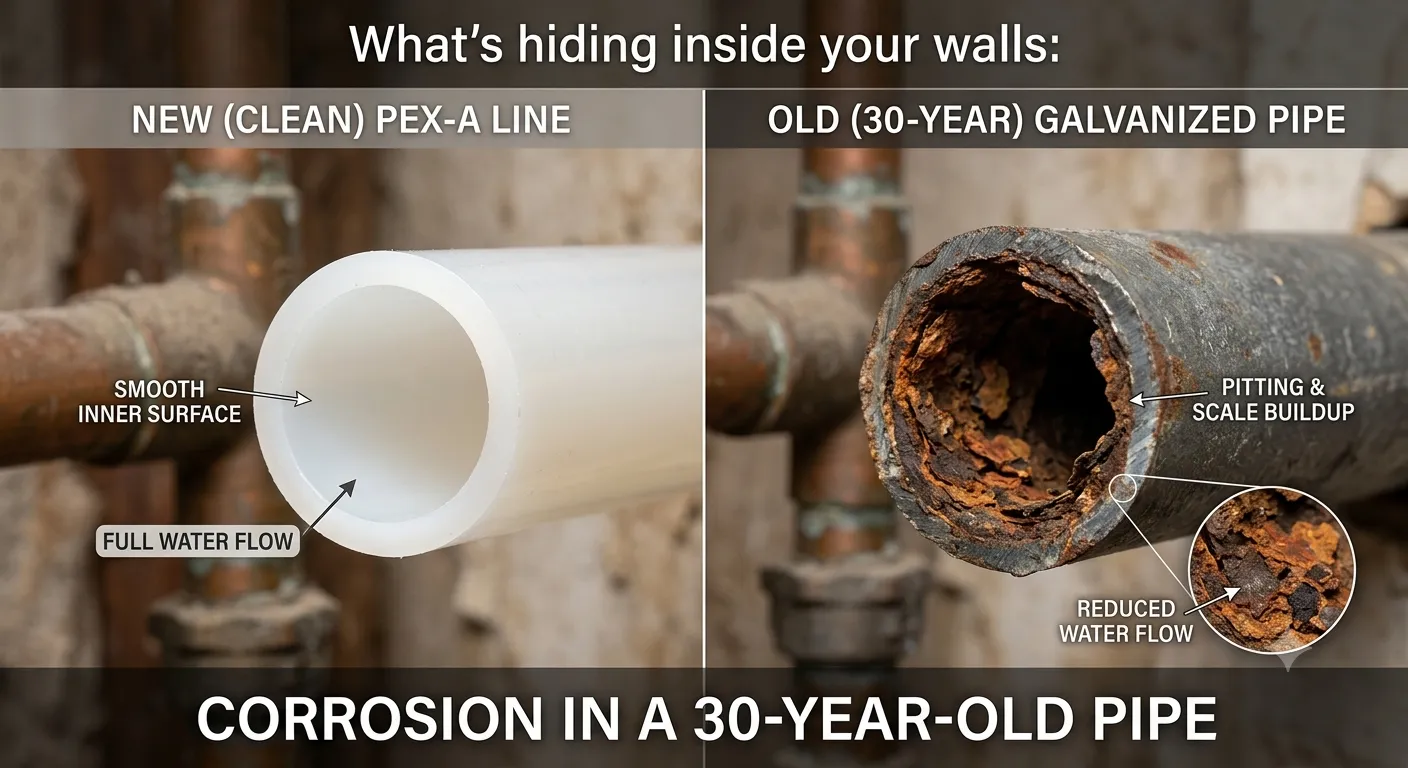
In Florida, underground infrastructure exists in a uniquely hostile environment. Data from Florida Peninsula suggests that the state’s high water table and saline (salty) soil accelerate corrosion in legacy cast iron systems, often causing failure decades before the 60-year national average [1].
- Saltwater Intrusion: In coastal zones, brackish groundwater thins out cast iron through "scaling," eventually turning the pipe walls into paper-thin flakes.
- The Porous Limestone Trap: South Florida's coral limestone shifts. This movement causes "bellies" or joint separations that aggressive tropical root systems—like Ficus and Palms—exploit with surgical precision.
- Submerged Lines: Because the water table is so high, many lines remain submerged year-round. Any small crack becomes a gateway for infiltration, forcing the pump to work overtime and eventually leading to a total backup.
"I get the appeal of doing it yourself — PEX is genuinely easy to work with. But the pipe is the easy part. What trips people up is slope on the drain lines, proper strapping every four feet so the line doesn't sag and stress the joints, and knowing which fittings actually pass inspection in this county. We've been called to fix more 'DIY-adjacent' jobs than total failures — small mistakes that turn into slow leaks two years down the road, right when the warranty everyone forgot to ask about would've covered it."
— Danny Folkes, Repipe Project Lead at Miami Expert Plumbing
How Trenchless Works: Surgery Without the Incision
Trenchless repair is essentially materials science applied to plumbing. Instead of replacing the host pipe, technicians use it as a mold. This process is governed by ASTM F1216, a rigorous engineering standard that regulates resin types and wall thickness to ensure the new liner can stand on its own, even if the old pipe completely disintegrates [2].
Option 1: Cured-in-Place Pipe (CIPP) — The "Pipe-Within-a-Pipe"
CIPP is a multi-stage rehabilitation. First, a high-definition camera maps the damage. Then, hydro-jetting (high-pressure water cleaning) scours the line back to its original diameter. Finally, a felt liner saturated with epoxy resin is inserted and inflated. Once it cures—using ambient air or steam—it forms a seamless, jointless structural pipe.
Option 2: Pipe Bursting — The Heavy-Duty Alternative
If the line is too damaged for a liner but still follows a clear path, technicians use pipe bursting. A conical "bursting head" is pulled through the old line, shattering it and pushing the fragments into the soil. Simultaneously, it pulls a new, seamless HDPE (High-Density Polyethylene) pipe into the void.
The Honest Math: The "Expense Iceberg"
The most common mistake is comparing quotes based solely on the plumbing work. A traditional excavation quote rarely accounts for the restoration of what sits *on top* of the dirt.
As Marcus Reed, a Miami-based civil estimator, explains: "The plumbing bill is just the tip of the iceberg sticking out of the water; the real mass sits below in concrete, pavers, and lost weekends." In Miami, restoring a standard driveway after a dig typically adds $1,200 to $1,800 to the bill, with complex hardscaping or patio repairs reaching $3,500 [3]. If the leak is under your foundation, you must factor in the cost of jackhammering through tile or hardwood and the professional restoration that follows.
Protecting Your Equity: The "Certificate of Health"
A failing sewer line is a massive liability during a home sale. Modern buyers and inspectors are increasingly savvy about "cast iron issues." A house with an original, un-rehabilitated line is often a deal-breaker or a reason for a $20,000 price drop.
Implementing a trenchless solution with a transferable warranty changes the narrative. It provides the buyer with a modernized infrastructure with a projected lifespan of up to 50 years [4]. Providing a post-repair video inspection report acts as a "Certificate of Health." Homeowners can often recoup 70–85% of the repair cost through a higher closing price, whereas ignoring the issue can slash market value by 5–15% [5, 6].
Health and Safety: The Invisible Risks
A leaking sewer line isn't just a nuisance; it’s a biological hazard. Traditional excavation brings contaminated soil to the surface, potentially exposing your family to pathogens. Trenchless methods are inherently cleaner. The entire process is contained within the pipe, preventing the release of sewer gases and bacteria into your living space.
Furthermore, Florida code is strict: lines require a minimum of 12 inches of cover. Improper manual excavation by unlicensed laborers can lead to regulatory violations that complicate future permits and insurance claims [5].
When You Have No Choice But to Dig
Trenchless technology is powerful, but it isn't magic. There are three scenarios where an excavator is unavoidable:
1. Total Collapse: If the pipe is "pancaked," there is no path for a liner or a bursting head. It’s like a straw someone stepped on—no amount of pressure will reopen it.
2. Severe Back-Pitch: If the ground has sunk and created a permanent pool (a belly), a liner will simply follow that sunken path. You must dig to reset the proper grade.
3. Cross-Bores: If a gas or water line was accidentally bored through your sewer line during previous utility work, it requires manual separation.
3 Questions for Your Contractor
To protect your budget and your property, ask these three questions before hiring:
1. "Do you own your CIPP equipment?" Direct ownership usually means the crew has more experience and the pricing is more competitive than those who sub-contract the work.
2. "Will I get a 'Before and After' video on a digital drive?" This is your only proof of a job well done and your best tool for home resale.
3. "Are you licensed for 'Underground Utility and Excavation' in Florida?" Verify this through the official MyFloridaLicense portal to ensure they are legally cleared for structural work [7].
DIY vs. Professional: Where the Line is Drawn
While you can handle a simple toilet clog, sewer main repair is never a DIY project.
- What you can do: Locate your "clean-out" (the white PVC cap in your yard), clear away brush to provide access, and stop using water the moment you suspect a backup.
- The "Drop the Wrench" Moment: If you see sewage coming up through a floor drain or multiple fixtures gurgling simultaneously, stop. Attempting to "snake" a collapsed or scaled line yourself can lead to the cable getting stuck, turning a repair into a much more expensive extraction.
FAQ: What Homeowners Need to Know
Does insurance cover this?
Standard Florida policies often exclude "wear and tear." However, if you have a "Service Line Coverage" endorsement, you may be eligible for $10,000–$12,000 in coverage [1].
How long does it take?
Trenchless: 1–2 days. Traditional: 5–10 days (plus weeks for landscaping to recover).
Are the resins safe?
Yes. Once cured, the epoxy resins used in CIPP are inert and do not leach chemicals into the soil or groundwater.
Is a permit required?
Yes. All major sewer work in Florida requires a permit. Under Florida Statutes Chapter 558, contractors may provide up to a 10-year warranty on CIPP systems for construction defects [8].
Your Action Plan
If you suspect a failure, immediately locate your "clean-out" to give the technician a starting point. Do not agree to any excavation until a professional video inspection has been performed. That visual evidence is the only bridge between a $5,000 lining job and a $20,000 landscape disaster.
In the world of South Florida homeownership, the ground beneath your feet is rarely static. A sewer failure is a test of your ability to choose long-term stability over a quick, destructive fix. By opting for a documented, trenchless solution, you aren't just fixing a pipe—you are insulating your home's value against the inevitable scrutiny of the next buyer. You are choosing a surgical strike over a scorched-earth campaign, ensuring that the only thing people notice about your yard is the landscaping, not the scars of a backhoe.
References
[1] Florida Peninsula - Service Line Coverage & Lifespan — https://www.floridapeninsula.com/blog/understanding-service-line-coverage
[2] ASTM F1216-22 Standard for CIPP — https://www.astm.org/f1216-22.html
[3] HomeGuide Driveway Repair Costs — https://homeguide.com/costs/driveway-repair-cost
[4] Laboratory Data: Epoxy Liner Lifespan Analysis [Industry Standard Report]
[5] Louis Law Group - Sewer Line Damage Florida — https://www.louislawgroup.com/sewer-line-damage-contractor-florida-tallahassee
[6] Knight Rooter - Property Value Impact — https://www.knightrooter.com/blog/2025/march/how-sewer-line-damage-affects-your-property-valu/
[7] MyFloridaLicense Official Portal — https://www.myfloridalicense.com/
[8] Florida Statutes Chapter 558 (Construction Defects) — https://www.leg.state.fl.us/




























Sign in to leave a comment.