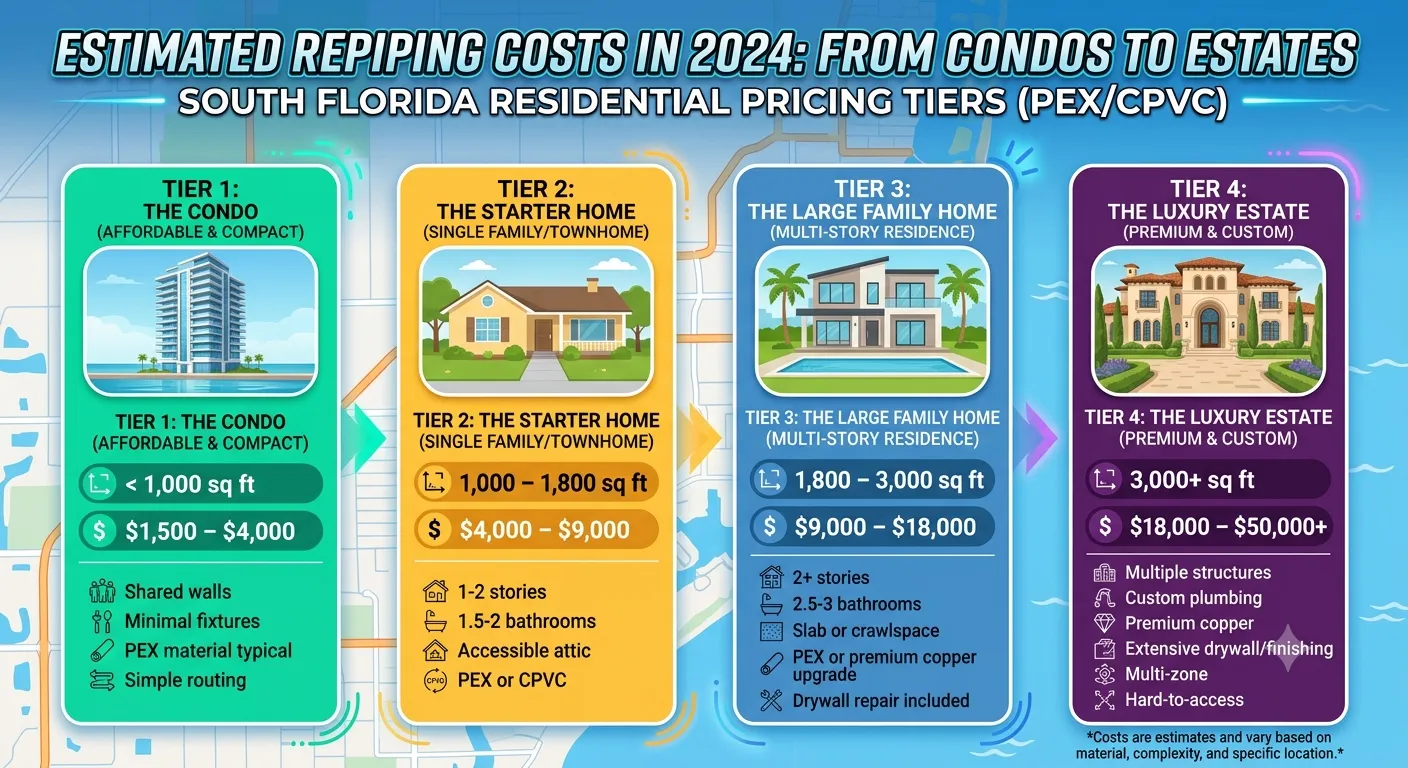

A whole-house repipe is one of the few home investments where the most expensive option is doing nothing. While national averages provide a starting point, homeowners in South Florida operate in a unique environment where salt air, high-density condo rules, and shifting insurance mandates dictate the final invoice.
The "Miami Reality Check": what you’re actually paying for in 2024
In the Miami-Dade corridor, repiping isn't just about the pipes; it’s about navigating a landscape of aging infrastructure and strict local codes. For homes built between 1954 and 1964, the clock is ticking: many of these properties still rely on materials that have long outlived their engineered lifespan [17].
If you own a condo, your costs are often dictated by HOA (homeowners association) protocols and the complexity of shared vertical stacks. For single-family homes, the "Miami surcharge" often comes down to the labor market. You are paying for licensed professionals who understand the county’s specific permitting gauntlet. Furthermore, with providers like Citizens Insurance increasingly excluding older cast iron systems, a proactive repipe has moved from a renovation to a financial necessity to keep your home insurable [17].
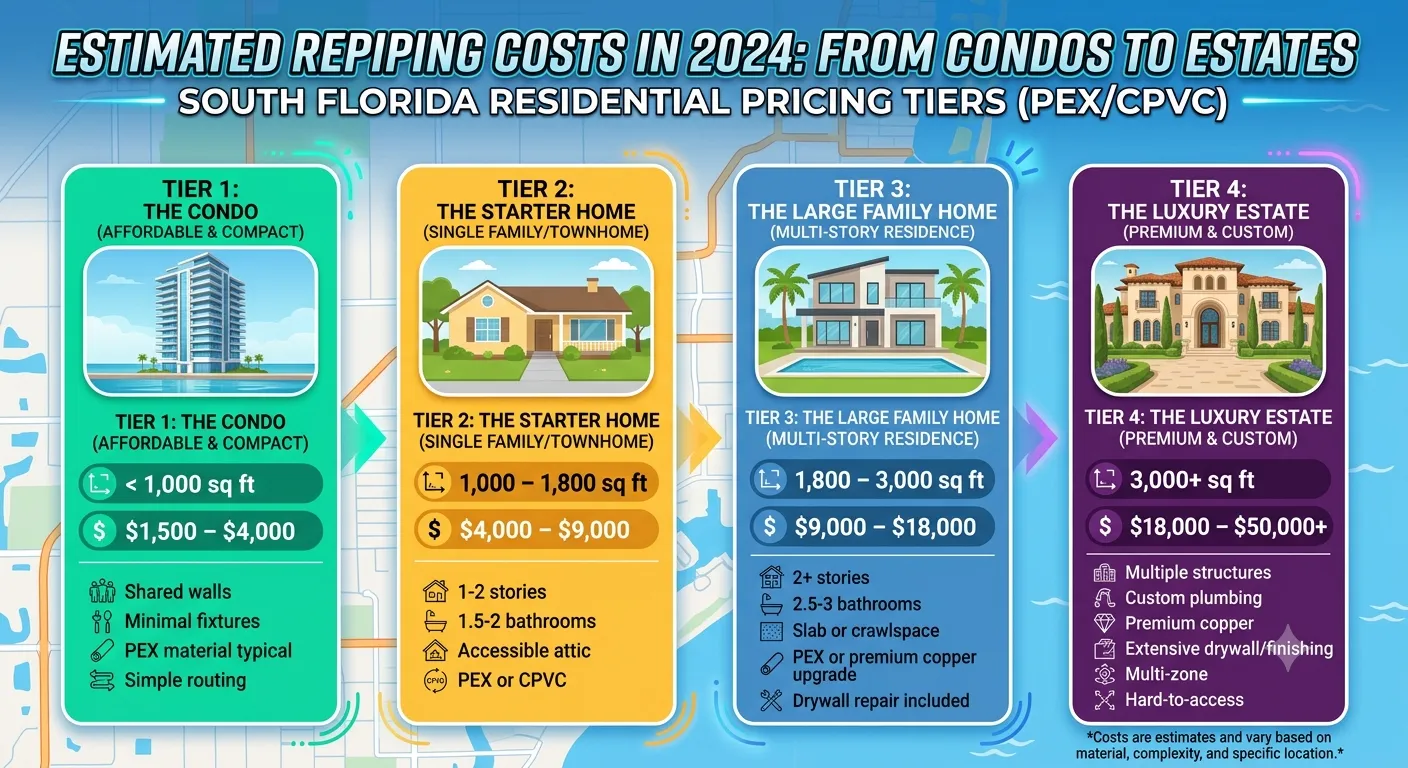
For a standard 1,500 sq. ft. home in Miami, expect a price corridor of $6,500 to $8,500, depending heavily on the material choices detailed below.
National Average Cost to Repipe: breakdown by material
Aside from square footage, your choice of material is the primary lever for the total cost. Each option carries a different price per linear foot (approximately 30 cm) and requires a specific skill set for installation [3], [5].
Choosing your material: PEX vs. Copper
For most 1,500 sq. ft. residences, PEX is the modern default. Its flexibility allows it to be "fished" through walls, significantly reducing labor costs [4]. Copper remains the "gold standard" for luxury markets, valued for its durability, though it requires a much higher investment in both materials and specialized soldering labor [5], [6].
A note on CPVC: while it is the most budget-friendly option, many South Florida experts recommend avoiding it for whole-house projects. Over time, heat and chlorine in the water can make CPVC brittle, leading to cracks that PEX simply doesn't suffer from.
The physical pipes are a fraction of your bill. In Miami-Dade, you are paying for the expertise required to manage the permitting phase (7–30 days for design) and the subsequent county approval process, which can stretch from 30 to 90 days [3]. Skilled plumbers must navigate the home's skeleton, often in tight crawl spaces, ensuring every inch meets modern code to pass the mandatory local inspections.
The Ticking Bomb: why "waiting for a leak" is the most expensive strategy
In South Florida, the "wait and see" approach is a high-stakes gamble. A single burst pipe in our humidity doesn't just mean a plumbing bill: it triggers a cascade of structural damage and rapid mold growth [8].
Insurance companies have noticed. Major providers like Citizens Insurance are tightening the screws on aging systems. If your pipes are past their service life, a leak may be classified as "wear and tear" rather than "sudden damage," leaving you to foot the entire restoration bill [17]. A single pinhole leak in a concrete slab can easily lead to $10,000+ in restoration costs, far exceeding the price of a controlled repipe.
Beyond the financial risk, there is the invisible reality of what’s inside your water lines:
- Lead contamination: roughly 9.2 million US homes still have lead lines, impacting nearly 60 million people [9].
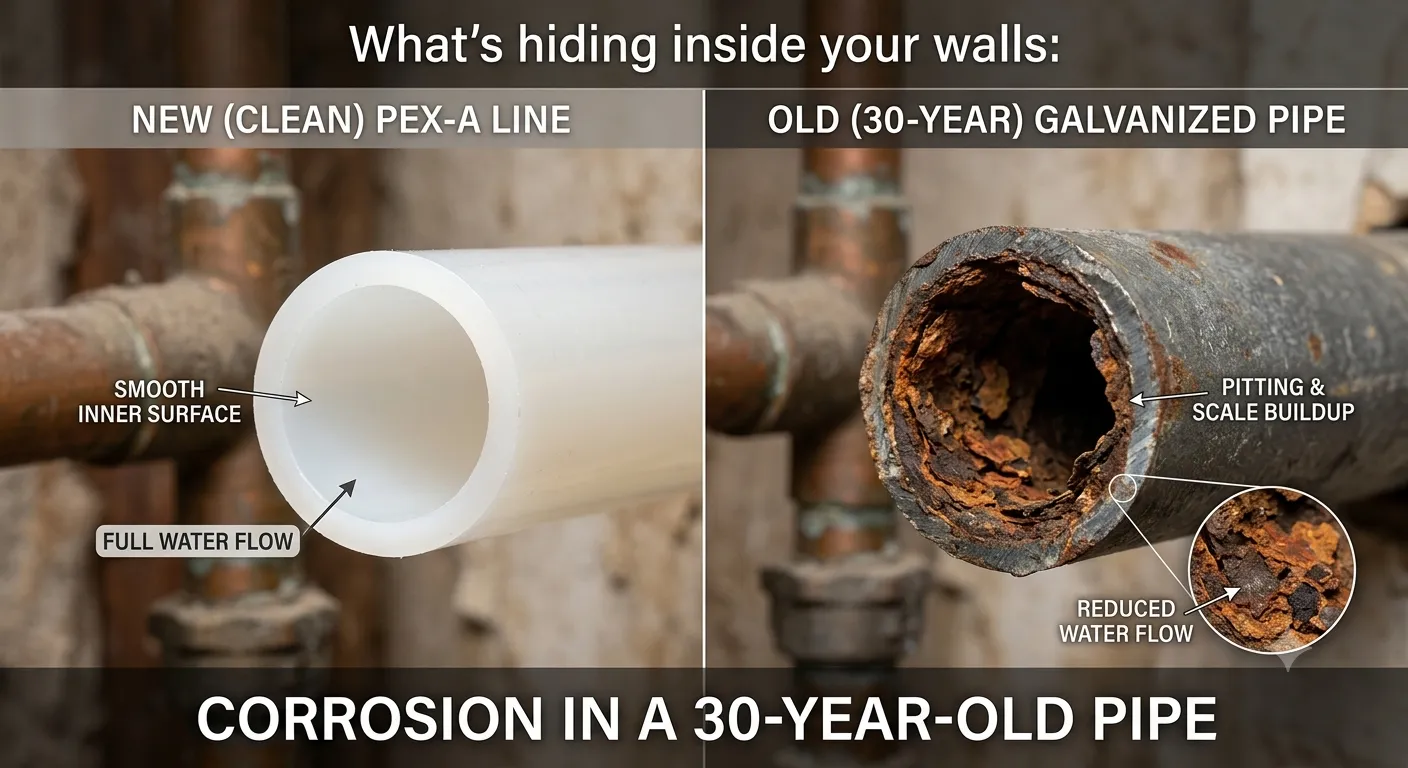
- Biofilms: corroded, pitted pipes provide the perfect breeding ground for bacteria.
- Mold remediation: post-leak cleanup can easily add thousands to your total costs [8].
PEX-A: the 2025 industry standard
In South Florida's climate, water hardness and salt-heavy air are the silent enemies of plumbing. PEX-A, manufactured via the "Engel" method, is the superior choice for Florida. It possesses "thermal memory," allowing it to expand and contract without losing seal integrity. This flexibility is crucial for handling the pressure fluctuations and heat of the South Florida environment [10].
Copper is naturally antimicrobial, but it is vulnerable to "pitting" corrosion if your local water pH falls below 6.5 or rises above 8.5 [12]. Before committing to copper in coastal areas, a water chemistry test is a mandatory first step.
5 Factors that "inflate" Miami repiping estimates
1. Slab foundations: most Florida homes sit on concrete. If your pipes are under that slab, expect a 35% surcharge for the labor-intensive trenching required to reach them [13].
2. HOA/Condo rules: restricted hours and high insurance minimums for contractors can drive up the daily rate.
3. Permit fees: Miami-Dade filing fees start at $130–$147, but the total administrative cost for a full project often hits $800 [14].
4. Drywall restoration: plumbers cut holes; they rarely paint them. Unless you hire a "turnkey" (full-service) contractor, budget for a separate finish contractor.
5. Fixture count: every additional hose bib (outdoor faucet) or guest bath adds to the material and labor clock.
"Slab work is where estimates go from 'rough number' to 'we need to see it first.' I can't tell a homeowner over the phone whether their lines run through the slab or up through the attic — that determines whether we're cutting concrete or fishing PEX through a wall cavity in an afternoon. Anyone who quotes a flat price sight-unseen on a slab home is guessing, and you don't want to be the one who finds out they guessed wrong."
— Danny Folkes, Repipe Project Lead at Miami Expert Plumbing
Is repiping a DIY job?
The short answer is: no. While a homeowner can certainly replace a vanity faucet or a showerhead, a whole-house repipe requires a master plumber's license for several reasons:
- Permits: Miami-Dade will not issue a repipe permit to an unlicensed individual for a project of this scale.
- Insurance: if you DIY a repipe and a leak occurs, your insurance provider will likely deny the claim because the work wasn't permitted or professionally installed.
- Code compliance: modern codes dictate specific slope, support, and venting requirements that are invisible to the untrained eye but critical for home safety.
The line in the sand: if you have to open a wall or touch the main water shut-off, it is time to call a professional.
Modern "minimal impact" methods
Many homeowners fear their house will be unlivable. In reality, modern PEX rerouting allows plumbers to "fish" lines through wall cavities with surgical precision—much like threading new veins through a skeleton. Water is typically restored at the end of every workday, meaning you don't have to check into a hotel.
Long-term value and ROI: does it pay off?
A repipe is a capital improvement. In the Miami market, a certified new plumbing system is a massive selling point.
- Property value: infrastructure upgrades (plumbing, roofing, and electrical) can boost home value significantly. While some estimates suggest a 15–40% increase [15], this usually applies when these upgrades are part of a total home modernization that makes an older property "insurance-friendly."
- Insurance savings: eliminating the risk of water damage often leads to lower premiums or prevents you from being dropped by your carrier.
- Tax credits: if your repipe includes a high-efficiency water heater upgrade, you may qualify for the Federal Energy Efficient Home Improvement Credit of up to $3,200 [18].
Your 4-step action plan
1. Verify the license: check the Florida DBPR (Department of Business and Professional Regulation) or Sunbiz. Ensure they have active Workers' Comp—don't take their word for it.
2. Get three bids: ensure they specify PEX-A vs. PEX-B. Ask: "Does your quote include the cost of permits and drywall patching?"
3. Alert the HOA: get your "Notice of Commencement" (a legal document for jobs over $2,500) handled early to avoid bureaucratic delays.
4. The final sign-off: never release the final payment until the municipal inspector has closed the permit.
Frequently Asked Questions
How long does it take?
The active "workers in your house" phase usually lasts 3 to 7 days for a standard home. However, the entire process—including permits and final inspections—takes 2 to 6 weeks [16].
Can I stay in the house?
Yes. Water is generally only off during active work hours (8 AM – 5 PM) and is restored every evening.
Does insurance cover this?
Rarely. It’s considered maintenance. However, they will charge you more—or refuse to cover you at all—if you don't do it [17].
References
[1] Repipe Solutions Inc - Cost Guide 2026 — https://www.repipesolutionsinc.com/how-much-does-it-cost-to-replumb-a-1500-square-foot-house-in-2026/
[2] Miami-Dade County Building Fee Schedule — https://www.miamidade.gov/resources/economy/building/documents/plumbing-gas-fee.pdf
[3] Angi - Cost to Repipe a House — https://www.angi.com/articles/cost-to-repipe-a-house.htm
[4] Valtec - Technical Analysis PEX (Price/Spec) — https://valtec.ru/document/article/miphs_about_pex.html
[5] Geek Powered Studios - Whole Home Repipe Guide 2026 — https://www.geekpoweredstudios.com/post/whole-home-repipe-cost-guide-2026
[6] Copper Material Pricing Data — Industry Benchmarks
[7] CPVC Material Standards — Industry Benchmarks
[8] HomeAdvisor - Mold Remediation Costs — https://sovetysad.ru/blog/view/skolko-stoit-ustranenie-pleseni
[9] EPA - Lead and Copper Rule Data — https://www.epa.gov/system/files/documents/2023-12/lcri-fact-sheet-for-the-public_11.29.23-russian.pdf
[10] PEX Lifespan vs Temperature Analysis — Technical Data
[11] Copper Longevity Benchmarks — Industry Standards
[12] Water Chemistry & Corrosion Zones — Technical Standards
[13] Slab Foundation Cost Impact Study — Industry Benchmarks
[14] Miami-Dade Plumbing Permit Fees — https://www.miamidade.gov/resources/economy/building/documents/plumbing-gas-fee.pdf
[15] SberBusiness - ROI Calculation Methodology — https://sberbusiness.live/publications/roi
[16] Project Timeline Benchmarks (2024) — Industry Data
[17] Citizens Insurance - Florida Risk Assessment — Carrier Policy Data
[18] IRS - Energy Efficient Home Improvement Credit — https://www.irs.gov/credits-deductions/energy-efficient-home-improvement-credit
It is perfectly normal to feel a sense of dread when thinking about the pipes hidden beneath your floors. But remember: you aren't just paying for plastic or copper; you are purchasing a decade of "dry" nights and the peace of mind that comes with knowing your home’s backbone is solid. You’ve done the research, you know the numbers, and you’ve seen the risks. Now, take that first step—verify a license, get a quote, and protect the sanctuary you’ve built. You have the tools to do this right.


























Sign in to leave a comment.