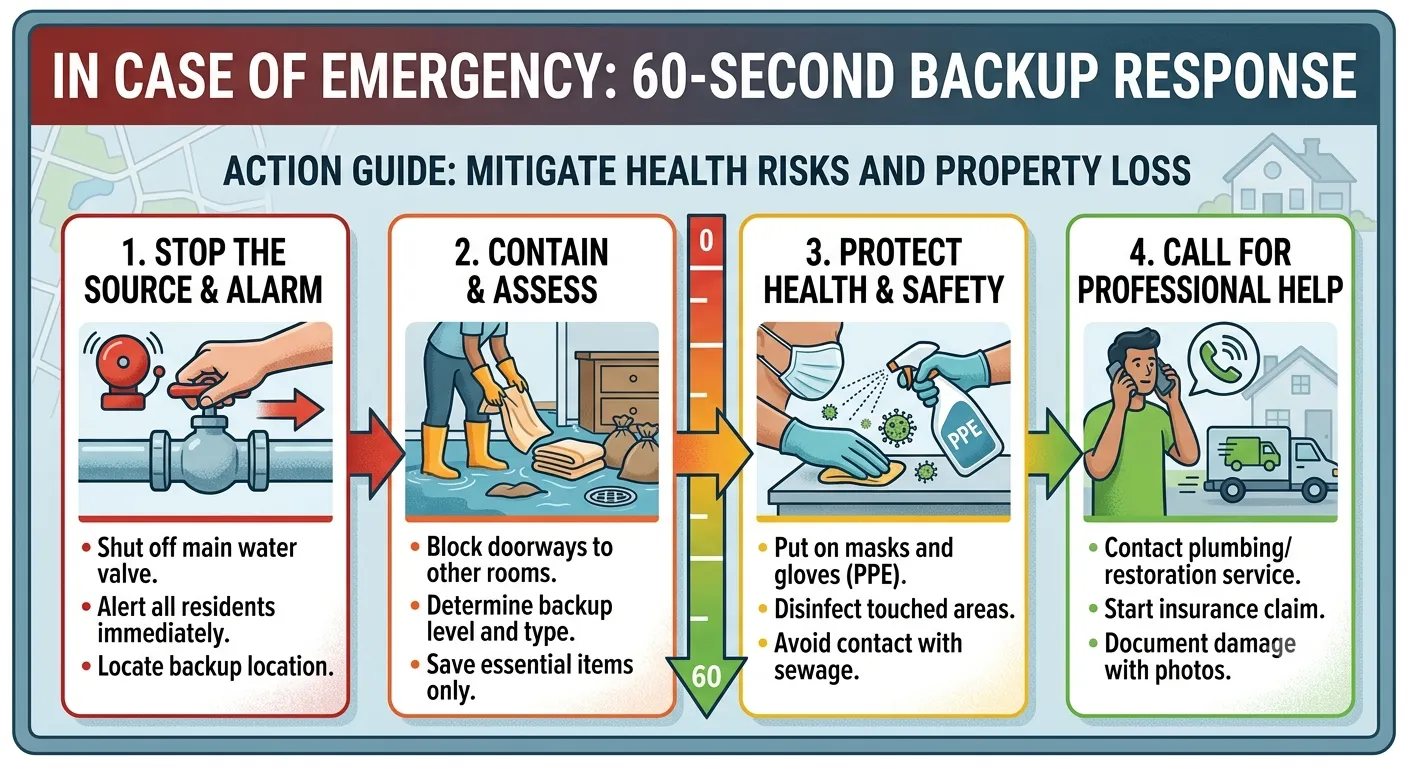

When sewage reverses into a Miami home, the first sixty seconds dictate whether you face a localized cleanup or a $12,000 structural restoration. The immediate priority is stabilization, not repair. Do not attempt to flush toilets or clear drains with chemical cleaners; under pressure, these chemicals can cause thermal damage to pipes or chemical burns to the technicians you will eventually need to hire [6].
Safety is the only metric that matters during the initial surge. If water levels approach electrical outlets or your HVAC (heating, ventilation, and air conditioning) return, shut off the main power—but only if you can reach the breaker box without stepping into standing water. Raw sewage is a "Category 3" biohazard; it contains volatile organic compounds and pathogens that become airborne almost immediately.
The 60-Second Emergency Protocol
- Kill the Water: shut off the main valve to stop adding volume to the backup.
- Isolate the Air: deactivate the HVAC system to prevent the spread of airborne contaminants through the vents.
- Document: take photos from the doorway. You will need these for the "Sewer Backup Rider" claim later.
- Call for a Camera Diagnostic: request a professional camera inspection ($250–$350) to determine if the blockage is on your property or the city’s side [5], [10].

Why "Blackwater" is a Non-Negotiable Biohazard
In the restoration trade, sewage is classified as "Category 3" or Blackwater. This is not a description of the water's color, but of its toxicity. This water is grossly contaminated with E. coli, Salmonellosis, and Hepatitis A [6].
Remediation follows the IICRC S500 standards (the professional "bible" for water damage), which are clear: porous materials like carpets, padding, and upholstered furniture cannot be "cleaned"—they must be disposed of as biohazardous waste. Standard household bleach is insufficient; it cannot penetrate subfloors where bacteria colonies thrive.
The Cost of Delay: A 72-Hour Timeline
- 0–2 Hours: water spreads; primary damage to flooring begins.
- 2–24 Hours: "wicking" begins; drywall absorbs bacteria; odors intensify.
- 24–48 Hours: mold growth is guaranteed; costs double as demolition becomes mandatory [11].
- 48+ Hours: structural integrity of subfloors is compromised; full restoration required.
The Florida Factor: Why Miami Pipes Fail
Miami’s geography presents two unique challenges: aggressive flora and limestone shifts. In historic areas like Coral Gables or Shorecrest, Ficus and palm roots act as "biological drills," seeking the nutrient-rich moisture inside old cast-iron or clay pipes. Once a root enters, a "fatberg" of grease and debris forms, leading to an inevitable backup.
Furthermore, Miami sits on porous limestone. During heavy Atlantic rain events, the high water table can cause soil shifting, leading to "bellies" (low spots where waste settles) or breaks in the line. Under the Miami-Dade Code of Ordinances, any Sanitary Sewer Overflow (SSO) exceeding 1,000 gallons must be reported to the Florida Department of Environmental Protection (FDEP) [8]. Determining liability depends on the "Building Backup" definition under the EPA Miami-Dade Consent Decree [1]. If the failure occurred on the municipal side, the city may be liable, but you will need a plumber’s camera report to prove it.
The "Sewer Backup Rider" Reality
A standard homeowners policy rarely covers sewage backups by default. Most require a specific "Sewer Backup and Sump Discharge" endorsement. Without this rider, you are likely paying a $10,000 restoration bill entirely out of pocket.
Claim Survival Kit: 5 Steps to Approval
1. Verify the Rider: check your policy for "Sewer Backup Endorsement" language before the adjuster arrives.
2. Keep the Evidence: do not throw away damaged items or "flushable" wipes that caused the clog until the adjuster sees them.
3. Get the Camera Footage: a digital recording of the pipe blockage is the only way to prove you weren't negligent.
4. Log Maintenance: have your receipts for annual hydro-jetting or inspections ready to defeat the "negligence exclusion."
5. Mitigate Immediately: insurers can deny claims if you wait 3 days to call a pro, as this allows "preventable" mold to grow.
The $150 vs. $5,000 Rule: When to DIY
The line in the sand is simple:
- DIY ($10–$150): a localized clog in a single sink or tub trap involving "Greywater" (no fecal matter). A $20 manual snake or a $150 power auger rental is appropriate [6], [7].
- Call a Pro ($1,390+): any backup involving a floor drain, a toilet, or multiple fixtures at once.
The risk of DIY sewage cleanup is "phantom mold." If you fail to dry the subfloor to professional standards using industrial dehumidifiers, mold growth is guaranteed within 48 hours [11].
"People underestimate how fast 'just a backed-up toilet' becomes a structural job. We get the call on day three, after someone tried a snake and a wet vac on their own, and by then we're not talking about a $150 fix anymore — we're tearing out drywall. If it's past the trap and into the floor drain, put the gloves down and make the call. That decision alone is usually worth more than the service fee."
— Anthony Russo, IICRC-Certified Restoration Specialist at RooterPRO
Contractor Red Flags: Don’t Pay for a Guess
In Miami’s high-demand market, avoid any contractor who gives a firm quote over the phone without seeing a camera inspection.
Verification Checklist:
1. IICRC Certification: specifically in Applied Microbial Remediation (mold and bacteria removal).
2. Video Diagnostic: a reputable pro uses a camera to show you the break before they start digging up your yard.
3. Itemized Estimate: ensure they list specific "hospital-grade" antimicrobials and HEPA (high-efficiency particulate air) air scrubbers.
Prevention: The 10-Year Solution
The most effective defense for Miami homes is a Backwater Valve. This mechanical flap allows waste to exit but locks shut if the city main begins to back up during a storm. Installation typically costs between $600 and $1,500 but can save $12,000 in a single afternoon.
Additionally, replace "snaking" with Hydro-jetting. While a snake just pokes a hole in a clog—like "poking a hole in a donut"—hydro-jetting uses high-pressure water to scrub the pipe walls clean of grease and roots. A yearly camera inspection ($250–$350) is the cheapest insurance you can buy against a catastrophic failure [5], [10].
Frequently Asked Questions
How long does cleanup take?
expect 3 to 7 days. This includes extraction, 48 hours of industrial drying, and final sanitization.
Can I stay in the house?
no. Airborne pathogens and the noise of HEPA scrubbers make the environment unsafe and uninhabitable during the process.
How do I handle the smell temporarily?
while waiting for the pros, you can use a 1:1 white vinegar solution or baking soda to neutralize surface odors, but this will not kill the underlying bacteria [12]
A sewage backup is more than a plumbing failure; it is a race against biology. In the humid Miami climate, a small overflow can evolve into a full-scale biohazard in less than a weekend. By acting within the first hour—isolating the water, documenting the damage, and calling for a camera diagnostic—you move from being a victim of the "wicking effect" to a homeowner in control of the recovery. Your home is your most significant investment; don't let a preventable backup wash it away.
References
[1] EPA Miami-Dade Consent Decree — https://www.epa.gov/sites/default/files/2013-08/documents/miami-dade-cd.pdf
[2] Miami-Dade Water & Sewer Design Standards — https://www.miamidade.gov/global/service.page?Mduid_service=ser148156625339722
[3] ProMatcher Miami Plumber Costs — https://plumbers.promatcher.com/cost/miami-fl-plumbers-costs-prices.aspx
[4] HomeGuide Sewer Line Repair Cost 2025 — https://www.vevor.com/ru/diy-ideas/how-much-does-it-cost-to-fix-a-sewer-line/
[5] HomeAdvisor Sewer Inspection Guide — https://www.homeadvisor.com/cost/plumbing/sewer-inspection/
[6] Restoration 1: Sewage Cleanup Costs — https://restoration1.com/blog/how-much-does-sewage-cleanup-cost
[7] Home Hardware Market Estimates
[8] Municode: Miami-Dade Code of Ordinances — https://library.municode.com/FL/Miami_-_Dade_County/CODES/Code_of_Ordinances
[9] North Miami Restoration Services — https://northmiamirestoration.com/sewage-cleanup/
[10] Internal Market Data: Premium Remediation Rates
[11] Mold Growth Timelines (Industry Standard)
[12] Aireserv: Musty Smell Removal — https://www.aireserv.com/about/blog/why-does-my-house-smell-musty-/

























Sign in to leave a comment.