

For a Miami property owner, a leaking pipe isn't just a maintenance chore—it’s a financial crossroads. Deciding whether to patch a small drip or overhaul the entire system determines your home’s long-term valuation and your eligibility for insurance in an increasingly tight Florida market. To make the right call, you need to look past the surface and understand the technical state of your home's infrastructure.
The "Three-Strike Rule" and Your Decision Grid
Plumbing experts generally rely on the "Three-Strike Rule" to help homeowners identify the point of diminishing returns. If a specific section of your plumbing has required professional repair twice, a third failure is usually the signal for a mandatory replacement [1].
However, modern standards are shifting toward a more comprehensive risk assessment [2]. Rather than simply counting leaks, professionals evaluate the systemic integrity of the materials. In South Florida, where high humidity can trigger rapid mold growth following a burst, "patching" often becomes a cycle of sunk costs.
5 Warning Signs of Systemic Pipe Failure
Recognizing the early symptoms of failure can save your flooring, cabinetry, and peace of mind. These indicators suggest that your pipes have reached their mechanical limit:
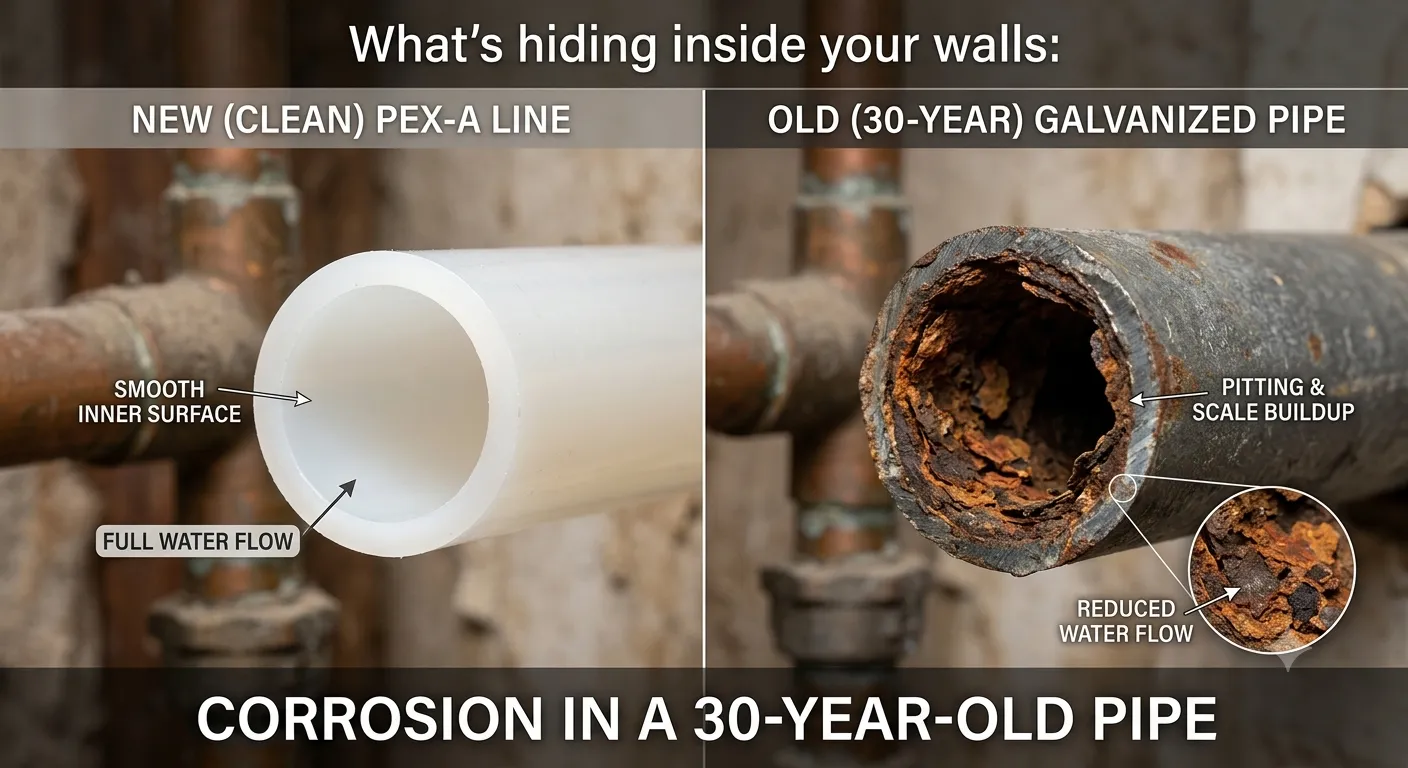
1. Discolored Water and Internal Oxidation: if your water arrives with a brown or reddish tint, you are likely seeing the "blood" of your plumbing system. This is a hallmark of galvanized steel pipes corroding from the inside out.
2. Chronic Low Water Pressure: low pressure in Miami is rarely just a "city issue." It is often caused by mineral scaling (отложения). Because our water is sourced from the Biscayne Aquifer, it carries a heavy mineral load: approximately 78 ppm of Calcium and 12 ppm of Magnesium [3][4]. Over decades, these minerals build up like plaque in an artery, narrowing the pipe's diameter.
3. Visible Corrosion or "Pitting": small green or white powdery spots on copper pipes indicate "pitting corrosion" (точечная коррозия)—tiny, needle-like holes developing from the exterior [2][5].
4. Frequent Clogs or "Slow" Drains: in older homes, this often signals "channeling" in cast iron pipes, where the bottom of the pipe has literally dissolved into the soil [13].
5. Unexplained Humidity or Mold Smells: in the Florida heat, even a pinhole leak can saturate drywall, leading to mold blooms long before a puddle appears on the floor [6].
The Florida Factor: Why Local Pipes Age 20% Faster
Miami’s geography is notoriously hostile to metal. Our proximity to the Atlantic introduces salt-laden air that accelerates electrochemical corrosion, even on pipes tucked away in utility closets.
Furthermore, the high water table in Miami-Dade means underground lines are frequently submerged in moist, sandy soil. Local data suggests that while copper might last 50 years elsewhere, in Miami, it can fail in as little as 15 to 20 years [2][5][6].
The Polybutylene Crisis and the Insurance Trap
Polybutylene (Poly-B) reacts poorly to the chlorine used in municipal water treatments, becoming brittle and prone to sudden shattering. In the South Florida heat—especially in attics that reach 120°F—the lifespan of Poly-B is often cut drastically [1].
Many Florida carriers now deny coverage or spike premiums for homes with Poly-B or cast iron, viewing them as a "total loss" water claim waiting to happen.
The ROI of Replacement: Why "Cheap" is Expensive
In Miami, a full repipe offers a massive return on investment of 80-125% [10][11]. If you choose to patch instead, you may face "price chipping" during a future home inspection, where buyers demand credits that far exceed the actual cost of the repipe.
"In Miami, we pull cast iron lines that look fine from the outside but are completely hollow underneath," says Derek Holt, Lead Drain Specialist at Miami Expert Plumbing. "The soil moisture and the constant heat basically eat the metal from below. By the time a homeowner notices slow drains, we're usually looking at a pipe that's already lost 40 to 60 percent of its structural wall. At that point, a camera inspection isn't optional—it's urgent."
David Reyes, licensed master plumber and founder of H2Osolutions
DIY vs. Professional: Where to Draw the Line
In Florida, it is illegal for unlicensed individuals to perform major plumbing. Work must be permitted through Miami-Dade County to ensure it meets the Florida Building Code [9].
- Safe for DIY: replacing a showerhead, fixing a flapper in the toilet, or swapping an under-sink P-trap.
- Call a Pro: any leak inside a wall, any work on the main shut-off valve, or any issue involving the water heater or gas lines.
A Warning on Chemical Cleaners: using caustic, store-bought chemical cleaners on aging pipes is a dangerous gamble. These acids generate heat that can eat through the thinning walls of old galvanized or cast iron systems, turning a simple clog into a major flood.
Prevention & Future-Proofing
After a replacement, the goal is preservation:
1. Filtration: new PEX systems are vulnerable to high chlorine levels; a whole-home filter can extend their life [1].
2. Smart Sensors: installing leak detectors can automatically shut off your water at the first sign of a drip.
3. Hurricane Readiness: high winds can cause structural shifts that stress aging main lines. Always ensure your main shut-off valve is accessible before storm season.
FAQ: Miami Homeowner Essentials
How long does a full repipe take?
Most professional crews can complete a standard Miami residence in 2 to 6 business days [12].
Can I stay in my home during the work?
Generally, yes. Plumbers typically restore water service at the end of each day, though you will experience shut-offs during working hours.
Is it ever okay to just keep repairing?
If the system is less than 15 years old and the leak was caused by external damage (like a nail through a pipe), a repair is perfectly fine. If the leak is due to corrosion, the first leak is your warning; the third is your eviction notice from a reliable system.
Your Action Plan
- Document: take photos of any visible leaks or water stains for insurance and contractor review.
- Inspect: invest in a professional video camera inspection to see the internal state of your lines.
- Verify: check the Florida Department of Business and Professional Regulation (DBPR) website to ensure your contractor’s license is active.
- Interview: ask your contractor about their experience with Miami-Dade permitting and whether they offer a "drywall-to-paint" finish or just the plumbing work.
References
[1] QWRAP Fact Sheet: Pipe Whispering & Material Lifespans [2] PHMSA Risk Assessment & Aging Plumbing [3] Crystal Flow Miami: Water Quality Data [4] Lead Pipe Replacement & Property Value Study [5] Polybutylene Risks in Florida [6] Florida Condo Association Advisor: Water Leaks [7] Miami Plumbing Guide: Repair vs Repipe [8] PipeSafe Terms & Epoxy Lining Conditions [9] PE100+ Association: HDPE Design Lifetime [10] Miami-Dade Water Quality Report 2024 & ROI [11] Whole Home Repiping Cost South Florida [12] Florida Condominium Pipe Leak Responsibility [13] Cast Iron Pipe Replacement Cost Miami 2026 [14] Aztec Plumbing: Typical Pipe Lifespans.
Your home is likely your most significant asset, and in Miami’s volatile climate, its infrastructure is under constant siege from salt, heat, and minerals. Addressing a failing system isn't just about stopping a drip; it's about protecting the foundation of your family's daily life and ensuring your property remains an insurable, valuable legacy. Don't wait for the third strike to realize the game has changed—take control of your home’s health before the choice is made for you by an emergency.


























Sign in to leave a comment.