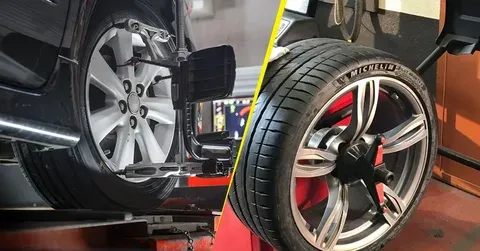

Getting new tyres installed seems like a task smoothly finished. The old rubber is discarded, the tread depth is restored to its maximum, and the car feels more stable on the road after the change. However, quite a few motorists walk out of the garage unaware that the one simple step, wheel balancing, is what decides whether those new tyres will serve their full life or get worn out unevenly in a short time. Learning about how tyres and balancing complement each other, and what the result of ignoring either one is, helps drivers better understand what the real tyre care is all about.
Why Tyre Condition Matters Beyond Tread Depth
Most motorists naturally link tread depth with tyre safety, quite rightly, because grip is severely compromised once tread depth goes below 1.6mm. This incidentally is the UK legal limit. However, tread depth is only one aspect of measuring a tyre's condition and safety.
Besides tread depth, a tyre's safety and effectiveness largely depend on:
- Sidewall condition: Cracks, bulges, or deep gouges on the sidewall are signs of structural failure that even full tread depth cannot offset. In the case of a bulge, it is a clear indication that internal air is escaping due to the separation of layers.
- Wear resulting from ageing: Even without being driven, tyre rubber gradually hardens and loses elasticity. Most tyre manufacturers advise changing tyres that are more than 7 to 10 years old, regardless of remaining tread depth.
- Pressure levels: Inflation pressure that is 20% less than the recommended level leads to the tyre generating more heat due to the excessive flexing of the sidewalls. Hence, resulting in faster wear of the internal components and greatly reduced resistance to blowouts, even when travelling at high speed.
- Different wear patterns: Feathering, wear of only one side, or scalloping throughout the tread surface are signs of car alignment, balancing, or suspension problems. This will wear out even a brand-new tyre as fast as the one it replaced
Motorists who get tyres Peterborough from a reliable and well-known local dealer are getting all these elements assessed thoroughly during fitting time.
Understanding Wheel Balancing in Detail
Every tyre and wheel pairing harbours tiny differences in the way the weight is spread around the circle of the wheel. Such deviations are present even in brand-new parts, as the manufacturing process allows for slight discrepancies in rubber and metal. When a wheel rotates, these weight variations lead to a centrifugal force, which makes the combination vibrate at particular speeds.
Wheels are balanced with the help of a machine that spins them and accurately detects where the weight imbalance is located. Next, the technician places small calibrated weights on the rim at certain points to offset the uneven distribution. Ultimately, the wheel is able to spin even at high speeds without causing any vibration.
Static vs Dynamic Balancing
There are two different ways of imbalance that need to be fixed during a professional balance check.
Static imbalance is the condition of the weight being unevenly distributed around the circumference of the tyre. In other words, one side is heavier than the other. This leads the tyre to be constantly bouncing up and down as it rotates, causing it to be very noticeable at certain speeds.
On the other hand, dynamic imbalance is a condition when the weight not only differs around the circumference of the tyre, but also along its width. This finally makes the wheel wobble from side to side while spinning. This is the main consequence that the drivers experience the steering shimmy or disclose vibration through the wheel after a new tyre fitting. Contemporary computerised balancing tools take care of both types at once. Hence, this is why a good balancing procedure should always be a part of every new tyre fitting without any exceptions.
The Damage Unbalanced Wheels Cause
When driving on unbalanced wheels, not only will their ride be uncomfortable, but they will also get a whole chain of damage from it. The vibration caused by an unbalanced assembly is transmitted continuously through the vehicle's suspension and steering systems during each wheel rotation.
The drivers who simply choose to delay their wheel balancing Peterborough services after buying new tyres may experience the progressive damage which leads to:
- Fast tyre wear: The tyre is not able to maintain the proper contact with the road surface due to the bouncing or wobbling motion. This leads to the tyre wear that is so irregular that it results in the tyre life being shortened significantly.
- Wheel bearing failure: Bearings are normally not intended to be used as absorbing components of the lateral and vertical forces. Thus, resulting from the persistent imbalance, in fact, an unaided prolonged imbalance is directly leading to premature bearing failure.
- Shock absorber wears out: Since the vibration is constant, shock absorbers will be working much harder even when the car is not moving, resulting in their significantly reduced working life.
- Steering components get worn: Tie rods, steering rack components, and associated joints get stressed further due to imbalance-induced vibration, and their diminishing function in terms of play and the steering system's precision/accuracy come as a consequence of this time after time.
When Balancing Should Be Booked
Wheel balancing is not a one-time thing associated solely with fitting new tyres. Many instances call for a new balance check irrespective of the last balancing date, for example:
- Since a repair changes how the weight is spread around the tyre, it is necessary to balance after the tyre repair or the fixing of the puncture.
- If someone encounters a massive pothole or bumps against a curb and the existing balance weights get dislodged from the rim, then the balance will be disturbed.
- Every 10,000 to 12,000 miles, as a schedule, weights can gradually shift under normal wear and tear.
Conclusion
New tyres cost a fair amount, so it's only right that they get full benefit from that purchase, which means balancing the wheels that have those new tyres properly. Wheels that are not balanced decrease the viability of tyres, wear down the suspension components, and cause vibrations that make the ride uncomfortable and unsafe. Doing wheel balancing as an integral part of every tyre fitting and not just as something someone can add on is the choice that really looks after both tyres and the vehicle that they belong to.



























Sign in to leave a comment.