
When businesses talk about building a website or app, the conversation often circles around design, development, user experience, and performance. Somewhere in the middle of that discussion, confusion starts.
One person says they need a designer, and another one says they need a frontend developer. Someone else assumes both roles are the same thing.
That misunderstanding costs businesses time, money, and growth.
In 2026, customers expect digital experiences that feel smooth from their very first click on your website or any digital identity that your brand has. They want pages to load fast with easy navigation for every age group, a clean layout, and interactions that make sense instantly. If your website looks great but feels frustrating and difficult to use, people will leave, and you just lost a potential customer. If it functions perfectly but the UI is outdated and cluttered, they still leave, and you have again lost a potential customer.
That is why understanding ui ux design vs frontend development matters more now than ever before.
For entrepreneurs, solopreneurs, and digital marketing agencies, this topic goes far beyond technical roles. It affects conversions, customer trust, ad performance, SEO rankings, and overall business growth.
This article breaks everything down in simple terms so you can clearly understand the difference between ui ux and frontend development, how both roles work together, and what that means for your business or career moving forward.
Why Businesses Keep Confusing UI/UX and Frontend Development
The confusion around ui ux design vs frontend development starts because both roles shape what users see and interact with on a website or app. From a customer’s perspective, everything feels connected, but behind the scenes, these are very different skill sets.
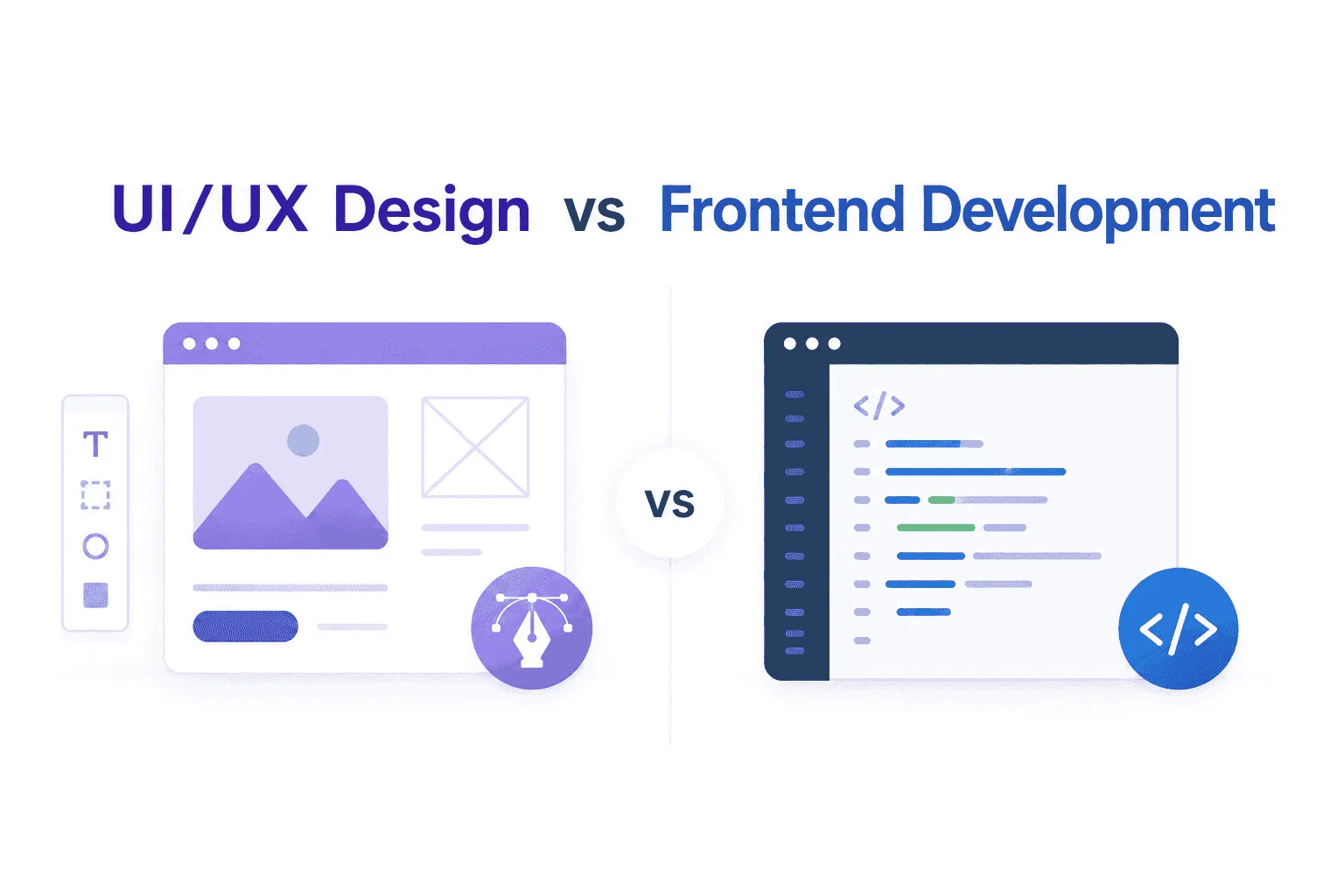
UI/UX designers focus on user experience, layout, and usability, while frontend developers focus on building the interface technically. Since modern teams work closely together, many people assume both roles are the same.
For businesses, understanding this difference is important. A great design without proper frontend performance can frustrate users, while strong development without good UX can make a website feel confusing or outdated.
Today, businesses need both strong design and smooth frontend performance to create better user experiences, improve conversions, and compete online.
What UI/UX Designers Actually Focus On
When people compare a ui ux designer vs. a frontend developer, they often focus only on visuals. But UI/UX work goes much deeper than making websites look attractive.
UI stands for User Interface.
UX stands for User Experience.
Together, they shape how people interact with digital products.
A UI/UX designer studies customer behaviour, navigation patterns, decision making, readability, accessibility, and emotional response. Their job is to reduce confusion and make digital experiences feel natural.
That process includes:
- User research
- Wireframes
- Page layouts
- Design systems
- Customer journey mapping
- Prototypes
- Usability testing
- Accessibility improvements
This is the foundation of good digital product design.
Let’s say an e-commerce brand notices shoppers abandoning carts before checkout.
A UI/UX designer investigates questions like:
- Is the checkout process too long or confusing for everyone or for a particular age group?
- Are buttons hard to find or not labelled?
- Does the mobile layout create friction while the user makes their purchase?
- Are users confused about shipping information or other details that they concerns them?
Small design decisions can dramatically affect conversions.
This is why website user experience directly impacts sales, lead generation, and customer trust.
Adobe research has consistently shown that users stop engaging with websites that feel poorly designed or difficult to navigate. That matters even more in 2026 because users now expect fast, clean, mobile friendly experiences across every platform.
The role also plays a huge part in branding.
Customers often judge credibility within seconds. A cluttered interface or confusing layout creates doubt immediately.
That is why understanding ux design vs web development matters for growing businesses. Good UX shapes perception before customers even read your offer.
For entrepreneurs and agencies, investing in better UX often improves:
- Conversion rates
- Customer retention
- Time spent on site
- Lead quality
- SEO performance
- Ad campaign results
The impact goes far beyond visuals.
What Frontend Developers Really Do
Once the design direction is ready, frontend developers step in and turn those ideas into working digital experiences.
This is where HTML, CSS, and JavaScript development become essential.
Frontend developers build the actual interface users interact with inside a browser or app.
Their work includes:
- Coding layouts
- Making websites responsive
- Building interactive features
- Connecting APIs
- Optimizing speed
- Improving accessibility
- Ensuring browser compatibility
In simple terms, designers create the blueprint. Frontend developers build the experience people actually use.
This role has become increasingly important because websites today are far more dynamic than they were even a few years ago.
Modern users expect:
- Instant page loading
- Smooth animations
- Mobile optimization
- Interactive dashboards
- Personalized experiences
- Real time updates
Without strong frontend execution, even excellent design ideas fail in practice.
This is where businesses often underestimate the value of frontend development.
A visually attractive site means very little if pages lag, buttons break, forms fail, or layouts shift unexpectedly on mobile devices.
Google now factors page experience and loading performance into rankings. Core Web Vitals continue shaping how websites perform in search visibility and how they hold the position of a brand on the web.
That means frontend development affects SEO directly.
Stack Overflow Developer Surveys also continue ranking JavaScript among the world’s most widely used programming languages, showing how central frontend technologies remain in today’s digital economy.
For agencies and business owners, this affects customer acquisition more than many realise.
Imagine paying for traffic through SEO or Meta ads, only to lose visitors because your frontend performance frustrates users.
That creates wasted ad spend and lost opportunities.
This is one of the biggest reasons the conversation around ui ux designer vs frontend developer responsibilities matters for growth focused businesses.
How Design and Frontend Development Work Together
The best digital experiences happen when designers and frontend developers collaborate from the beginning.
Strong products rarely come from isolated workflows where designers create everything first and developers simply “make it work” afterwards.
The smartest teams build together.
This is where the conversation around the roles of ui ux designer and frontend developer becomes important.
Both roles solve different problems while working toward the same outcome.
UI/UX designers focus on:
- Human behavior
- Experience flow
- Usability
- Visual consistency
- Accessibility
- Emotional response
Frontend developers focus on:
- Technical functionality
- Performance
- Responsiveness
- Browser behavior
- Code structure
- Interactive implementation
One side focuses more on people, while the other focuses more on systems.
When both areas align properly, businesses create digital experiences that feel intuitive and perform smoothly at the same time.
Think about a SaaS platform onboarding process.
The designer may simplify the sign up flow to reduce friction, and the frontend developer ensures the forms load quickly, validate correctly, and function seamlessly across devices.
Both contributions directly affect conversion rates.
This is why the discussion around what the difference is between ui ux design and frontend development should never turn into a debate about which role matters more.
Businesses need both.
And in many cases, the gap between these roles creates communication problems inside projects.
A designer may create layouts that look beautiful but are difficult to build efficiently.
A developer may prioritise functionality while overlooking customer behaviour.
The strongest digital teams bridge both perspectives early and incorporate them during development.
That collaboration improves:
- SEO performance
- Customer retention
- User engagement
- Lead generation
- Brand perception
- Website usability
For agencies managing client projects, understanding this relationship also improves project timelines and client expectations.
Career Paths, Skills, Salaries, and Future Opportunities
One of the most searched questions today is: Which is better, ui ux or frontend development?
The answer depends entirely on your strengths, interests, and long term goals.
People drawn toward creativity, psychology, research, and visual storytelling often enjoy UI/UX design more.
People who enjoy logic, coding, systems, and technical problem solving usually prefer frontend development.
When discussing skills required for ui ux vs frontend development, the difference becomes much clearer.
UI/UX Designers typically focus on:
- User research
- Wireframing
- Prototyping
- Visual systems
- Design thinking
- Customer psychology
- Tools like Figma and Adobe XD
Frontend Developers usually focus on:
- HTML
- CSS
- JavaScript
- Frameworks like React or Vue
- Responsive coding
- Performance optimization
- Debugging and testing
Both fields continue growing rapidly.
According to the U.S. Bureau of Labour Statistics, web development and digital design related careers are projected to grow faster than average over the coming years.
Remote work has also expanded opportunities globally.
This creates strong career potential for both paths in 2026.
The discussion around ui ux vs frontend salary and scope often depends on:
- Location
- Experience
- Industry
- Technical specialization
- Portfolio quality
Senior frontend developers in enterprise environments often command higher technical salaries due to coding complexity.
At the same time, experienced UX strategists and product designers can earn equally competitive compensation because of their direct impact on business growth and customer experience.
The bigger takeaway here is that businesses increasingly value professionals who understand both worlds.
That is why hybrid roles continue growing.
Many companies now look for professionals who can bridge design thinking with technical execution.
This trend also shapes the ongoing ui ux vs frontend developer career comparison conversation.
The future favours collaboration, adaptability, and customer focused thinking.
Actionable Takeaways
- UI/UX design focuses on usability, experience flow, and customer behaviour.
- Frontend development focuses on coding, responsiveness, and technical functionality.
- Strong UX improves conversions, engagement, and customer retention.
- Frontend performance directly affects SEO rankings and user satisfaction.
- Businesses grow faster when design and development teams collaborate early.
- UI/UX suits creative and research driven professionals.
- Frontend development suits analytical and technical problem solvers.
- Understanding both areas improves communication inside agencies and growing businesses.
Final Thoughts
The discussion around ui ux design vs frontend development often sounds like two separate worlds competing against each other.
In reality, they depend on one another.
Your customers do not separate design from functionality when they interact with your website or app. They simply decide if the experience feels smooth, trustworthy, and easy to use.
That experience shapes everything from conversions and SEO rankings to customer loyalty and brand perception.
For entrepreneurs and agencies, understanding the difference between ui ux and frontend development helps you make smarter hiring decisions, build stronger digital products, and avoid expensive mistakes.
For professionals exploring career paths, both fields offer strong opportunities in 2026 and beyond.
The bigger opportunity lies in understanding how these disciplines connect.
Because the businesses winning online today are not choosing between design and development.
They are building experiences where both work together seamlessly.


























Sign in to leave a comment.