
In the modern world of sheet metal production, making an accurate, precise die diagram is of crucial use in achieving accuracy, efficiency and consistency in production. Automotive, electronics, aerospace and industrial engineering are just some of the sectors where sophisticated die systems play a critical role in the precision manufacturing of critical metal parts. Companies that have quality engineering solutions to offer must be familiar with the various types of dies and their uses, so that they can decide which type of die work is most suitable for their company.
A good die diagram will assist the manufacturer to visualise the tools and how they will work on materials, sequences of cutting, and forming operations, before any materials are produced. This will make for efficient operations, minimise material losses and afford a consistent product.
What is a Die Diagram?
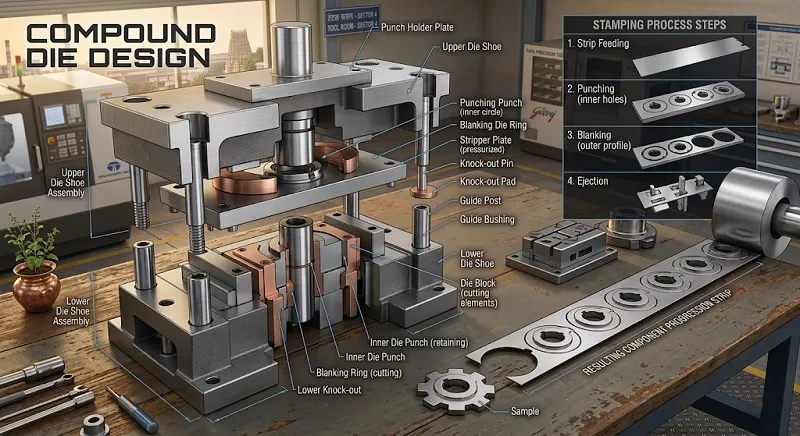
A die diagram is a technical representation of a stamping die that shows the arrangement of punches, die blocks, stripper plates, guide pins and work stations of a stamping die that performs metal forming and/or cutting operations. It serves as a guide for the design of dies and the development of production plans.
A well-designed die diagram helps the manufacturers in precision engineering to be able to:
- Improve production accuracy
- Minimize set up and tooling inaccuracies
- Improve repeatability for mass production.
- Optimize material utilization
- Minimise downtime and maintenance issues
Since modern industries require highly precise components manufactured in high quantities, the diagram of a die is now considered to be an essential element in complicated tool designs and production.
Types of Dies Used in Metal Stamping
Depending on the complexity of the component produced, the number of quantities and the operating conditions, various stamping operations demand different dies. Commonly used dies are:
- Simple Dies
- Compound Dies
- Combination Dies
- Progressive Dies
- Transfer Dies
- Multiple Dies
Of these, compound dies, combination dies, and progressive dies are popular for precision metal stamping processes.
Compound Dies and Their Industrial Importance
Compound dies have the capability to work multiple cuts with a single press stroke. This is because blanking and piercing are done in a single process, which makes it very efficient and cost-effective for flat metal parts, such as washers and electric contacts.
The design of the compound die guarantees repeatability, dimensional stability and quick tooling changeovers. Such dies are ideal for medium-volume manufacturing lines where the part geometry is not so complicated.
Advantages of Compound Dies
- High production speed
- Excellent dimensional accuracy
- Reduced operational time
- Suitable for flat parts.
- Improved repeatability
Limitations of Compound Dies
However, compound dies have some serious drawbacks because they are inefficient for highly complex geometries or those applications involved in the forming process as well. The cutting force is frequently larger owing to several cuts that take place at the same time.
To ensure proper alignment of the tools, elimination of any chip breaks, and to limit the amount of wear during punching, it is essential to obtain a precise compound die design.
Combination Dies in Precision Manufacturing
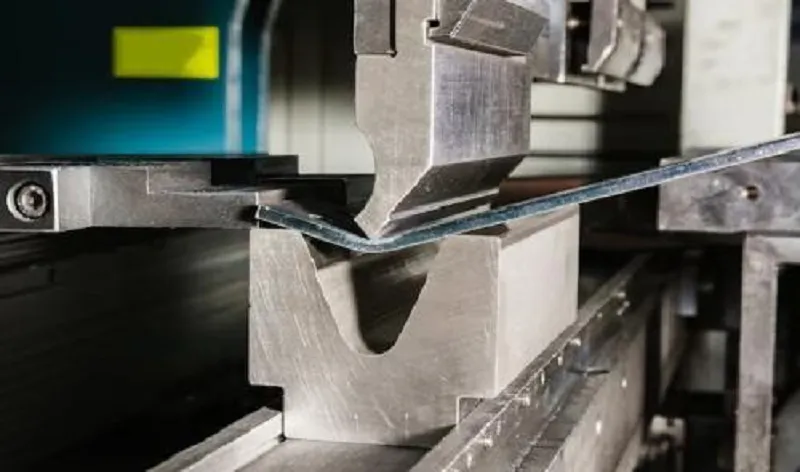
Combination dies offer a blending excision and bending together in the same press cycle. As opposed to compound dies, these kinds of tooling systems can execute bend, form, blanking, and piercing tasks concurrently.
A properly created combination die structure is a representation of how multiple operations will occur in just one tooling setting. This helps manufacturers to produce faster, and yet achieve the precision in each component.
Common use of combination dies is:
- Electrical enclosures
- Appliance components
- Automotive brackets
- Industrial hardware
They can easily combine forming and cutting processes and thus are very suitable for advanced manufacturing environments.
Progressive Dies and Multi-Stage Production
A progressive die is one of the most advanced tooling systems in the precision engineering tooling. Progressive stamping is a stamping process in which the metal strip passes through a series of stations, where each station carries out a certain action.
For progressive tooling the die diagram will clearly show the order of operations for the workstations, strip progressions, pilot alignment, and feeding routes for the material. The shape of each component is also an important one because they all form the shape of the entire component.
Benefits of Progressive Dies
- High-speed mass production
- Reduced labour requirements
- Minimal material scrap
- Consistent product quality
- Ability to create complex shapes
Due to the highly detailed nature of progressive dies and the high volumes they can operate, they are effective in creating intricate components and manufacturing parts with high accuracy.
Challenges of Progressive Dies
While very productive, progressive tooling can be very costly in terms of set-up and demands accuracy of the set-up. If one of the stations is damaged, the entire tooling assembly may become damaged.
For such a reason, it is crucial for the manufacturers to have an optimised diagram of the die in their design and development process.
Importance of Proper Die Selection
The proper choice of the type of die will directly affect manufacturing efficiency, die life and production cost. Any kind of improper design of a die can cause:
- Punch chipping or breakage
- Misalignment of die components
- Excessive material wastage
- Poor dimensional accuracy
- Increased downtime
Whether using progressive tooling or advanced compound die design, precision engineering demands accurate die planning and robust tooling construction.
In Conclusion, as industries continue to demand tighter tolerances and higher production efficiency, the importance of a well-structured die diagram continues to grow. From compound and combination dies to sophisticated progressive tooling systems, each die type serves a unique role in precision manufacturing.
An optimised compound die design improves productivity, enhances operational consistency, and supports cost-effective production for flat metal components. Similarly, progressive and combination dies enable manufacturers to handle complex geometries with speed and precision.
For precision engineering companies like Eigen Engineering, advanced die development remains a critical factor in delivering reliable, high-performance metal stamping solutions for modern industrial applications.


























Sign in to leave a comment.