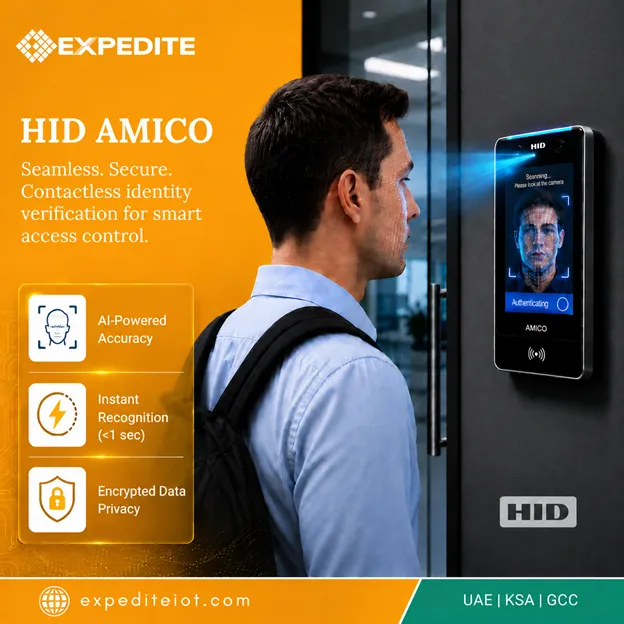

HID Amico is redefining how Saudi Arabian organizations verify identity at the door, replacing badges and PIN codes with fast, touchless facial authentication. As offices, hospitals, campuses, and government facilities across the Kingdom pursue smarter, more resilient entry security, this next-generation reader is emerging as the credential-free standard for high-traffic, high-security environments.

This guide explains how the platform works, what sets its anti-spoofing engine apart from conventional facial readers, and how facility managers in Riyadh, Jeddah, and beyond can deploy it as part of a broader access control strategy.
What Is HID Amico and Why It Matters for Saudi Facilities
Traditional entry credentials — cards, fobs, and PIN codes — share a common weakness: they verify possession of an object or knowledge of a code, not the identity of the person standing at the door. HID Amico closes that gap by using computer-vision-based facial authentication to confirm exactly who is requesting entry, in well under a second, without requiring the user to touch a reader or fumble for a badge.
For Saudi organizations balancing Vision 2030's digital-transformation priorities with rising expectations around workplace and campus security, this shift from token-based to identity-based verification represents a meaningful upgrade — one that reduces credential-sharing risk while speeding up throughput at busy entrances.
HID Amico Facial Recognition: How the Technology Works
At the core of the device sits a sophisticated HID Amico Facial Recognition engine that captures a facial template, converts it into an encrypted mathematical representation, and compares it against enrolled profiles stored securely on the device or synced through a connected access-control platform. The entire match-and-decision process completes in real time, allowing doors to release the instant a verified face is presented — no lingering, no manual override needed from security staff.
Because the matching engine is trained across diverse lighting conditions, skin tones, and facial coverings common in the region — including sunglasses, masks, and headscarves — accuracy remains high across the varied populations found in Saudi workplaces, hospitals, and educational campuses, rather than being optimized only for a narrow demographic.
HID Amico Facial Reader: Hardware Built for Demanding Environments
Software accuracy only matters if the hardware capturing the image performs reliably under real-world conditions. The HID Amico Facial Reader is engineered with a wide-angle camera and adaptive infrared illumination that maintains recognition accuracy in bright Gulf sunlight streaming through a lobby window, in dim evening conditions, or in the low-light stairwells common in multi-story office towers. A sleek, wall-mountable form factor suits both a corporate reception desk and a hospital entrance without looking out of place in either setting.
- Wide dynamic range camera tuned for variable indoor and outdoor lighting.
- Sub-second match speed even during peak entry and exit periods.
- Compact, tamper-resistant housing suitable for both indoor and semi-outdoor mounting.
- Support for masked and partially obscured face recognition without a performance drop.
- Simple enrollment workflow that captures a new facial template in seconds.
HID Aero Controller: The Intelligence Behind the Door
A facial reader is only one half of a complete entry solution — the decision to unlock a door still needs a controller capable of applying schedules, permission rules, and integration logic. The HID Aero Controller serves as this intelligence layer, processing access decisions locally at the edge so doors continue operating correctly even during a brief network outage, then syncing event logs back to the central platform once connectivity is restored.
This edge-based architecture is particularly valuable for large Saudi campuses and multi-building facilities where network reliability can vary between wings, ensuring that a single connectivity hiccup in one building never compromises the security posture of the entire site.
HID Access Control: A Unified Ecosystem, Not a Standalone Device
One of the strongest advantages of deploying this platform is that it does not operate in isolation. It plugs directly into a broader HID Access Control ecosystem that already supports cards, mobile credentials, and third-party integrations, meaning organizations with an existing card-based deployment can layer facial authentication onto select high-security doors without ripping out infrastructure that already works. Visitor management, CCTV analytics, and fire-alarm integrations extend the same event data across a facility's entire security stack, giving administrators a single, coherent view rather than fragmented logs across disconnected systems.
HID Mobile Access: Flexibility Beyond the Face
For situations where a phone-based credential makes more sense than facial capture — a visiting contractor, a temporary staff badge, or a user who prefers not to enroll their face — HID Mobile Access lets organizations issue and revoke digital credentials directly to a smartphone. Administrators can combine both methods on the same door, letting employees badge in with their phone during a temporary enrollment period and switch to facial verification once fully onboarded, giving facility managers flexibility without compromising the overall security policy.
AI-Powered Anti-Spoofing: Stopping Fraud Before It Reaches the Door
Facial recognition is only as trustworthy as its ability to reject fraudulent attempts — a printed photo, a video replay, or a mask held up to the camera. AI-Powered Anti-Spoofing analyzes subtle depth cues, texture patterns, and micro-movements that distinguish a living person from a static image or screen replay, rejecting spoofing attempts in real time before a fraudulent match can ever reach the decision stage.
This layer of protection matters most in unattended lobbies and after-hours entrances, where no security guard is present to visually catch an obvious spoofing attempt — the device itself becomes the last line of defense against impersonation.
Liveness Detection: Confirming a Real, Present Human Being
Closely related to anti-spoofing, Liveness Detection specifically verifies that the face presented to the camera belongs to a live, physically present individual rather than a static reproduction. The system checks for natural signs of life — subtle changes in facial texture and depth — within a fraction of a second, adding a verification layer that operates seamlessly in the background without slowing down a legitimate user's entry experience.
Together, anti-spoofing and liveness detection form a defense-in-depth approach that pushes facial authentication well beyond the vulnerabilities associated with early-generation camera-based systems, making it suitable for sensitive environments such as data centers, hospital pharmacies, and school administrative offices.
HID Amico KSA: Compliance and Deployment Considerations
Rolling out a HID Amico KSA -wide deployment involves more than mounting a reader on the wall. Organizations must align biometric data capture with Saudi Arabia's Personal Data Protection Law, secure informed consent from enrolled users, and configure data retention and encryption settings in line with National Cybersecurity Authority guidance. Working with an integrator experienced in Saudi regulatory expectations shortens the path from procurement to a fully compliant, operational deployment.
HID Amico Riyadh: Deployment in the Capital's Corporate and Government Sector
As the administrative and financial hub of the Kingdom, Riyadh hosts a dense concentration of corporate headquarters, government buildings, and healthcare facilities where entry security carries significant operational weight. An HID Amico Riyadh installation benefits from local technical support familiar with the city's high-rise office towers, multi-tenant buildings, and the network infrastructure typical of large Saudi enterprise campuses, ensuring the reader's performance is tuned to real building conditions rather than a generic factory default.
HID Amico Jeddah: Securing the Kingdom's Commercial Gateway
Jeddah's role as a major logistics, trade, and tourism gateway brings its own access-control demands — ports, hotels, hospitals, and commercial towers all require fast, reliable entry verification at scale. An HID Amico Jeddah deployment benefits from the same wide dynamic-range camera performance that handles the city's bright coastal light, along with local installation partners who understand the humidity and climate factors relevant to hardware placement near entrances exposed to outdoor air.
How Expedite IoT Deploys HID Amico Across Saudi Arabia
Expedite IoT has spent years engineering IoT-driven security infrastructure for education, healthcare, and enterprise clients across the Kingdom and the wider Gulf. Our engineering team combines certified HID integration experience with an understanding of the compliance landscape unique to Saudi Arabia, giving facility managers a partner who can specify, install, and support the platform correctly the first time.
Facility and security managers evaluating this technology can review our full HID Amico facial reader solution page to see hardware specifications, integration options, and deployment details tailored to Saudi organizations.
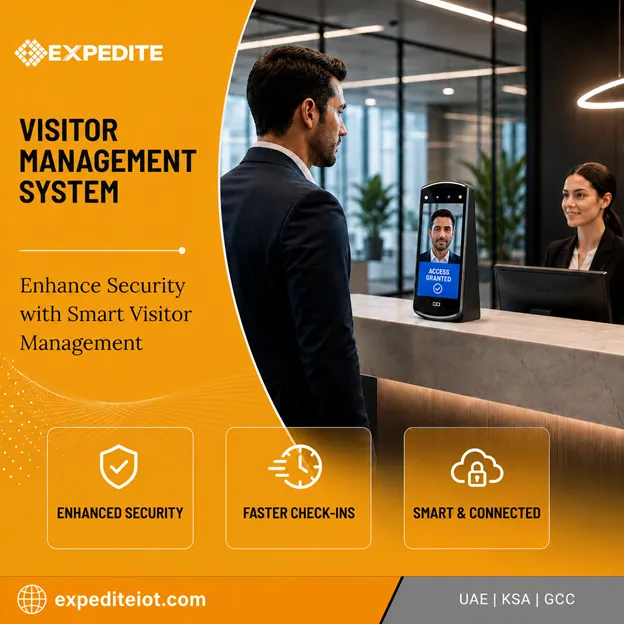
Our deployments integrate the reader with existing CCTV, visitor management, and building-management infrastructure, meaning organizations gain a unified identity layer without discarding equipment already in place. Every project includes local onboarding, staff training, and ongoing technical maintenance — the hands-on service that distinguishes a trusted regional integrator from a remote hardware reseller.
For a closer look at how our facial authentication and anti-spoofing deployment handles enrollment, liveness verification, and multi-site management, explore the dedicated solution page linked above.
Feedback from facility managers who have deployed the platform consistently cites three benefits: faster throughput at busy lobby entrances during peak hours, a sharp reduction in credential-sharing incidents compared to card-only systems, and confident rejection of spoofing attempts that would have gone undetected on legacy camera-based readers.
Why Vendor Experience Matters When Deploying Biometric Access Technology
Biometric systems handle some of the most sensitive personal data an organization can collect, so vendor credibility deserves the same scrutiny as the technology specification itself. Facility managers should confirm how long a prospective integrator has worked with HID's ecosystem specifically, request references from existing regional clients, and ask how firmware updates, warranty support, and biometric data governance are handled after installation.
A partner who documents real deployment history, holds relevant certifications, and maintains a locally available support team is far more likely to deliver a system that continues performing accurately years after installation, rather than one that only impresses during an initial vendor demonstration.
Best Practices for a Successful HID Amico Rollout
- Pilot the reader at one high-traffic entrance before a full-site rollout to validate lighting and mounting placement.
- Combine facial authentication with mobile or card credentials for visitors and temporary staff.
- Review enrollment consent language to ensure it satisfies Saudi PDPL requirements before go-live.
- Schedule periodic firmware updates to keep anti-spoofing and liveness models current against new threats.
- Audit access logs regularly to confirm permission structures still match current staff and visitor roles.
Organizations that treat biometric access as an evolving security program — rather than a one-time hardware purchase — see the strongest long-term accuracy and the fewest operational disruptions.
Conclusion
HID Amico brings a genuinely next-generation identity layer to Saudi facilities, combining HID Amico Facial Recognition with a rugged HID Amico Facial Reader and an edge-intelligent HID Aero Controller. Backed by broader HID Access Control and HID Mobile Access flexibility, plus AI-Powered Anti-Spoofing and Liveness Detection, the platform delivers fast, fraud-resistant entry. Organizations pursuing HID Amico KSA compliance, or deploying HID Amico Riyadh and HID Amico Jeddah installations, gain the strongest results with an experienced regional integration partner.
FAQs
1. What is HID Amico and how does it differ from a standard facial scanner?
HID Amico is a facial authentication platform that combines high-accuracy recognition with built-in anti-spoofing and liveness checks, verifying that a real, present person — not a photo or video — is requesting entry, unlike basic camera-based scanners.
2. How accurate is HID Amico Facial Recognition in varied lighting conditions?
The HID Amico Facial Recognition engine uses a wide dynamic-range camera and adaptive infrared illumination, maintaining accurate matching in bright sunlight, dim corridors, and everything in between.
3. Does the HID Aero Controller work if the network connection drops?
Yes. The HID Aero Controller processes access decisions locally at the edge, so doors continue functioning correctly during a temporary network outage and sync logs once connectivity returns.
4. Can HID Mobile Access be used alongside facial recognition on the same door?
Yes. HID Mobile Access credentials can operate on the same reader as facial authentication, giving organizations flexibility for visitors, contractors, or staff who haven't completed facial enrollment yet.
5. How does Liveness Detection prevent spoofing attempts with a photo or video?
Liveness Detection analyzes depth, texture, and subtle natural movement to confirm a live human is present, rejecting printed photos, video replays, or mask-based spoofing attempts in real time.
For more information contact us on:
Expedite IT
+966 502104086
Office No 01, Conference Building (Kirnaf Finance), Abi Tahir Al Dhahabi Street, Al Mutamarat,
Riyadh 12711, Saudi Arabia




























Sign in to leave a comment.