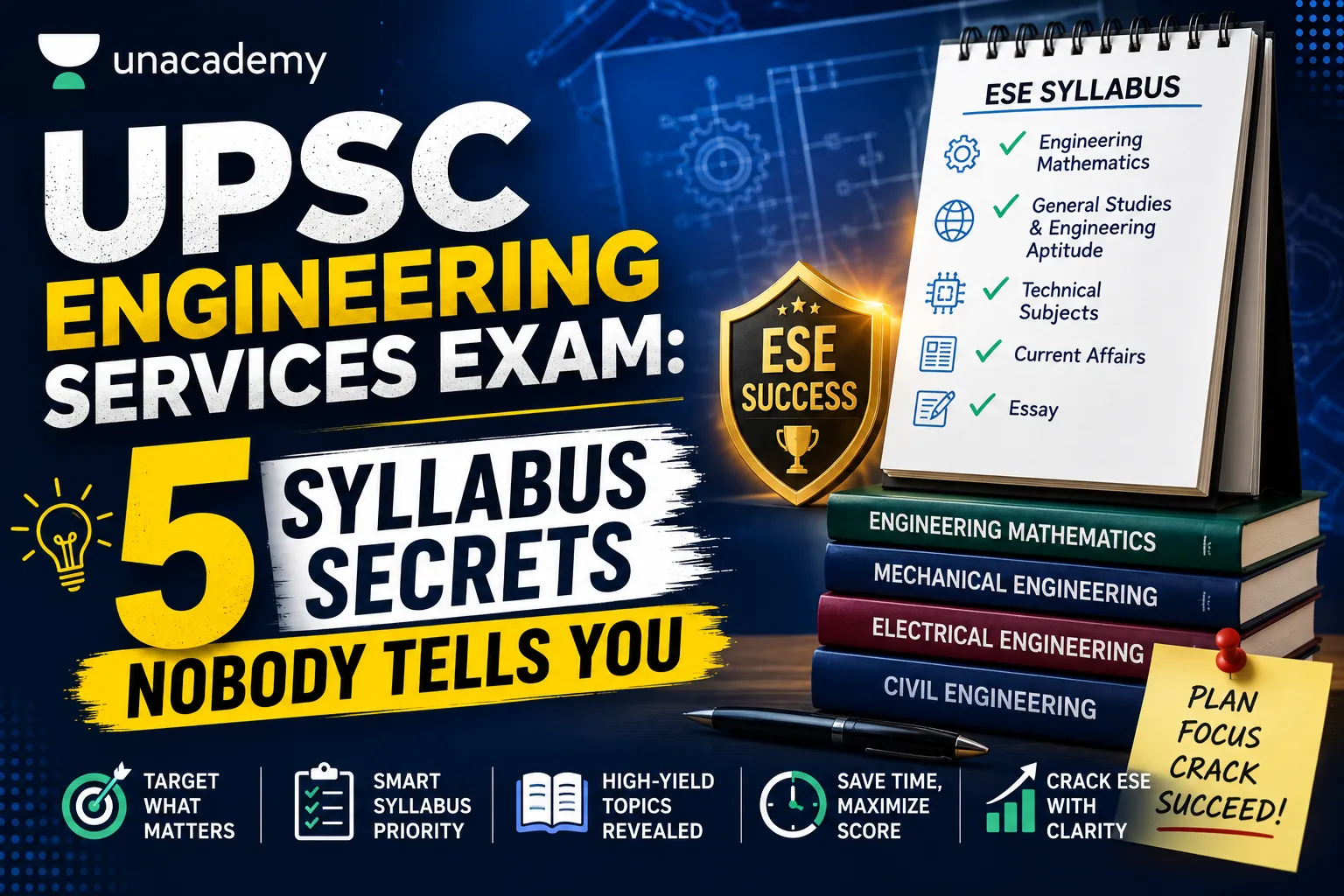

The notification drops, you download the PDF, and your screen fills with a massive wall of text detailing the upsc engineering services exam syllabus. If you are like most aspirants, your first instinct is to treat it like a college semester on steroids. You map out a schedule, buy the standard coaching modules, and prepare to grind through every single topic line by line.
But here is the reality check: thousands of candidates do exactly that every year, yet the selection ratio remains brutal.
The secret isn’t that the successful candidates study more hours; it’s that they realize the official curriculum document is a bit of a smoke screen. The engineering services exam (often called the ies exam) has an unspoken architecture. UPSC tests patterns, interconnections, and real-world engineering judgment that are never explicitly spelled out in the syllabus topics.
If you are feeling overwhelmed by the sheer volume of material, let’s peel back the layers. Here are five syllabus secrets that coaching institutes rarely highlight, but top rankers use to clear the upsc ese.
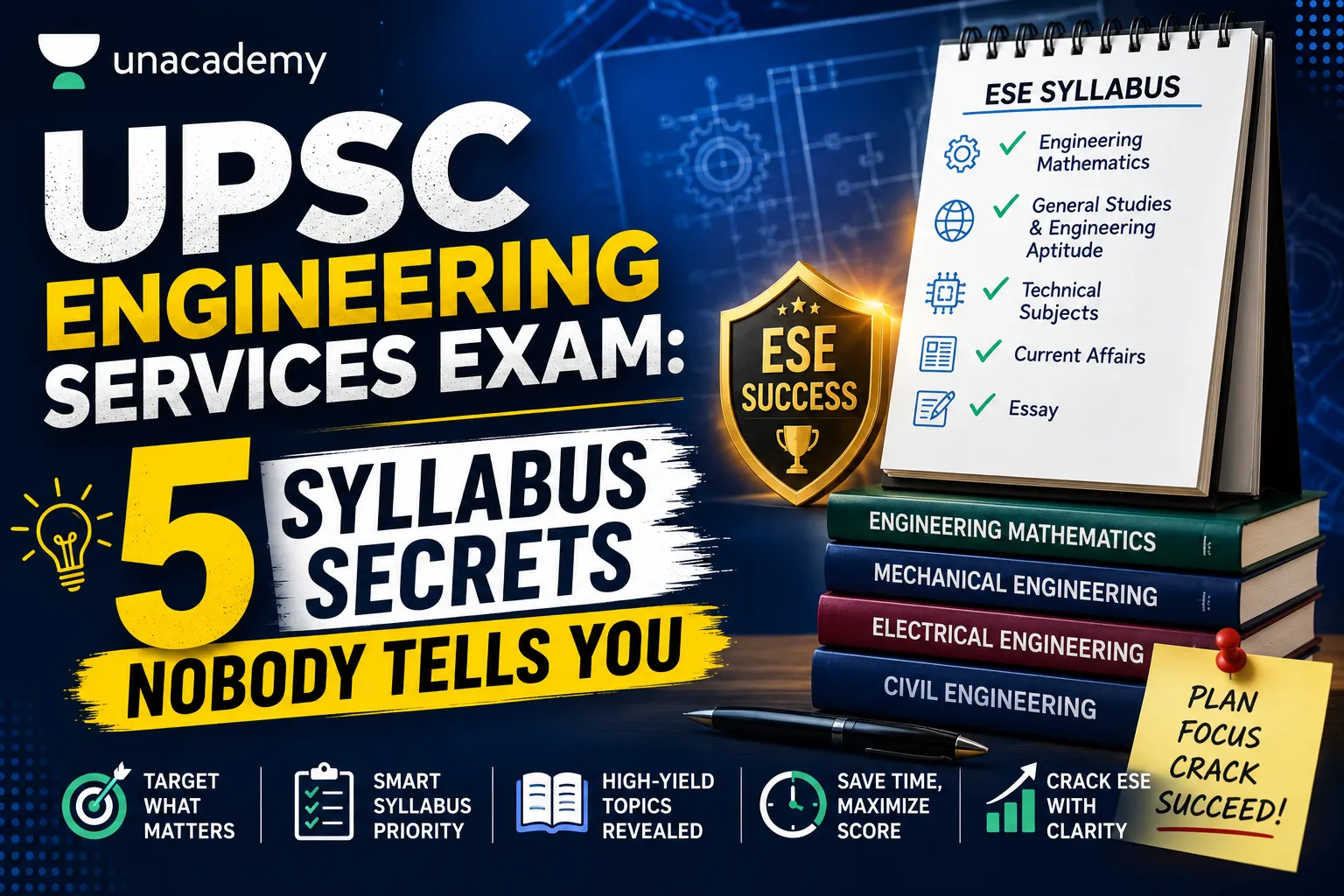
1. The "Hidden Core" vs. The Filler Topics
When you look at the upsc engineering services exam syllabus for any branch Civil, Mechanical, Electrical, or Electronics and Telecommunication every subject appears to carry equal weight on paper. The official document lists them as a flat, sequential list.
In practice, the exam is highly asymmetric. Every engineering branch has a "hidden core"—three or four subjects that effectively anchor both the Preliminary and Main stages.
- The Trap: Spending three weeks mastering a highly complex, niche elective topic because it occupies a prominent bullet point in the syllabus.
The Reality: UPSC routinely draws 60–70% of its high yield conceptual questions from core foundational areas (like Strength of Materials in Civil/Mechanical, or Network Theory and EM Fields in Electrical/Electronics).
Before you start a subject, analyze the past ten years of question papers. You will notice that while the syllabus expands horizontally every few years, the scoring weight remains vertically stacked on foundational concepts. Master the core first; the filler topics can be managed with basic formula application.
2. General Studies Paper 1 is a Test of Aptitude, Not an Encyclopedia
In the current upsc ese pattern, Preliminary Paper 1 covers General Studies and Engineering Aptitude. The syllabus lists ten distinct areas, ranging from environmental pollution and climate change to material science and project management.
It looks terrifying. It reads like you need a separate degree in environmental science and corporate governance.
Nobody tells you that UPSC does not expect deep academic scholarship here. The secret to this paper is cross-domain logic. For instance, the questions on Material Science often overlap heavily with basic physics and your core engineering properties. Questions on Environment are rarely rote-learning statistics; they test your basic understanding of ecological balance and engineering ethics.
Instead of reading massive, multi-volume textbooks for General Studies, treat it as a test of awareness. Focus heavily on Engineering Mathematics and General Aptitude these are predictable, high-scoring anchors that guarantee solid marks while you navigate the more subjective GS questions.
3. The "Mains Translation" Factor
One of the biggest mistakes you can make while preparing for the engineering services exam is partitioning your study into "Prelims mode" and "Mains mode."
The syllabus is identical for both stages, but the intent shifts completely. A topic that appears as a simple definition in the Prelims can become a complex, 20-mark derivation or multi-stage design problem in the Mains.
When you study a syllabus topic for the ies exam, ask yourself: Can I derive this from scratch, or do I just know the final formula? If you only know the formula, you have only prepared for half the syllabus.
True Syllabus Mastery: You should be able to explain the underlying assumptions behind a formula. UPSC examiners love to alter standard assumptions in Mains questions to see if you actually understand the derivation or if you just memorized a template.
4. The Interdisciplinary Crossover Questions
The official upsc ese syllabus presents subjects in silos. Fluid Mechanics is in one box, Thermodynamics is in another; Control Systems is separate from Analog Electronics.
The actual exam paper regularly shatters these walls.
UPSC increasingly designs questions that sit right at the intersection of two or three syllabus topics. You might encounter a question that requires you to apply thermodynamic principles to a fluid flow problem, or use electronic sensor concepts within a mechanical instrumentation setup.
If you study these subjects in total isolation, you will freeze when you see these hybrid questions. As you progress through your preparation, actively look for bridges between subjects. How does the math you learned in linear algebra apply to stability analysis in your core papers? Identifying these connections is how you develop "engineering intuition"—which is exactly what the interview board looks for later.
5. The Low-Yield Content Trap
Every syllabus has topics that are incredibly difficult to master but rarely show up on the actual test. In the upsc engineering services exam, these are often the highly descriptive, theory-heavy topics added to keep the curriculum modern (e.g., advanced specialized manufacturing processes or niche communication protocols).
Coaching institutes often spend dozens of hours on these topics to ensure their material looks "complete." But your time is finite.
Apply the 80/20 rule ruthlessly. If a topic takes a week to understand, has zero numerical application, and historically yields one question every three years, skim it. Learn the basic definitions, understand the primary use cases, and move on. Your time is far better spent practicing conventional problems from high-yielding chapters.
Real Perspectives from the Field
To give you a better sense of how this looks in practice, here are two real reflections from people who have navigated the grind:
"During my first attempt at the ies exam, I treated the syllabus like a checklist. I tried to read everything equally. I failed the Prelims cutoff by 14 marks. The second time, I stopped reading new books and just focused on the deep relationships between the core subjects. I realized UPSC repeats conceptual profiles, not questions. Changing my focus to the foundational core made all the difference."
— Ananya R., Electrical Engineering Discipline
"Everyone freaks out about the General Studies paper. I spent weeks trying to memorize current affairs booklets for the upsc ese. Looking back, it was a waste of energy. I should have spent that time perfecting my Engineering Math and structural analysis derivations. The GS paper tests your logical elimination skills, not your capacity to act as a data repository."
— Rahul K., Civil Engineering Discipline
Common Mistakes to Avoid
- Reading multiple textbooks for one topic: Stick to one standard reference book or high-quality set of notes, then immediately pivot to solving past papers.
- Ignoring the conventional writing practice until after Prelims: The gap between Prelims and Mains is shorter than you think. If you haven't practiced structuring long-form answers cleanly, your speed will betray you during the conventional test.
- Neglecting calculator proficiency: The physical mechanics of operating your scientific calculator quickly and accurately during numerical-heavy papers is an unwritten part of the syllabus. Practice with it daily.
Frequently Asked Questions
1. Is the syllabus for the upsc engineering services exam different from GATE?
Yes, significantly in its structure and approach. While GATE focuses heavily on deep, single-concept numerical problems and allows a virtual calculator, the engineering services exam requires a broader theoretical understanding, conventional descriptive writing, and includes a dedicated General Studies paper. The ies exam syllabus generally covers more topics but sometimes tests them at a slightly less granular level in the Prelims compared to GATE.
2. How should I approach the General Studies syllabus for the upsc ese?
Do not try to study it like a Civil Services aspirant. Focus heavily on the structured, logical portions like Engineering Mathematics and Aptitude first. For the remaining topics like Material Science, ICT, and Environment, focus on understanding core principles, major national policies, and foundational definitions rather than getting lost in dense academic texts.
3. Can an average student clear the engineering services exam by self-study?
Absolutely. The syllabus looks intimidating because of its volume, not its complexity. If you are disciplined enough to decode the core subjects, practice conventional answer writing systematically, and consistently solve previous years' papers, you can clear the exam without expensive coaching.
4. How many years of previous papers should I solve to understand the hidden syllabus?
You should analyze and solve at least the last 10 to 15 years of question papers for both the Preliminary and Mains stages. This gives you a clear statistical picture of which topics UPSC favors and how they cross-reference different parts of the curriculum.
5. When should I start preparing for the conventional (Mains) part of the syllabus?
From day one. Do not treat them as separate phases. When you learn a concept or a derivation, practice writing it out step-by-step. Developing the habit of clean layout, stating assumptions clearly, and structuring your calculations early saves you from immense pressure later on.
Final Thoughts
The upsc engineering services exam is as much a test of strategy as it is of technical knowledge. The official syllabus gives you the boundaries of the playing field, but it doesn't give you the playbook.
Stop treating every bullet point on that PDF with equal reverence. Identify your branch's foundational core, bridge the gaps between subjects, treat General Studies with practical logic, and build your conceptual depth right from the start. Once you understand what the exam is actually testing, the massive wall of text becomes a highly manageable roadmap.























Sign in to leave a comment.