
If you are preparing for the upsc prelims, you already know the sinking feeling of looking at a 100-page current affairs compilation and wondering if any of it will actually show up on the paper.
Every year, the question paper shifts. One year it is heavy on conceptual economic policies, and the next, it asks about obscure international conflict corridors or critical minerals. With the upsc prelims date 2026 officially locked in, the clock is ticking. You cannot afford to lose hours drowning in information overload.
The biggest trap in the upsc prelims exam cycle isn’t a lack of reading material; it is a critical surplus of it. You do not need to read every daily editorial, track five different news channels, or stack your desk with four different monthly magazines. What you need is a lean, highly strategic combination of foundational reading and compounding revisions.
Let's break down the exact, field-tested sources you need to navigate current affairs for upsc prelims 2026 efficiently, helping you clear the cutoff without losing your sanity.
The Core Blueprint: Why Current Affairs is Changing
Before throwing yourself into a pile of books, you need to understand what you are actually preparing for. The Union Public Service Commission has progressively moved away from asking simple, linear current affairs questions. Today, it tests the applied background of a current event.
If a specific national park was in the news because of a species relocation project, the exam won't just ask where the park is. It might ask you about the specific vegetation type, the river flowing through it, or the legal status of the indigenous community living on its fringes. Your current affairs sources must bridge the gap between daily happenings and your static syllabus.
1. The Daily Foundation: Choosing Your Newspaper
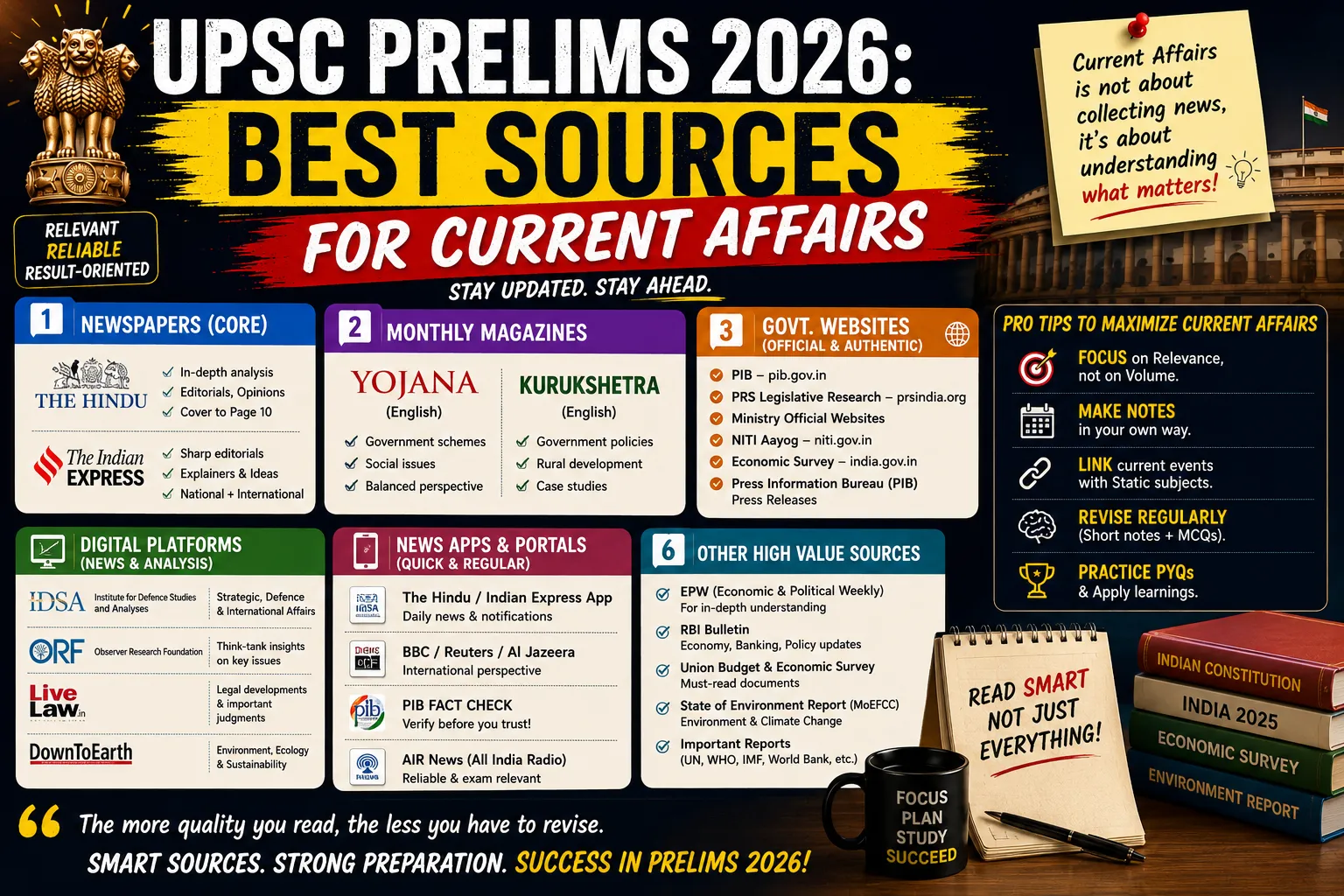
You cannot bypass the daily habit of reading a reliable newspaper. It builds the subconscious context that monthly compilations assume you already have. Pick one of the following and stick to it religiously.
The Hindu vs. The Indian Express
Both are exceptional, but they serve slightly different functions:
- The Hindu: Excellent for environmental policies, supreme court judgments, and international relations. The science and tech page on Sundays is particularly useful for tracking emerging technical trends.
- The Indian Express: Outstanding for explaining complex economic policies and governance structures. The 'Explained' section is arguably the best single daily resource for an option-by-option breakdown of complex issues.
Pro-Tip: Do not spend more than 45 to 60 minutes on the paper. Skip the local crime reports, political blame games, and commercial lifestyle sections. Focus heavily on national news, international updates, economy, and environmental developments.
2. Monthly Consolidations: The Pillar of Retention
While daily reading keeps you informed, monthly magazines organize that raw data into structured topics. Trying to build your own daily current affairs notes from scratch can quickly become a massive time sink. Let the institutional research teams do the heavy lifting for you.
Unacademy`s PT 730
For a vast majority of candidates clearing the upsc prelims exam, this remains a staple asset. It divides news logically into Polity, Economy, International Relations, and Environment. The layout directly mimics the sub-headings of the official syllabus, making it incredibly easy to map back to your static textbooks.
Forum IAS or Insights IAS Monthly Compositions
If you find the Vision booklets too dense, these alternatives offer a cleaner, more bullet-point-heavy layout. They strip out some of the descriptive prose, focusing heavily on raw analytical points and factual data tables that are easy to memorize.
3. High-Yield Government Portals
UPSC loves primary data directly from the source. Secondary news websites can occasionally misinterpret technical fine print, but official government platforms do not.
Press Information Bureau (PIB)
The PIB is the official communication arm of the Government of India. You do not need to check the portal every hour, but keeping track of the weekly or monthly summaries is vital. Pay specific attention to:
- Launches of new central sector and centrally sponsored schemes.
- Bilateral trade agreements and international summits hosted by India.
- Technology transfers and major space missions by ISRO.
PRS Legislative Research
If you struggle with the legal intricacies of newly introduced or amended bills, PRS is your holy grail. Their monthly policy reviews break down complex legal jargon into plain, understandable language, outlining the pros, cons, and core provisions of critical legislation.
4. The Final Stretch: Annual Compilations
As you approach the upsc prelims date 2026, your daily newspaper reading should naturally give way to intense revision. This is where annual compilations like Vision IAS PT 365 or Rau's IAS Compass become invaluable.
These booklets aggregate an entire year's worth of news into single, subject-focused volumes. Instead of flipping through twelve separate magazines to find environment updates, you get a single book dedicated entirely to it.
- When to start: Begin integrating these into your schedule roughly 75 to 90 days before the exam.
- How to use them: Do not treat them as brand-new study material. Use them to plug gaps in your monthly readings and to build quick-recall memory maps.
Things You Should Know: Common Current Affairs Mistakes
Even with the best materials, it is incredibly easy to steer your preparation off course. Avoid these common traps to keep your momentum steady:
- The Infinite Video Loop: Watching three different 2-hour daily newspaper analysis videos on YouTube is a false sense of productivity. It makes you a passive consumer rather than an active learner. Read the paper yourself or use videos strictly as a quick 15-minute summary tool if a concept goes entirely over your head.
- Ignoring the Static Core: Current affairs is completely useless without strong roots in history, economy, polity, and geography. If you don't know how inflation works fundamentally in your static economics textbook, reading five articles on RBI monetary policy won't help you crack the questions in the actual exam hall.
- Hoarding Multiple Magazines: Pick one monthly compilation series and stick to it. Reading one magazine three times will always yield a higher score than reading three different magazines just once.
Real Candidate Perspectives
"In my first attempt, I collected material from three different coaching centers, thinking I was being thorough. I ended up failing the CSAT and missing the GS cutoff because I couldn't remember basic facts. For my next attempt, I threw out the extra clutter, stuck strictly to The Indian Express and one monthly booklet, and cleared comfortably."
— Ananya R., Rank 142
"Don't underestimate the power of making a single, master document for places in the news. Map work tied to international current affairs saved my paper last year. When you see a conflict zone or an island mentioned in a magazine, look it up on an atlas immediately."
— Siddharth M., Selected IPS
Frequently Asked Questions (FAQs)
How many months of current affairs are needed for UPSC Prelims 2026?
Ideally, you should cover a minimum of 12 to 15 months of current affairs leading up to the upsc prelims date 2026. For the upcoming exam, thoroughly focus on news from January 2025 all the way up to April 2026.
Can I skip the daily newspaper if I read monthly compilations?
It is highly recommended not to skip the newspaper entirely. The daily habit builds a narrative framework in your mind. Without that baseline context, trying to memorize a monthly magazine feels like trying to read a dictionary from cover to cover—it simply won't stick.
How should I revise current affairs effectively for the upsc prelims exam?
The best approach is active recall and testing. After finishing a monthly module, immediately attempt corresponding sectional mock tests. Use annual compilations in the final two months to run through at least three quick iterative revision cycles.
Are government magazines like Yojana and Kurukshetra mandatory?
They are highly valuable for the Mains analytical papers, but less critical for the objective layout of the upsc prelims. If you are short on time, you can safely rely on monthly coaching compilations, which naturally extract the core facts and data from Yojana and Kurukshetra anyway.
How do I link static subjects with dynamic current affairs?
Whenever you encounter a major current event, ask yourself which static syllabus topic it belongs to. For example, if a Governor's role is being debated in the news, open your Lakshmikanth textbook and read the entire static chapter on the Governor that same evening.
Genuinely Rooted Progress
At the end of the day, current affairs is not an isolated subject; it is the living, breathing manifestation of your static syllabus. Treat it as a window into how the concepts you study function in the real world. Keep your resource list minimal, trust your chosen sources, prioritize deep revisions over expanding your bookshelf, and approach your daily reading with genuine curiosity. Stay consistent, manage your hours deliberately, and keep moving forward.


























Sign in to leave a comment.