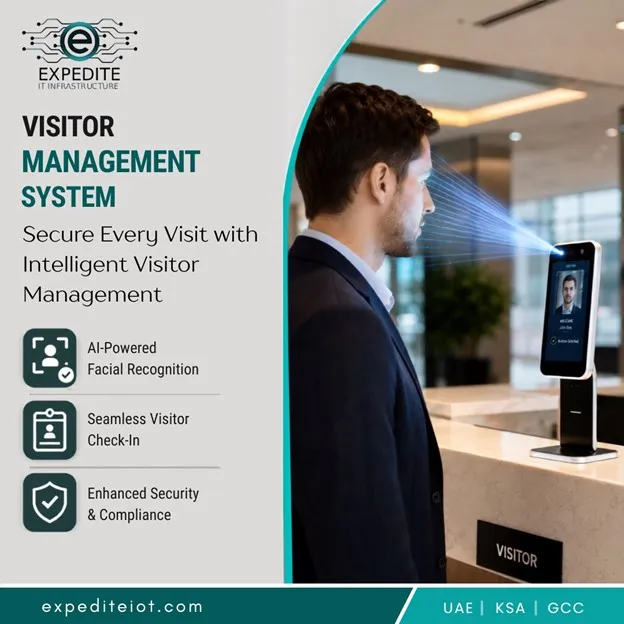

Reception desks at Saudi corporate offices, government buildings, and industrial sites still rely on a paper logbook at far too many locations, leaving no real record of who entered the building or when they left. A Visitor Management System replaces that book with a digital workflow that verifies identity, prints a badge, and keeps a searchable record of every visit from arrival to departure. Organizations comparing options can review Expedite IoT's visitor check-in platform to see how the workflow is configured for Saudi office and industrial environments.
Why Saudi Workplaces Are Replacing the Visitor Logbook
Handwritten entries are easy to falsify, often illegible, and impossible to search after the fact, which matters increasingly as organizations regulated under Saudi Civil Defense codes and broader Vision 2030 modernization efforts are expected to maintain auditable records of building access. The National Cybersecurity Authority (NCA) and the Saudi Data and Artificial Intelligence Authority (SDAIA) have also pushed organizations to treat front-desk systems that touch personal data as part of their wider information security posture rather than a standalone reception tool.
From Sign-In to Verified Identity
Replacing the Paper Sign-In Sheet
Visitor Registration Software lets a visitor enter their own details on arrival, capturing a photo, host name, and purpose of visit in seconds rather than handing a receptionist a stack of forms to file away at the end of the day.
Consistent Check-In at Every Door
A Visitor Check in System standardizes the process across every entrance a facility operates, whether that's a single reception desk or a multi-building campus, so security teams see the same data structure and verification steps no matter which door a visitor walks through.
Confirming Exactly Who's at the Door
Matching the Person to Their ID
Visitor Identification captures national ID, Iqama, or passport details directly from the document rather than relying on a visitor to self-report their own name, closing a gap that's easy to exploit with a handwritten logbook entry.
Verifying Before Granting Access
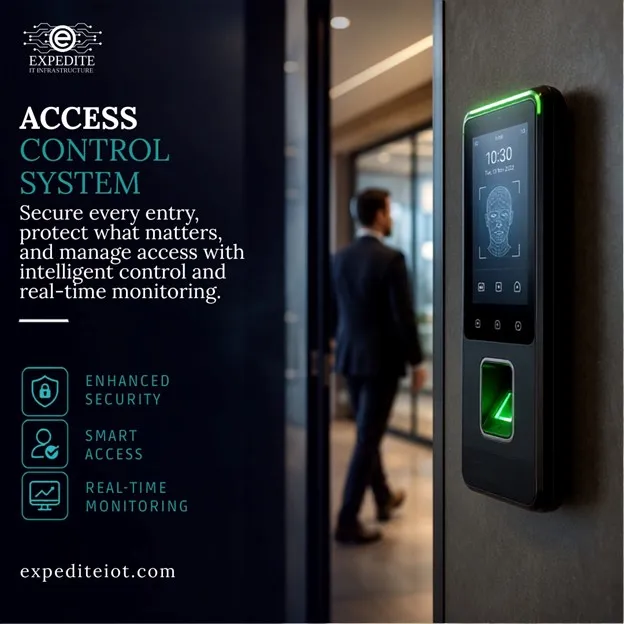
Visitor Authentication, often paired with biometric hardware from vendors such as HID Global and Suprema, confirms that the person standing at the kiosk matches the identity just captured, adding a verification step that document scanning alone doesn't provide.
From Verification to Access
Badge Printing completes the check-in process with a visible, time-limited pass showing photo, host, and validity window, giving security staff an immediate way to confirm who belongs in the building without checking a screen.
Hardware and Software Working Together
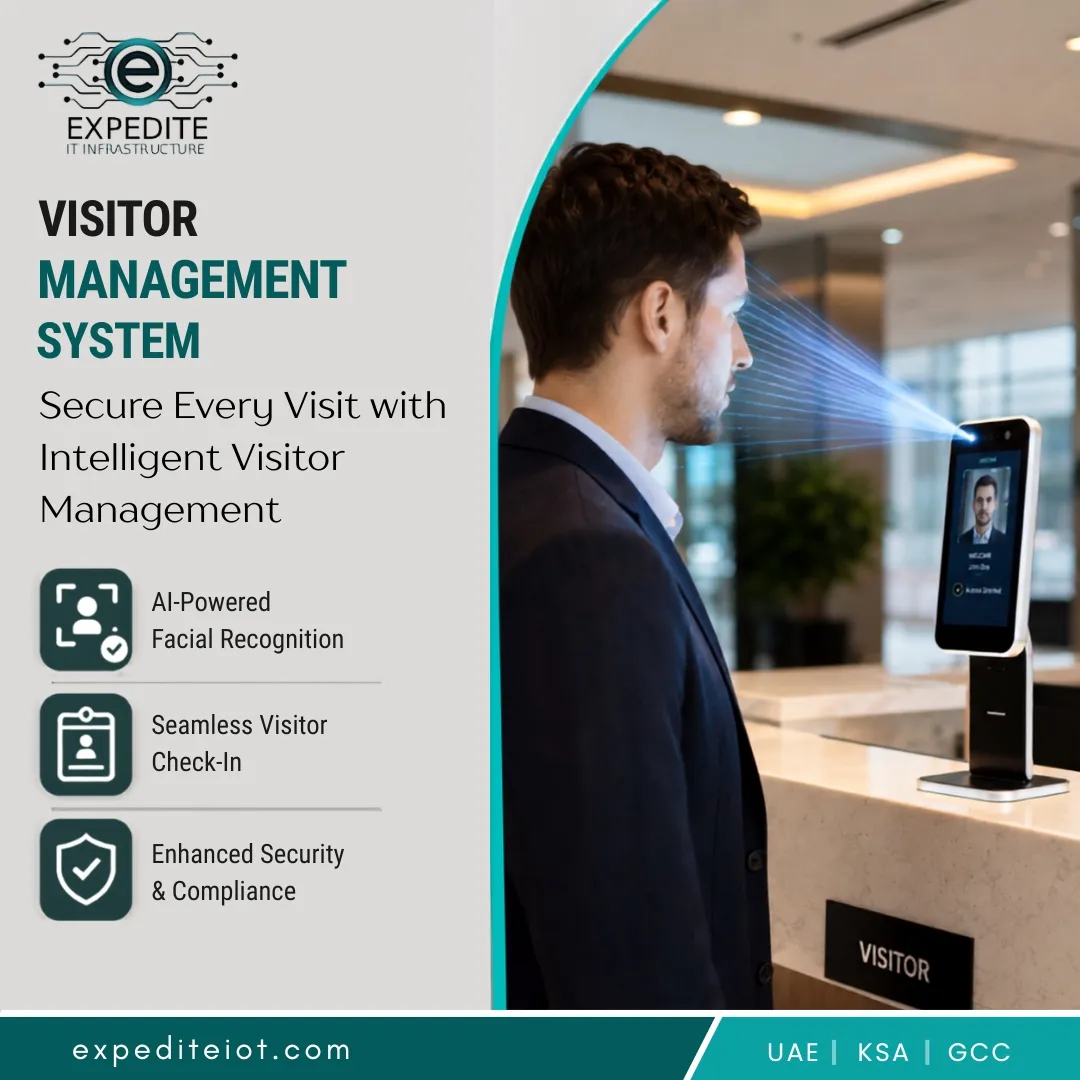
Every deployment pairs a physical Visitor Management Device, the kiosk, tablet, or reception terminal visitors interact with directly, with the Visitor Management Software running behind it that handles identity capture, host notification, badge design, and record-keeping from a single administrative dashboard. Facilities can review Expedite IoT's front-desk hardware and software options before specifying a rollout across multiple buildings.
Safety and Oversight
Emergency Alerts triggered from the visitor management platform can notify everyone currently checked in, building-wide, during a fire, security incident, or evacuation, a capability a paper logbook simply can't offer when every second matters.
Visitor Tracking maintains a live count of who's in the building at any moment, which becomes critical during an emergency headcount and useful day-to-day for understanding peak visitor periods and host responsiveness.
Compliance, Standards, and Proven KSA Deployment Experience
Expedite IoT builds every Visitor Management System KSA deployment around recognized data protection and security benchmarks rather than a generic check-in app. Identity capture and data handling align with Saudi Arabia's Personal Data Protection Law (PDPL), while networked platform security follows ISO 27001 principles and the NCA's Essential Cybersecurity Controls for systems that process personal information. Manufacturing and integration work follow ISO 9001 quality management practices, and engineers hold direct certifications on HID Global and Suprema hardware, backed by completed rollouts across government buildings, corporate offices, and industrial sites throughout the Kingdom. Organizations ready to scope a project can request a front-desk workflow assessment to receive a configuration matched to visitor volume and security requirements.
Deployment Across Saudi Arabia's Major Cities
Visitor Management System Riyadh
Riyadh's concentration of government ministries, corporate headquarters, and Vision 2030 giga-project offices drives demand for visitor management deployments that satisfy NCA security expectations alongside the visitor volume typical of multi-tower business districts.
Visitor Management System Jeddah
In Jeddah, logistics facilities near the port, King Abdullah Economic City (KAEC) tenants, and hospitality operations along the Red Sea coast increasingly specify systems built to handle high visitor turnover without slowing down reception.
Visitor Management System Dammam
Dammam and the wider Eastern Province, anchored by industrial operations tied to the Royal Commission for Jubail and Yanbu, favour visitor management deployments that can manage contractor and vendor traffic at scale alongside strict site safety documentation requirements.
Conclusion
A paper logbook can't verify identity, notify a host instantly, or produce a usable record during an emergency, which is exactly why Saudi workplaces are moving reception desks to digital visitor management. The right configuration depends on visitor volume, security classification, and how tightly the system needs to integrate with existing access control and emergency response procedures. Expedite IoT continues to deploy and support these systems across government buildings, corporate offices, and industrial sites throughout Saudi Arabia, scaling each rollout to the facility's specific visitor flow.
FAQS
How long does check-in take for a first-time visitor?
Most first-time check-ins complete in under a minute, covering identification, photo capture, and host notification before the badge prints.
Can the system handle both employees and visitors at the same entrance?
Yes, most platforms support separate workflows for employee badges and visitor check-in at the same reception point, keeping the data and reporting distinct for each group.
What happens to visitor data after the visit ends?
Retention periods are set by the host organization's policy and generally align with Saudi PDPL data minimization principles, with most deployments configured to archive or purge records after a defined period.
Can one system manage multiple buildings or sites?
Yes, cloud-based platforms are built to handle multiple locations, giving a central security team visibility into visitor activity across every site from one login.
Is a receptionist still required once the system is installed?
Most organizations keep a staffed desk for exceptions and assistance, but day-to-day check-in volume shifts largely to the self-service kiosk, freeing staff for other tasks.




























Sign in to leave a comment.