

What AI for Sales Prospecting Actually Does
Modern AI Sales Dashboard with Real-Time Insights
AI-powered sales prospecting tools perform three core functions that manual processes simply can’t match at scale: lead qualification, contact enrichment, and automated outreach based on user behavior.
Here’s how it works in practice:
- Lead scoring analyzes your past closed deals and ranks new leads based on similarity patterns.
- Data enrichment pulls real-time firmographic and intent data from sources like LinkedIn, G2, Clearbit, and others.
- Automated outreach triggers follow-ups based on engagement signals instead of fixed schedules.
According to Salesforce, sales teams spend nearly 30% of their time on manual prospecting tasks—work that AI can now complete in seconds. That saved time scales significantly across teams.
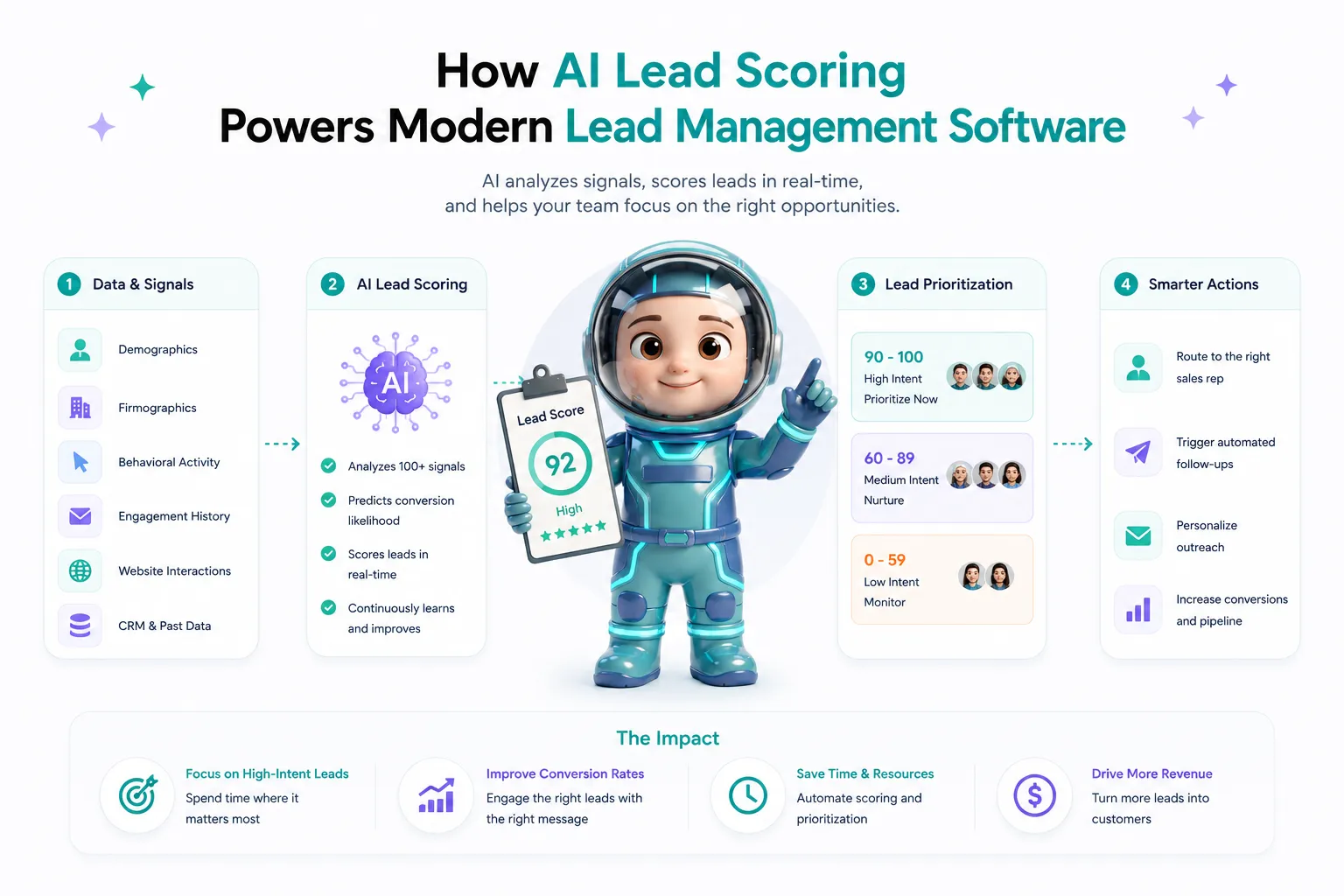
AI-driven scoring also changes prioritization—helping sales teams focus on high-conversion leads first, which directly improves closing rates.
For a deeper breakdown of tools in this space, check the full prospecting tools comparison.
How to Evaluate AI Prospecting Tools
Most lists oversimplify selection with basic checklists. In reality, these are the factors that actually matter:
1. Data Quality & Refresh Speed
Tools relying on a single data source miss critical updates like job changes, funding rounds, and hiring signals. Always verify how frequently data updates and how many sources are used.
2. Explainable Scoring Models
AI lead scoring should clearly explain why a lead is ranked high. Without transparency, optimization becomes impossible.
3. CRM Integration Depth
Basic integrations only push data into CRM fields. Strong systems continuously sync activity data both ways, improving scoring accuracy over time.
4. Personalization Quality
Test email output on real prospects before adopting the tool. Generic AI messaging can reduce conversion rates.
5. Cost vs Output Efficiency
Instead of focusing on subscription cost alone, evaluate how many qualified leads or meetings the tool actually generates.
Quick Comparison: 6 Leading AI Sales
Prospecting Tools
| Tool | Best For | Starting Price | Free Plan | Key Feature |
|---|---|---|---|---|
| Lio | IT teams & outbound automation | Custom | Yes | AI-based lead scoring + routing |
| Apollo.io | High-volume prospecting | $49/mo | Yes | 275M+ contact database |
| Clay | Advanced enrichment workflows | $149/mo | No | Multi-source enrichment automation |
| Seamless.AI | Real-time email discovery | $147/mo | Yes | Live contact scraping |
| Outreach | Enterprise sales teams | Custom | No | Revenue intelligence system |
| Lavender | Cold email optimization | $29/mo | Yes | AI email scoring |
For a detailed breakdown, see the full prospecting tools comparison. Budget-focused teams should also review the cost comparison between AI systems and human SDRs.
Top 6 AI Sales Prospecting Tools (2026 Breakdown)
1. Lio (WorksBuddy)
Lio is an all-in-one AI sales engine that handles lead capture, scoring, and routing in a single workflow. When a lead interacts through a form, booking page, or website, Lio instantly evaluates it against your ideal customer profile and sends it to the right sales sequence.
Its AI scoring model blends behavioral signals, company data, and engagement history instead of relying on a single metric.
- Integrates with Evox (follow-up automation) and Taro (task management)
- Ideal for IT founders who want SDR-level output without hiring SDRs
- Pricing is significantly lower than hiring a full-time sales rep (see cost comparison between AI systems and human SDRs)
- Limitation: Best performance within the WorksBuddy ecosystem
2. Apollo.io
Apollo combines a massive contact database with basic AI scoring and outreach tools. It’s widely used for outbound campaigns at scale.
- Best for: High-volume outbound teams
- Limitation: AI scoring lacks deep learning from closed-won data unless on higher tiers
- Pricing: Free plan available; paid starts around $49/user/month
3. Clay
Clay is a powerful enrichment automation platform that connects with multiple data providers and allows custom workflows without coding.
- Best for: Hyper-personalized outbound campaigns
- Limitation: Requires technical understanding of data workflows
- Pricing: Starts at $149/month
4. Seamless.AI
Seamless.AI focuses on real-time data discovery and verification, especially for LinkedIn-based prospecting.
- Best for: Fast lead generation from social platforms
- Limitation: Data accuracy varies across regions
- Pricing: Free limited plan; paid starts around $147/month
5. Cognism
Cognism specializes in GDPR-compliant data, making it strong for European outreach.
- Best for: EMEA-focused sales teams
- Includes: Verified mobile numbers + intent data from Bombora
- Limitation: Enterprise pricing model
6. Instantly.ai
Instantly focuses on cold email delivery infrastructure rather than lead sourcing.
- Best for: High-volume cold email campaigns
- Limitation: No built-in lead database
- Pricing: Starts at $37/month
AI Prospecting vs Traditional Prospecting
Traditional prospecting requires manual research, list building, and guesswork. AI drastically reduces this workload by automating most of the process.
Key differences:
- Speed: AI qualifies leads in seconds vs 20+ minutes manually
- Scale: AI processes thousands of signals simultaneously
- Cost: SDRs cost $60K–$80K/year, while AI tools operate at a fraction of that (see cost comparison between AI systems and human SDRs)
However, human reps still play a key role in closing deals and building relationships. AI handles filtering; humans handle conversion.
How to Choose Based on Team Size
Solo Founder (1 person)
You need an all-in-one system that handles enrichment, scoring, and outreach without operational overhead.
Small Team (2–10 reps)
Focus on automation of lead routing and consistent pipeline visibility. AI scoring should distribute leads fairly across reps.
Scaling Teams (10+ reps)
Integration quality becomes critical. Your system must sync cleanly with CRM and maintain structured data flow.
For deeper insights, explore the full prospecting tools comparison.
FAQs About AI Sales Prospecting
Does AI actually save time in sales prospecting?
Yes. It removes repetitive tasks like list building and manual research, reducing workload significantly.
What is the difference between AI lead generation and manual prospecting?
Manual prospecting relies on human research, while AI automatically ranks and qualifies leads using data models and behavior signals.
How does AI lead scoring work?
It evaluates historical deal data and current behavioral signals to assign conversion probability scores.
Where should I start comparing tools?
Begin with the full prospecting tools comparison to understand category differences before selecting a tool.
Final Thoughts
The best AI prospecting tool is the one that directly solves your current bottleneck—whether that’s lead quality, enrichment speed, or follow-up automation.
For teams starting out, tools like Lio can immediately generate a scored pipeline. For advanced outbound teams, Apollo or Clay may be a better fit.
The key is simple: test with real data before committing budget.























Sign in to leave a comment.