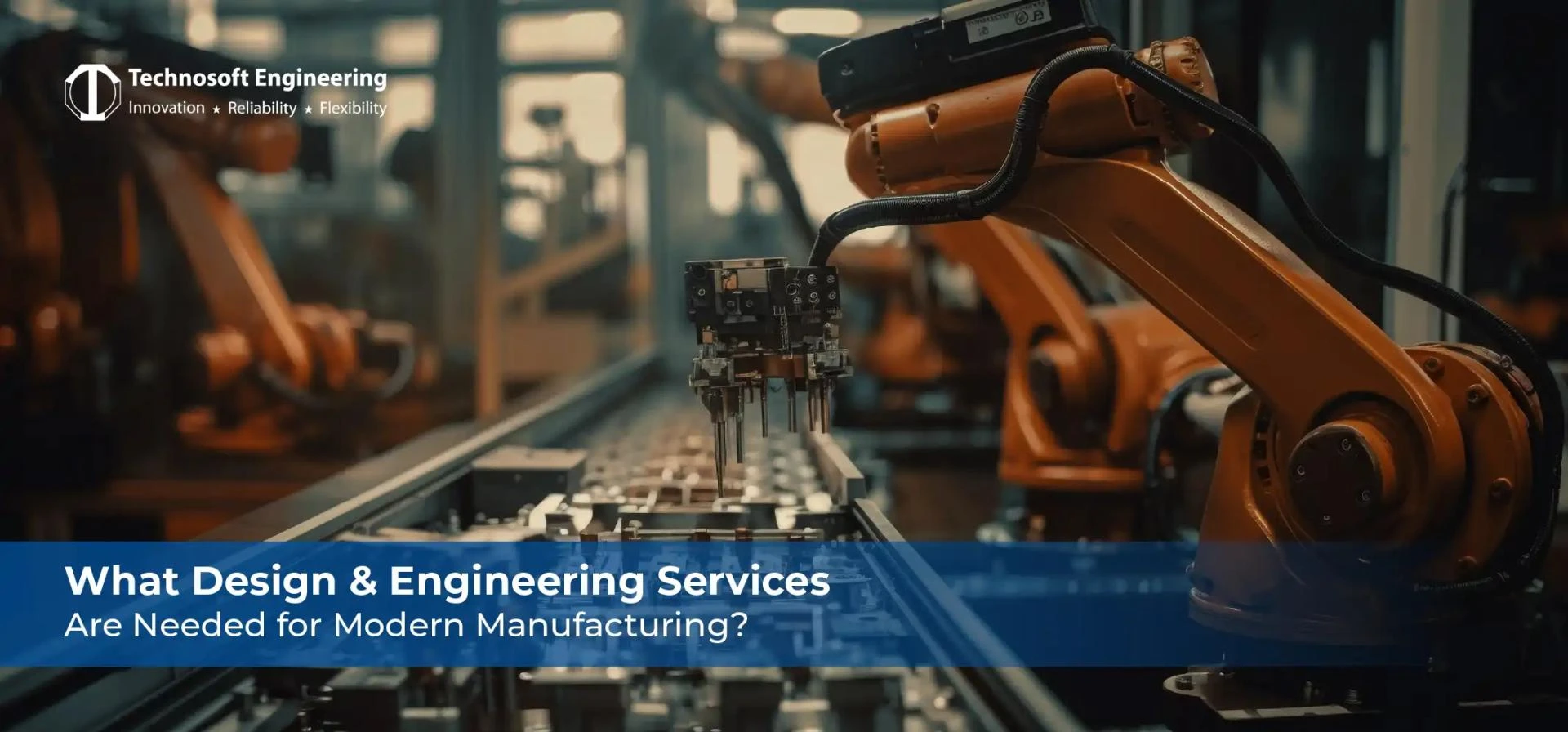

In the manufacturing sector, turning a groundbreaking idea into a scalable product asks more than just creativity; it demands a strong design and engineering approach. Therefore, design and engineering services are the core of modern manufacturing that bridges the gap between concept and market-ready product.
Defining Design & Engineering Services
Design and engineering services are known to comprise a broad spectrum of technical work from conceptual sketches and detailed CAD modeling to prototyping, testing, and production optimization. All these services combine product design, mechanical and electrical engineering, and prototype development to bring solutions that meet form, function, and manufacturability. All of these services make sure that an idea does not look good on paper, but it can be actually built efficiently, following regulatory market demands.
The Key Stages in the Engineering Process
Modern manufacturing benefits most when the design and engineering are treated as structured, iterative processes. There are several core stages:
- Concept Development: This is where the vision starts building slowly, teams brainstorm, sketch, and evaluate different design directions, often backed by feasibility studies to assess technical and market viability.
- Feasibility Analysis: This stage involves figuring out technical constraints and market realities. Is the concept viable given production costs, required materials, and regulatory needs?
- Prototyping & Testing: Initial physical or digital models are built so that the designers can validate the function, usability, and durability of the product. Feedback from this very initial prototype helps to bring changes as well as fine-tuning.
- Design Refinement: Based on what’s learned in prototyping, teams refine their designs. The goals make the performance perfect, simplify manufacturability, and reduce waste.
- Production-Ready Design: At this stage, the product is then optimized for larger-scale production. That means detailed engineering documentation, selection of materials, and design for manufacturing considerations to make sure there is smooth mass production.
Why Design & Engineering Services Are Great for Manufacturing?
Expertise and cross-domain skills: By collaborating with professionals who specialize in both electrical engineering as well as prototyping and testing, companies can have access to deep technical experts.
Risk reduction: Early-stage problem detection saves time and money. Designers use approved frameworks, such as Design for Manufacturing & Assembly, Value Analysis/Value Engineering, and Design for Excellence, to see the problems and reduce further difficulties.
Less time to market: Using design workflows and rapid prototyping helps to cut down the development cycles.
Scalability: As the production work moves ahead, a planned design makes sure that there is consistent quality as well as easy scaling at all steps.
Testing: When we talk about a regulated organization, such as medical or aerospace, design services add compliance testing from the outset, reducing roadblocks later in the manufacturing process.
How are these services helping Different Industries Transform?
Design and engineering services generic plans; they are tailored to industry-specific needs:
Medical devices: In this field, precision, safety, and regulatory compliance are the priority. Engineers design for usability, sterilization, and strict quality control.
Consumer electronics: Speed, innovation, and budget are key here; rapid prototyping works in companies for testing form and function quickly.
Aerospace and industrial equipment: Strength and performance under stressful conditions demand rigorous simulation and testing during the engineering phase.
The Competitiveness Advantage
When manufacturers invest in high-quality design and engineering services, they unlock several competitive benefits:
- Optimized production efficiency: Design decisions that are made early in the engineering process can greatly reduce manufacturing complexity and material costs.
- Improved product functionality: Engineers analyze the needs of the users and operational environments to refine form and performance, ensuring the final product meets the exact expectations.
- Better innovation: When there is expert design backing, companies can experiment with new materials, architectures, or technologies without hampering the manufacturability
- Reduced development risk: Validated prototypes and robust testing procedures help to prevent costly redesigns and failures.
Conclusion
Design and engineering services are the main support systems in modern manufacturing as they bring ideas to life in a practical, scalable, and market-ready form. All these services are doing more than simply making a product; they optimize performance and finally boost the launch time to market.
If your organization is in search of transforming concepts, then adapting to complete engineering design services will be a game-changer indeed.
Technosoft Engineering is here to help you bridge the gap between innovation and production efficiently and precisely.
























Sign in to leave a comment.