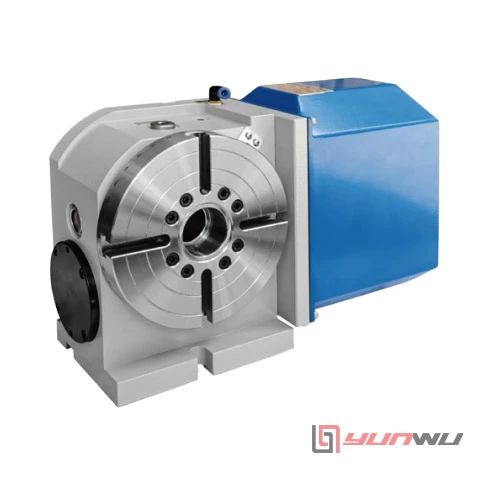

CNC rotary table is a crucial component in modern machining processes, offering enhanced precision and versatility in a wide range of applications. Whether used in vertical or horizontal milling machines, CNC rotary tables allow for efficient multi-axis machining, making them essential tools in industries such as aerospace, automotive, medical, and manufacturing.
What is a CNC Rotary Table?
A CNC rotary table is a mechanical device that rotates a workpiece during machining operations. It allows for the rotation of the workpiece around a vertical or horizontal axis, enabling the machining of complex geometries and angles with high accuracy. CNC rotary tables are integrated with Computer Numerical Control (CNC) systems, which enables automated control and programming for precise positioning and rotation during manufacturing.
Key Features and Benefits
- Improved Precision and Accuracy: CNC rotary tables are designed to provide exceptional accuracy in machining, reducing the potential for human error. With the ability to rotate the workpiece precisely to the desired angle, they ensure that each cut is made to the exact specifications.
- Increased Productivity: The use of a CNC rotary table reduces the need for multiple setups, as it enables multiple sides of the workpiece to be machined without manual intervention. This leads to quicker cycle times and higher throughput in production.
- Versatility in Machining: CNC rotary tables can be used for a variety of machining operations, including drilling, milling, tapping, and grinding. They are particularly useful for machining circular features, angled surfaces, and holes that require precise alignment.
- Multi-Axis Capability: CNC rotary tables provide multi-axis capabilities, typically working in conjunction with the primary machine’s X, Y, and Z axes. This allows for complex part geometry to be achieved with fewer setups, leading to greater flexibility in manufacturing.
- Reduced Manual Labor: By automating the rotation of the workpiece, CNC rotary tables minimize the need for manual repositioning, which can be time-consuming and prone to errors. The result is smoother operations and less labor-intensive tasks.
- Enhanced Surface Finish: The precision offered by CNC rotary tables leads to better surface finishes on the workpiece, reducing the need for additional post-machining operations like polishing or grinding
Types of CNC Rotary Tables
- Manual Rotary Tables: While not CNC-controlled, these tables can be adjusted manually to change the angle of the workpiece. They are typically used in less complex or lower-volume operations.
- Electric Rotary Tables: These tables use electric motors for rotation and can be programmed through CNC systems for automated rotation. They are suitable for both simple and more advanced machining tasks.
- Hydraulic Rotary Tables: These rotary tables are driven by hydraulic power, offering high torque and stable rotation, making them ideal for heavy-duty machining applications.
- Indexing Rotary Tables: Indexing rotary tables allow for precise rotational movements in fixed increments, which is useful for operations like drilling holes in specific patterns or positions.
Applications of CNC Rotary Tables
CNC rotary tables are used in a variety of industries for tasks that require high precision. They are commonly found in:
- Aerospace Manufacturing: Machining intricate components like turbine blades, engine parts, and structural elements that require precise geometry and angles.
- Automotive Industry: Used for machining parts such as engine blocks, transmission components, and other critical car parts.
- Medical Equipment Production: Creating parts like surgical tools, implants, and prosthetics that demand high levels of accuracy and surface finish.
- General Manufacturing: CNC rotary tables are used in producing parts for machinery, electronics, and other sectors that require complex and accurate components.























Sign in to leave a comment.