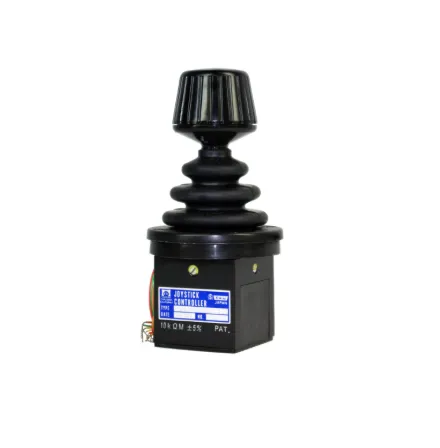

Industrial control systems depend on input devices that can deliver accurate commands day after day under demanding operating conditions. Whether the application is heavy equipment, material handling machinery, industrial automation, mobile equipment, marine controls, or specialized operator stations, the reliability of the control interface directly impacts machine performance. When an operator moves a joystick, the machine must respond consistently, predictably, and without introducing unwanted variability into the process.
Potentiometer-based joysticks have successfully filled this role for many years. However, the increasing demands for longer service life, less maintenance, higher reliability, and better environmental resistance have driven many engineers to consider contactless sensing technologies. One of the most common solutions is the Hall Effect Joystick, which replaces electrical contact with a magnetic field sensing system to determine joystick position. This change in sensing technology removes several wear-related limitations while providing stable and repeatable control signals for industrial applications.
How a Hall Effect Joystick Uses Magnetic Field Sensing
A Hall Effect Joystick operates by sensing changes in a magnetic field instead of relying on direct contact between electrical parts. When the operator moves the joystick handle, a magnet inside moves. Hall effect sensors built into the assembly detect changes in the strength and direction of the magnetic field and convert those changes into electrical signals that represent the joystick position.
Because the sensing process is entirely contactless, there is no wiper sliding across a resistive element and no direct mechanical interaction between the sensing components. The output is generated electronically through the magnetic field measurement process. As a result, signal generation remains consistent even after extensive operating cycles.
This sensing technique also provides designers with the ability to generate highly repeatable outputs over the entire range of motion of the joystick. The Hall effect sensing architecture provides a stable platform for accurate operator input, whether the application is for single-axis control, dual-axis control, proportional positioning, or multi-function machine operation.
Why Engineers Are Moving Away From Traditional Contact-Based Joysticks
Many traditional joystick designs use potentiometers to generate position signals. They are still effective for many applications, but inherently require physical contact between the wiper and the resistive element. Over time, repeated movement can introduce wear that gradually affects signal consistency and component life.
A Hall Effect Joystick removes this wear mechanism entirely. Since there is no electrical contact involved in generating the position signal, there is no resistive track wear, no wiper degradation, and no performance decline caused by contact erosion. This characteristic becomes increasingly valuable in equipment that experiences high cycle counts, continuous operation, or demanding environmental conditions.
The move toward Hall effect technology is therefore not driven solely by performance improvements. It is often driven by reliability objectives. Contactless sensing is often more in line with the goals of equipment manufacturers seeking longer maintenance intervals, fewer component changes, and more predictable behavior in the long term.
How Contactless Operation Improves Long-Term Reliability
Reliability is often one of the primary reasons engineers choose Hall effect sensing. In many industrial applications, joysticks operate continuously for years while being exposed to vibration, temperature variation, dust, moisture, shock loads, and repetitive operator inputs. In such cases, the removal of wear-prone sensing elements can substantially increase operational uniformity.
Because the Hall effect sensor does not require physical contact to determine position, the electrical output remains stable even after millions of operating cycles. The sensing system is less susceptible to degradation caused by friction or material wear. This helps preserve signal accuracy throughout the service life of the device.
The benefits are clearly seen on equipment where downtime is extremely costly. Mining equipment, mobile equipment, marine controls, agricultural equipment, and industrial automation systems are often used in environments where replacing a component is prohibitively costly or difficult. In these instances, the extended service life is a direct benefit to equipment availability and maintenance planning.
How Hall Effect Joysticks Support Precise Proportional Control
Many industrial machines require more than simple on-off commands. Operators often need proportional control that allows machine movement to correspond directly to joystick displacement. It is widely used in crane systems, hydraulic equipment, mobile machinery, robotic controls, and positioning systems where the speed or direction of movement is continuously changing during operation.
The Hall Effect Joystick provides a continuous signal that varies continuously as the handle is moved through its range of operation. This enables controllers to sense small changes to the input and translate them into corresponding outputs from the machine. The end result is improved control over speed, direction, positioning, and machine behavior.
The signal is smooth and repeatable across the entire range of travel because the output is electronically generated rather than through a mechanical contact interface. Such consistency builds operator confidence and enhances machine responsiveness for demanding operating tasks.
Why Environmental Resistance Is Important for Industrial Control Applications
Industrial equipment is often placed in environments that can be stressful for electronic components. Dust, moisture, vibration, temperature extremes, corrosive atmospheres, washdown procedures, and mechanical shock can all affect long-term reliability if equipment is not properly designed.
A Hall Effect Joystick can offer advantages in these environments because the sensing method itself is less dependent on exposed contact surfaces. The absence of mechanical electrical contact reduces susceptibility to contamination-related performance changes that can sometimes affect traditional sensing methods.
This does not eliminate the need for proper sealing, housing design, connector protection, and environmental qualification. However, the contactless sensing architecture provides more flexibility for engineers to design control systems for harsh operating conditions. Environmental protection becomes a matter of protecting the electronics rather than protecting a continuously sliding electrical interface.
How Hall Effect Technology Supports Modern Machine Control Systems
Modern industrial equipment increasingly relies on integrated control architectures that connect sensors, controllers, operator interfaces, and machine functions into coordinated systems. Input devices are expected to deliver consistent signals that can be processed by PLCs, machine controllers, electronic control units, and automation platforms.
Hall effect sensing aligns well with these requirements because the output can be designed to support a wide range of electrical interfaces. Outputs can be analog voltage signals, current-loop outputs, PWM signals, CANbus communication, or other electronic control formats common in industrial equipment, depending on the joystick design.
This flexibility allows the joystick to become part of a larger control strategy rather than functioning as a standalone input device. As machine architectures evolve, engineers increasingly appreciate components that interface well with modern electronic control systems and that are dependable over the long haul.
How to Determine Whether a Hall Effect Joystick Is the Right Choice
Selecting a joystick begins with understanding the operating requirements of the equipment. The engineer will select the appropriate sensing technology based on the expected number of cycles, environmental considerations, control architecture, operator interface considerations, positioning expectations, and service-life goals.
Hall effect technology is often advantageous in applications with high usage rates, harsh environmental conditions, or high reliability requirements. Good candidates can include equipment requiring long service intervals, proportional control capability, or stable performance over long operating periods.
In addition, the selection process must also take into account electrical integration needs, mounting constraints, handle configurations, output formats, redundancy needs, and application-specific safety requirements. The best choice is one that matches both the sensing technology and the mechanical design to the demands of the machine.
ETI Systems Hall Effect Joystick Solutions for Industrial Control Applications
ETI Systems develops industrial control solutions for applications that require dependable operator input, position sensing, motion control integration, and long-term reliability. The company’s joystick solutions support equipment manufacturers, automation designers, and engineers in industrial, mobile, marine, and specialized control applications.
ETI Systems supports selection based on application-specific requirements, including environmental exposure, output characteristics, mounting requirements, operating life expectations, and integration needs. By aligning the joystick architecture with the control objectives of the equipment, engineers can achieve more reliable and predictable machine performance throughout the operating life of the system.
Frequently Asked Questions
What is a Hall Effect Joystick?
A Hall Effect Joystick is a joystick that uses the Hall effect to sense the position of the handle instead of making physical electrical contact between sensing components.
How does a Hall Effect Joystick work?
The joystick uses magnets and Hall effect sensors to detect handle movement. Changes in the magnetic field are converted into electrical signals that represent the joystick position.
Why are engineers switching to Hall effect joysticks?
Many engineers choose Hall effect technology because it eliminates contact wear, improves long-term reliability, supports high cycle counts, and performs well in demanding environments.
Do Hall effect joysticks last longer than potentiometer joysticks?
In many applications, they can provide longer service life because the sensing system does not rely on physical contact between moving electrical components.
Are Hall effect joysticks suitable for harsh environments?
Yes. They are often found in vibration, dust, moisture, temperature variation, and harsh operating environments.
Can Hall effect joysticks provide proportional control?
Yes. Hall effect sensing allows continuous output signals that help provide accurate proportional control throughout the entire operating range of the joystick.
Where are Hall effect joysticks commonly used?
They are used extensively in industrial machinery, mobile equipment, marine controls, robotics, automation systems, material handling equipment, and heavy machinery applications.
What should engineers evaluate when selecting a Hall effect joystick?
Engineers need to consider the application and location of the actuator, including the environment, life cycle requirements, control compatibility, mounting requirements, safety considerations, and the overall design of the machine itself.














![The Benefits of Using a CNC Touch Probe [Infographic]](https://writeupcafe.com/data/post/1677697/bfdf3e040e67936848aa232d2dfe3d03.jpg.webp)











Sign in to leave a comment.