
Modern electrical systems are expected to deliver stable and reliable power. Even a brief voltage dip or harmonic distortion can interrupt production lines, damage sensitive equipment, or reduce the lifespan of expensive assets. That is why a Power Quality Analyser has become an essential tool for electricians, maintenance teams, and facility managers.
A Power Quality Analyser is a specialised instrument that measures, records, and analyses electrical parameters to identify power quality issues. It helps detect problems such as voltage sags, swells, harmonics, transients, power factor imbalance, and frequency variations before they lead to costly failures.
Whether you are managing an industrial facility, a commercial building, or a renewable energy installation, understanding how this device works can help improve operational efficiency and reduce downtime.
What Is a Power Quality Analyser?
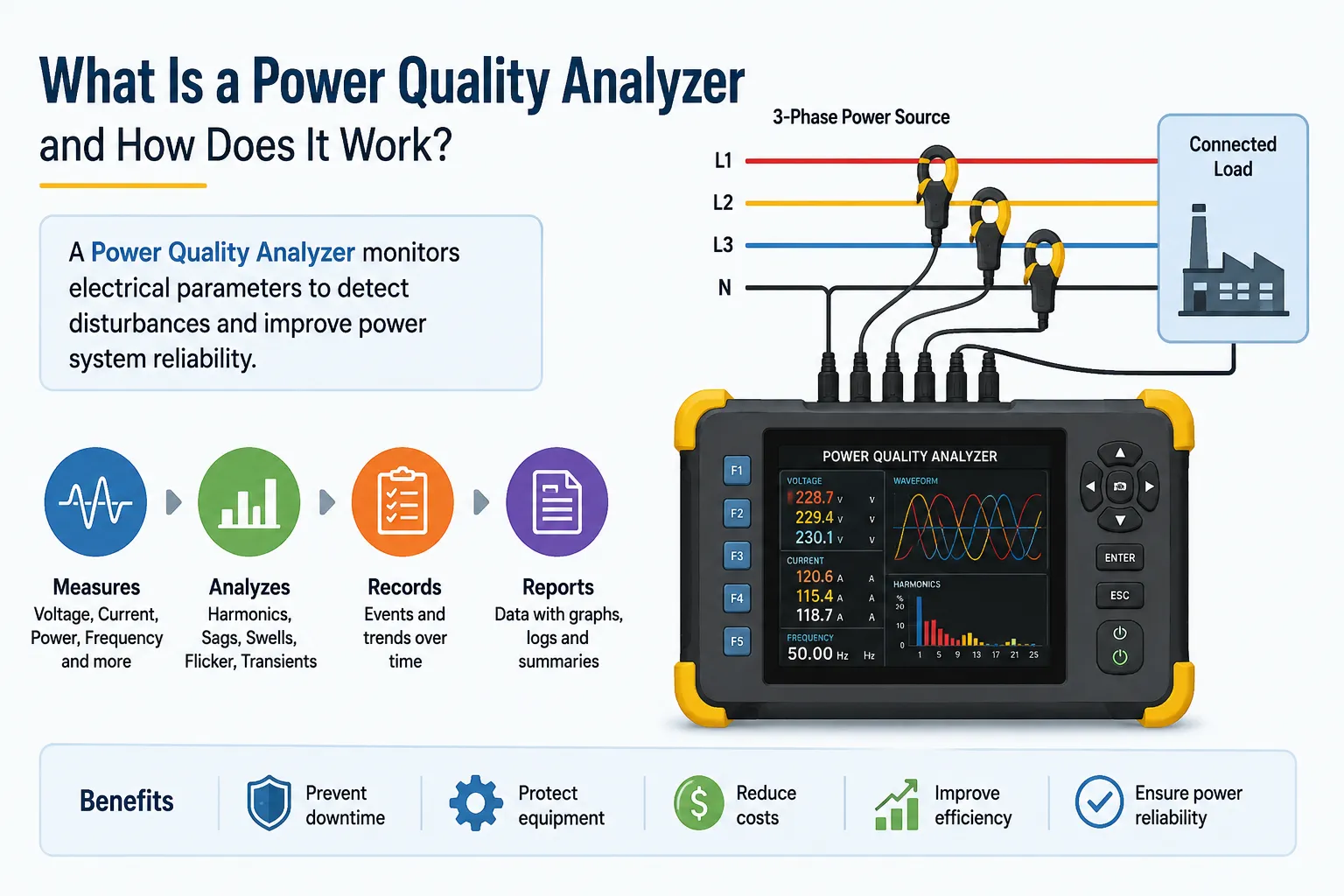
A power quality analyser is a specialized instrument that measures, monitors, and records the key parameters of an electrical supply. These include voltage, current, frequency, harmonics, power factor, and transients.
It assesses whether the electricity flowing through your system meets required standards. Think of it as a diagnostic device for your power supply. Just as a doctor checks vital signs, a power quality analyser meter checks the "vital signs" of your electrical network.
These devices fall under the broader category of power quality measuring instruments and are used by electricians, engineers, facility managers, and energy auditors across industries.
Why Power Quality Matters
Bad power quality does not just cause flickering lights. It causes real, measurable damage.
Voltage sags can trip sensitive equipment without warning. Harmonics overheat motors and transformers. Transient spikes destroy circuit boards. Poor power factor inflates electricity bills and strains the grid.
According to industry estimates, power quality issues cost manufacturers up to 4% of annual turnover in lost productivity. For large facilities, that figure can reach millions of dollars.
A reliable electrical power point tester or analyser helps identify these issues at the source, before they spiral into expensive failures.
How Does a Power Quality Analyser Work?
Understanding how these devices work doesn't have to be complicated. Here is a simplified breakdown of the process modern power quality monitoring devices use to check your electricity:
1. Picking Up the Signal
The analyser starts by safely "listening" to the live electricity in your circuit. Because the raw power is often too strong to measure directly, the device uses sensors to scale the voltage and current down to safe, readable levels.
To make this even easier, many tools use a Rogowski coil integrator. Think of this as a flexible, clip-on loop that can wrap around any wire without needing to cut or disconnect anything. It translates the magnetic field around the wire into a clear electrical reading, allowing for fast and safe setup in live electrical panels.
2. Cleaning the Data
Once the raw signals are captured, the device "cleans" them. It filters out background electrical noise and boosts weak signals so the final measurements are as accurate as possible.
3. Converting to Digital
The analyser then translates the smooth "analog" electrical waves into digital numbers that a computer can understand. The faster the device does this, the better it can catch tiny, split-second glitches like power spikes or sudden drops.
4. Analyzing the Results
A built-in processor runs math on the digital data to spot specific problems. It calculates things like:
- Average voltage and current levels
- Total Harmonic Distortion (invisible "pollution" in the power line)
- Power factor (how efficiently you are using energy)
- Sudden voltage dips or swells
- Flickering or imbalances in complex three-phase systems
In large facilities, a three phase power analyser is vital because it can track all three streams of power at once, finding hidden imbalances that smaller meters would miss.
5. Logging the History
Modern analysers don't just show what is happening now; they act like a flight recorder for your building. They store data over days or weeks, allowing engineers to look back and see exactly when a fault occurred and what might have caused it.
6. Reporting and Remote Viewing
Finally, the results are shown on a screen or sent to a computer via USB or the internet. This lets you view your energy health in real-time or create professional reports to guide maintenance decisions.

Types of Power Quality Analysers
Not all analysers suit every situation. Choosing the right one depends on your application.
Portable Power Quality Meter
A portable power quality meter is a handheld or clip-on device used for field surveys and troubleshooting. Electricians carry these to job sites to quickly assess power quality at any distribution point. They are compact, battery-powered, and ideal for spot checks.
Fixed or Panel-Mounted Analysers
These install permanently inside panels or switchboards. They provide continuous, long-term monitoring and are standard in industrial facilities and commercial buildings. CHK Shop stocks a strong range of panel-mounted units suited for permanent installation.
Three Phase Power Analysers
Industrial and commercial sites typically run on three-phase power. A three phase power analyser measures all three phases simultaneously, detecting imbalances, phase loss, and cross-phase harmonics that single-phase meters miss entirely.
Clamp-on and Rogowski Coil Models
For sites where interrupting the supply is not practical, clamp-on meters and units with Rogowski coil integrator accessories allow non-intrusive installation around live cables.
Key Parameters a Power Quality Analyser Measures
Here is a quick overview of what these instruments track:
| Parameter | What It Indicates |
| Voltage (RMS) | Overvoltage or undervoltage conditions |
| Current (RMS) | Overloads and imbalances |
| Frequency | Deviation from 50 Hz or 60 Hz standard |
| Total Harmonic Distortion (THD) | Harmonic pollution from non-linear loads |
| Power Factor | Efficiency of energy use |
| Voltage Sags / Swells | Short-duration voltage drops or rises |
| Transients | Sudden voltage spikes |
| Flicker | Rapid voltage fluctuations causing light flicker |
| Unbalance | Phase imbalance in three-phase systems |
The Role of Active Harmonic Filters
Once an analyser identifies harmonic distortion, the next step is correction. This is where an active harmonic filter comes into the picture.
An active harmonic filter monitors the electrical load in real time and injects compensating currents to cancel out harmonic distortion. Unlike passive filters, which target fixed frequencies, active filters adapt dynamically to changing load conditions.
Pairing a power quality analyser with an active harmonic filter gives facilities both visibility and control. The analyser identifies the problem. The filter fixes it. Together, they protect equipment, reduce energy waste, and extend the life of electrical infrastructure.
Common Mistakes When Using Power Quality Analysers
Even experienced technicians make these errors. Watch out for them.
Measuring at the wrong point. Capturing data at the main incomer tells you about the supply. But to find what is causing the problem, you need to measure at individual loads and distribution boards. Always trace from symptom to source.
Too-short measurement windows. Power quality issues are often intermittent. A one-hour measurement misses problems that only appear during shift changes, heavy machinery startup, or peak demand periods. Run measurements over at least 24 to 48 hours for reliable data.
Ignoring three-phase parameters. Engineers sometimes focus on voltage alone. Current unbalance and power factor across all three phases matter just as much, especially in motor-driven systems.
Skipping harmonic analysis. Voltage and current readings can look normal even when harmonic distortion is severe. Always check THD values as part of any complete assessment.
Who Needs a Power Quality Analyser?
These instruments are essential across a wide range of industries and applications:
Manufacturing and industrial plants — Protect motors, drives, and production equipment from harmonic damage and voltage fluctuations.
Data centers and IT facilities — Ensure uninterrupted power to servers and networking equipment. Even brief voltage sags can trigger costly shutdowns.
Healthcare facilities — Medical equipment demands stable, clean power. Any quality issues can directly affect patient safety and device accuracy.
Commercial buildings — Large HVAC systems, elevators, and lighting loads all contribute to power quality issues. Continuous monitoring helps facility managers stay ahead of problems.
Renewable energy installations — Solar inverters and wind turbine controllers generate harmonics. Monitoring ensures grid compliance and protects connected equipment.
If you source electrical equipment through an electrical supplies store and handle installation or maintenance, a power quality analyser belongs in your toolkit.
Choosing the Right Power Quality Analyser
Before purchasing, consider these factors:
- Application type — Field troubleshooting vs. permanent monitoring vs. energy auditing
- Phase configuration — Single phase or three phase
- Parameters required — Basic voltage/current or full harmonic analysis
- Data logging needs — Internal storage vs. external multi channel data logger integration
- Connectivity — USB, Ethernet, Modbus, or wireless
- Standards compliance — IEC 61000, EN 50160, or other relevant standards
- Portability — Do you need a portable power quality meter for field use or a fixed unit?
CHK Shop offers a range of power quality measuring instruments to suit different requirements, from compact handheld units to full industrial-grade analysers.
Making Better Power Quality Decisions
Choosing the right testing approach is just as important as selecting the right equipment. As electrical systems become more complex, having access to reliable information and suitable diagnostic tools can help maintenance teams make informed decisions and prevent costly downtime. For professionals looking to learn more about Power Quality Analyzer solutions and related electrical testing equipment, the technical resources available through CHK SHOP can serve as a useful starting point for planning future maintenance and monitoring strategies.
Frequently Asked Questions (FAQ)
Q1: What is the difference between a power quality analyser and a regular multimeter?
A multimeter measures basic voltage, current, and resistance at a single point in time. A power quality analyser continuously records multiple parameters including harmonics, transients, power factor, and sags over time. It provides a far more complete picture of how your electrical supply performs under real operating conditions.
Q2: How often should power quality measurements be taken?
For critical facilities, continuous monitoring with fixed power quality monitoring devices is the best approach. For general assessments, measuring over a full week captures typical load patterns including weekend and off-peak behavior. At minimum, measure for 24 to 48 hours at each location.
Q3: Can I use a portable power quality meter on a three-phase system?
Yes. Many portable meters support three-phase measurement, though you need to confirm this in the product specifications. A dedicated three phase power analyser provides the most comprehensive data for three-phase installations.
Q4: What does Total Harmonic Distortion (THD) mean?
THD measures the level of harmonic distortion in a voltage or current waveform relative to the fundamental frequency. Higher THD means more distortion. Most standards specify a maximum THD of 5% for voltage. Levels above this can damage sensitive equipment and cause overheating.
Q5: What is a Rogowski coil integrator and when is it used?
A Rogowski coil integrator is a flexible current sensor that wraps around a conductor to measure current without interrupting the circuit. It is particularly useful in tight spaces, on large busbar conductors, or where traditional current clamps cannot fit. Many high-end power quality analysers include Rogowski coil inputs.
Q6: What is an active harmonic filter and how does it relate to power quality?
An active harmonic filter is a device that eliminates harmonic distortion in real time by injecting canceling currents into the network. It works alongside a power quality analyser: the analyser identifies harmonic problems, and the filter corrects them. Together, they form a complete power quality management solution.
Q7: Where can I buy a power quality analyser in Australia?
CHK Shop is a trusted electrical supplies store in Australia offering a broad selection of power quality measuring instruments, portable meters, and three-phase analysers for commercial and industrial applications.
Q8: What industries benefit most from power quality monitoring?
Manufacturing, data centers, healthcare, commercial real estate, and renewable energy installations all benefit significantly. Any facility with sensitive electronic equipment, large motor loads, or strict uptime requirements should invest in regular power quality monitoring.
























Sign in to leave a comment.