In the ever-changing world where cyber crimes and attacks are increasing at a rapid pace, sustaining a clean system regularly has become crucial. Similar to individuals maintaining themselves and keeping away from illness, cyber hygiene safeguards enterprises and individuals from cyber attacks. However, numerous people are not aware of what does cyber hygiene primarily refers to and why it has become so essential nowadays.
Cyber hygiene refers to the foundation of utmost security, scheduled routines, and policies in today’s time. Such practices are practiced by users in order to shield devices, networks, and sensitive information from cyber bullies. By adopting such exercises, individuals and organizations can easily minimize data breaches and preserve the integrity of crucial data effectively.
Why is Cyber Hygiene Important for Users?
- Plenty of cybercrimes, like ransomware, malware, and phishing, abuse basic vulnerabilities. Implementing an appropriate cyber hygiene, like creating unique passwords, paying attention to unknown emails and their attachments, and updating software systems regularly, proves to be beneficial when it comes to preventing such cyberattacks.
- Users can easily mitigate the risk of phishing emails, attackers accessing vulnerable accounts and information such as social security code, private images, and bank credentials, by adopting the practice of cyber hygiene.
- Performing cyber activities regularly, like clearing out cache, deleting files that are no longer needed, or running scans, not only enhances privacy and security but also assists users’ devices in performing more effectively.
- Not making a habit of executing such practices can result in massive financial loss via system crashes, downtime, and data recovery for organizations, along with their reputation and consumers' trust.
- Poor cyber hygiene can endanger the users’ entire system to be jeopardized if they have a sophisticated cyber infrastructure.
What are Good Cyber Hygiene Practices?
Some of the best practices of cyber hygiene in cyber security are discussed in the following:
- Creating passwords with a unique and complex combination of characters for all of the users’ accounts.
- Addition of an extra layer of protection for safety by allowing Multi-Factor Authentication.
- Regularly updating the operating systems, along with the software to involve essential security patches.
- Cross-verify the sender's details and avoid accessing websites, emails, and links from unknown and suspicious sources.
- Archive data information in a cloud storage or physical storage device like a hard drive, a pen drive, or a flash drive, if ever the information gets hacked or other catastrophes.
- Having the security software updated on a regular basis for efficient scans and diagnostics to eliminate hostile programming.
- Avoid sharing personal and professional information on virtual platforms to minimize the risk of social engineering.
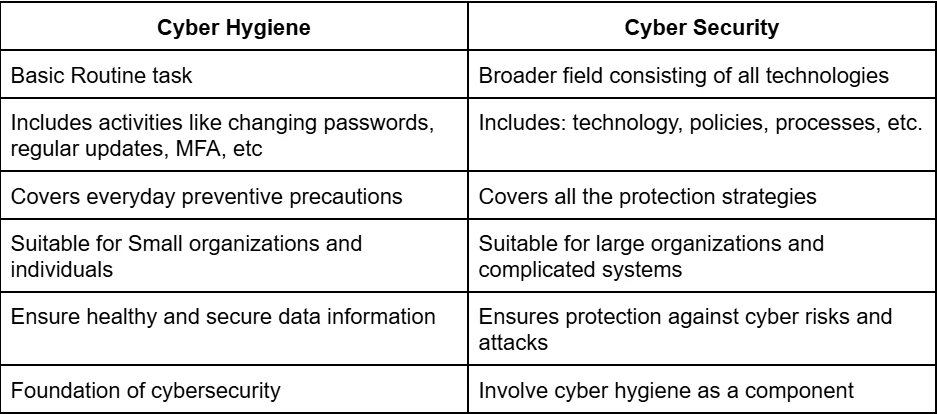
Comparison Between Cyber Hygiene and Cyber Security
Here’s a simple differentiation on what cyber hygiene primarily refers to and what is cyber hygiene in cyber security:
Numerous industries like E-Commerce, Healthcare, and Banking necessitate compliance standards such as HIPAA, PCI-DSS, and GDPR for their legal compliance. This is due to such bodies providing direct assistance in the form of prevention of penalties, legal requirements, and construction of consumer trust, to make sure streamlined auditing processes.
Advantages of Adopting Cyber Hygiene
- A qualitative Cyber Hygiene not only reacts to cyber threats but also enables individuals and organizations to proactively mitigate by building a hefty defense and making it resilient for criminals to breach into the system.
- Going for good cyber hygiene is considered cost-effective as it saves all the costs associated with leakage of sensitive information, including legal fees, recovery charges, fines, and many more.
- Give direct advantage to users by adding an extra layer of security through unique password creation, frequent backups, clearing unnecessary documents, etc., which further leads to optimum performance and fewer system crashes.
- Safeguarding networks associated with Wi-Fi and sorting out firewalls tend to remove unknown network traffic from suspicious sources, enhancing security and leading to smooth overall performance.
- Merging such cyber activities forms a systematic framework, resulting in a more flexible and adaptable technological environment, withstanding technical threats.
Conclusion
To conclude, cyber hygiene is the root cause of protecting users’ digital platforms and information. In today’s digital times, what is cyber hygiene and why is it important still remains a big question among many individuals and enterprises. Users can easily reduce cyber risks just by following these cyber exercises and promote a safe digital environment. Without it, trust, resilience, and compliance against cyber criminals and malicious attacks caused by them cannot be achieved.
Since the rise of AI and automation, the upcoming times of the digital world will be shaped by shifting from traditional efforts to a more intelligent and automated process, which will dehumanize routine exercises such as software patches, detection of threats, minimizing errors caused by humans, and ensuring a more compatible security posture.


























Sign in to leave a comment.