

Git is a tool that helps developers keep track of changes in their code, experiment safely, and work with others on software projects. Beginners should learn Git because it is one of the fundamental tools used in modern software development and is often the first step toward understanding how professional developers manage code.
The focus immediately shifts to creating code when you start programming. However, developing software necessitates managing modifications, correcting errors, and working together on projects. All of these issues are practically handled by Git. After the initial phases, it appears to be rather helpful.
A beginner-friendly Git tutorial should focus on helping learners understand these basic ideas first. Concepts such as commits, branches, and repositories become much easier when learners see how they solve real development problems.
The Git Fundamentals course on Coursera provides beginners with a structured introduction to Git. The course covers Git architecture, repositories, commits, branches, merges, remote repositories, GitHub integration, and practical workflows that developers use while working on projects.
Why Should Beginners Learn Git Early?
Many beginners wait until they start working professionally before learning Git. However, learning it early can make the transition into real development environments much smoother.
When working on their own projects, Git helps new coders acquire better practices. They learn to divide their job into manageable, incremental adjustments rather than making big, ambiguous modifications.
Additionally, it gets students ready for teamwork. A single individual does not create the majority of software projects. Developers frequently collaborate in groups to create a single application. Gaining an understanding of Git helps novices understand how those teams handle updates without confusing them.
Understanding the Basics of a Git Repository
A Git repository is where a project’s files and their complete change history are stored. It acts as a record of everything that has happened within a project.
For a beginner, a repository might simply contain the files for a personal coding project. As they continue learning, the same concept applies to larger applications developed by teams of engineers.
Repositories allow developers to create versions of their work, experiment with new ideas, and maintain a record of previous changes. This becomes especially useful when projects become larger and require multiple contributors.
Git and GitHub Difference Beginners Should Know
One of the most common questions beginners have is about the difference between Git and GitHub. Although these names are often used together, they are not the same thing.
Git is a version control system that monitors changes made to the code. It runs on a developer's PC and keeps track of the project's history. GitHub is an online platform that hosts Git repositories and offers other collaborative features.
For example, a developer can use Git to build local commits and branches. After that, they may share the repository with their team, evaluate code changes, and contribute to open-source projects via GitHub.
Beginners who want to learn about GitHub should first understand Git fundamentals. Once concepts like repositories, commits, and branches are clear, GitHub becomes much easier to navigate.
A GitHub tutorial can help learners understand the platform, but knowledge of Git provides the foundation for how GitHub actually works.
How Git Helps Beginners Become Better Developers?
It takes more than just commanding memorization to learn Git. Additionally, it shows novices how experienced engineers handle software modifications.
Git is used by developers to manage several application versions, test new ideas without impacting the primary project, and cooperate through organized processes. Software firms, open-source communities, and individual projects all frequently use these techniques.
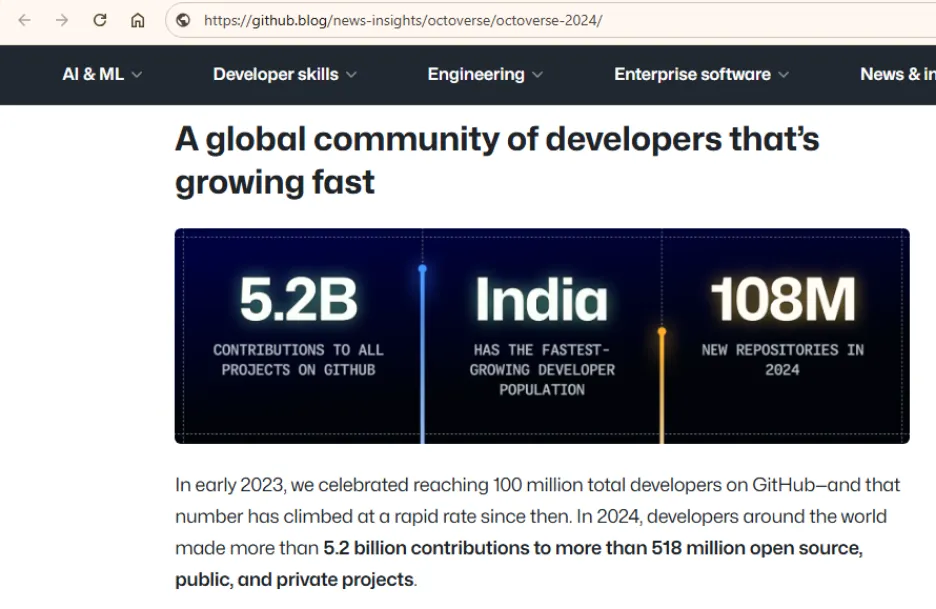
With over 518 million projects and over 5.2 billion contributions in 2024, GitHub's Octoverse 2024 report demonstrated the scope of collaborative development. This demonstrates the extent to which the developer community uses Git-based processes.
Start Your Git Learning Journey
Because Git introduces new concepts and procedures, it may first appear strange. But once the fundamental concepts are understood, it becomes a useful tool that developers use daily.
The Git Fundamentals course on Coursera is a great starting point for beginners who want to understand Git beyond simply memorizing commands. The course provides a practical foundation in Git operations, repository management, branching workflows, and GitHub integration through real-world development scenarios. I found the course especially useful for its structured approach and hands-on examples, which make complex Git concepts easier to understand and apply confidently in actual projects.
The primary advantage of learning Git at an early age is confidence. Without having to worry about losing work or making mistakes, beginners may explore, improve their projects, and learn how developers communicate in real-world settings.























Sign in to leave a comment.